← All books
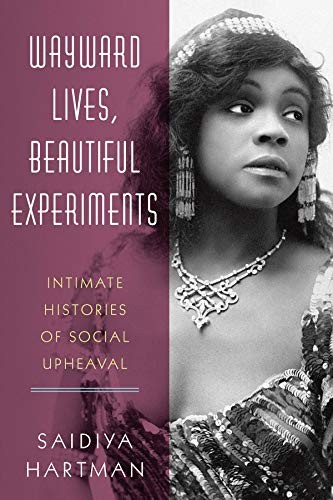
Wayward Lives, Beautiful Experiments
by Saidiya Hartman
Buy on Amazon
Social history poses a crucial question: Who is forgotten? Columbia University’s Saidiya Hartman has created a method – she calls it “critical fabulation” – that melds archival research with critical inquiry and imaginative writing to bring silenced people’s voices and images to life. Her latest work considers how, at the turn of the 20th century, African American women on the margins of society negotiated a freedom that white supremacy always kept fragile. Hartman uncovers court citations like one branding a teenage Eleanora Fagan – later called Billie Holiday – a juvenile delinquent; letters from soldiers to common-law wives left behind; and snapshots like one showing two young women in slacks outside a boarding house, embracing in a gleeful gesture of romantic love. Gorgeously written and intellectually rigorous, Hartman’s work shows us how these women built a free America inside the one that would keep them in bondage. In doing so, she challenges us to think differently about the official stories that have kept them from our view.
Recommended by
"Social history poses a crucial question: Who is forgotten? Columbia University’s Saidiya Hartman has created a method – she calls it “critical fabulation” – that melds archival research with critical inquiry and imaginative writing to bring silenced people’s voices and images to life. Her latest work considers how, at the turn of the 20th century, African American women on the margins of society negotiated a freedom that white supremacy always kept fragile. Hartman uncovers court citations like one branding a teenage Eleanora Fagan – later called Billie Holiday – a juvenile delinquent; letters from soldiers to common-law wives left behind; and snapshots like one showing two young women in slacks outside a boarding house, embracing in a gleeful gesture of romantic love. Gorgeously written and intellectually rigorous, Hartman’s work shows us how these women built a free America inside the one that would keep them in bondage. In doing so, she challenges us to think differently about the official stories that have kept them from our view."
"I was excited by her determination to create histories of undocumented lives."
"Hartman, one of our most brilliant contemporary thinkers, introduced the term 'critical fabulation' into my world. She's a theorist and writer who actually changes what's possible in my thought patterns. It's exciting."
"Hartman, one of our most brilliant contemporary thinkers, introduced the term 'critical fabulation' into my world. She's a theorist and writer who actually changes what's possible in my thought patterns."
"Its hybrid form is miraculous."
"I was inspired, surprised and deeply moved by Saidiya Hartman's Wayward Lives, Beautiful Experiments."
"Wayward Lives, Beautiful Experiments, by Saidiya Hartman left me awe-struck and grateful. I don't think I've ever read anything like it — radical, rigorous, lyrical, attentive."
"Wayward Lives, Beautiful Experiments , published in 2019, doesn’t couch itself as a book about the Harlem Renaissance. The words “Harlem” and “Renaissance” appear as a pair exactly once in its 441 pages, and it’s been far better recognized for the power of Hartman’s fictional-historical “critical fabulation” than as a rival to When Harlem Was in Vogue . But this intimate feminist record of “social upheaval” still strikes me as the most significant recent work of Harlem Renaissance scholarship. Hartman’s cast of freebooting Black women, rescued from the condescension of posterity through a blend of archival sleuthing and imaginative storytelling, are New Negroes before the fact. In advance of “the queer men and lady lovers and pansies [who] congregated at the Ubangi Club,” years before the “black communists and socialists preaching on Harlem street corners noticed” the city’s working girls, these women’s self-modernizing “ reconstruction of intimate life commenced .” Wayward Lives approaches Harlem Renaissance history from the boulevard up, and addresses the question of what the 90 per cent of Black New Yorkers mostly unnoticed by Lewis and company were doing as Harlem prepared for faddishness. Langston Hughes, cynically speaking in the wake of the Great Depression, and gendering his working class as paycheck-to-paycheck male, complained that “[o]rdinary Negroes hadn’t heard of the Negro Renaissance. And if they had, it hadn’t raised their wages any.” By contrast, Hartman submits that ordinary Black women in search of extraordinary lives produced a fitful revolution in consciousness sooner than Cane , Passing , or Harlem Shadows . At the start of the interview, I tried to stress both the group-mindedness and the stylistic variety of Harlem Renaissance writers, their similarities and differences from the loud-talkers of the modernist avant-gardes. One lasting legacy of this collectivity and variety is the tradition of Renaissance anthologies, public records of private debates and of the consistent diversity of Harlem literary methods. The Renaissance’s semi-official self-unveiling arrived in the form of Alain Locke’s 1925 collection The New Negro: An Interpretation , still in print along with a full-size facsimile of its original magazine edition from Black Classic Press. Locke’s compilation was followed by retrospective anthologies from scholars Nathan Huggins ( Voices from the Harlem Renaissance ), David Levering Lewis ( The Portable Harlem Renaissance Reader ), Rafia Zafar (the Library of America’s two-volume set of Harlem Renaissance novels), and the team of Venetria K. Patton and Mauren Honey ( Double-Take: A Revisionist Harlem Renaissance Anthology , which aims to rectify “the ongoing emphasis on male writers”). Volume one of the third edition of The Norton Anthology of African American Literature concludes with a healthy selection of Harlem Renaissance writing carefully edited by Brent Hayes Edwards. Though Norton probably doesn’t need the money, it’s worth mentioning that this and other collections make useful supplements to the single-authored selections discussed above. Whatever else it may have been, the Harlem Renaissance was a movement confident that five perspectives alone could not capture Black literature, let alone Black experience."