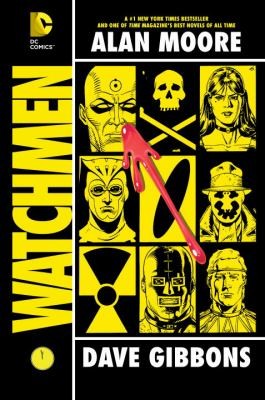
"This book examines each of the series' twelve issues in unprecedented detail, moving page by page and panel by panel to reveal the hidden foundations of this milestone in modern storytelling. Edited with notes by Leslie S. Klinger, this new edition draws upon critical and scholastic commentary, in-depth interviews with Dave Gibbons, and previously unseen original source material. Klinger provides the reader with a unique and comprehensive view of Watchmen as both a singular artistic achievement and a transformative event in the history of comics as a medium. Set in a world in which history has been forever altered by the existence of superheroes, Alan Moore and Dave Gibbons' monumental graphic novel Watchmen is one of the most influential comic book series of all time.…
"Watchmen was originally released in 12 parts, one a month, over a year from 1985 to 1986. There was a film made of it in 2009. And now a controversial prequel series is coming out, done by new writers and artists, which goes back to earlier in the characters’ stories and which has been disavowed by Alan Moore, who created the original. Watchmen isn’t about specific superheroes so much as archetypes. Moore was asked to do something new with a group of characters, the Charlton Comics superheroes. There was a Superman-type character, a vigilante character, a super-soldier, the token woman and so on. But what Moore came up with was so interesting that they didn’t want to use it with those characters, so they changed the names and turned them into almost mythical figures. It’s set in an alternative 1985, overshadowed by the threat of nuclear war, and that drives the plot. The comic starts with the death of a super-soldier character called Comedian, who was employed by the American government. He has been thrown out of the window, and Rorschach, the street-vigilante detective, investigates who could be behind the murder. I won’t spoil the plot, but through Rorschach’s investigation we get drawn into the past of all the major characters of this now-retired superhero team. It’s all linked to the threat of nuclear war. Comedian’s death is part of a master plot to avert nuclear destruction by presenting the Americans and the Soviets with a new threat, which is supposed to prevent them from destroying each other."
"I picked Watchmen for a lot of reasons. It’s arguably the most important comic book ever made. It fundamentally changed the way that the entire world viewed comic books and what they could accomplish, and everything that came after it is fundamentally different than all that came before it. The other reason I picked it is because if I did not pick it for this list, there would be pitchforks outside of my apartment, and I did not want that. Typically, Silver Age comic books tended to be formulaic. We were very much at the start of something. We were watching people tackle a new medium and find how we can tell superhero stories within it. Then, you get to the 70s and 80s, and you can watch the generation that was raised on comics come into its own. They take on those comic books and make them into plotlines more ambitious than anything you’d ever seen. Good examples of that are what Walt Simonson was doing with the Thor comics, and what Chris Claremont was doing with the X-Men comics. They took characters that had been established for mythology or ripped as genetic freaks, and they turned them into bold and audacious stories about enormous mythological consequences, consequential people’s lives, and day-to-day experiences of discrimination at the time, and adapted it for the era of LGBTQIA+ rights. In the 1980s, you saw the comic medium get stocked with more talent than it’s ever had before, including people who were taking a somewhat critical or reactive eye to everything that had come before, and that’s when you get to Watchmen . “We’re fundamentally visual creatures” Watchmen is a revelation. It takes the characters that had been left in the dustbin of comic book history, reinvigorates them, and tells a story of realism and verisimilitude. What would actually genuinely happen if Superman was real? What would happen if God was American? What would happen if you had vigilantes roaming the streets? What if these people accumulated some degree of celebrity? For a while, it was considered to be definitively, absolutely, no questions asked, un-remake-able. You could not make a film out of it; you could not make a television show out of it. This was held to be the gold standard of inability to adapt. Now we have two adaptations. We have the 2009 Zack Snyder Watchmen film, which is very true to the comic illustration. He takes lots of the illustrations from the comic and very directly adapts them. And, we have the recent HBO, Damon Lindelof-led miniseries, which takes this as an inspiration. This is a world in which the events of Watchmen have happened. Necessarily, the world has changed as a result, and here are the people who are within it. It’s a world that explores some of the themes that are unexplored and explored within Watchmen itself. This is my list of the best comics that have ever been adapted; not the best comic adaptations, necessarily. As far as graphic novels go—just in terms of historical import, its quality, the fact that the entire comic book world is unrecognizable after its creation, and the fact that to this day we’re still reconciling what this comic started, in terms of more nuanced portrayals of comic book heroism—you have to start the list with this one. Again, I’m begging people to leave their pitchforks at home. Watchmen introduces a new degree of moral complication. Not only had it never been imagined in comics before this, it was not printable. In many cases, these heroes are terrible people. They’re essentially archetypal figures that, in any of the pages that came before, would have been celebrated or had their edges sanded off. They are turned into monsters. It forces us to contemplate the implications of a superpowered world in a way that has become very popular these days. You can look at shows like Invincible and The Boys . You can look at any of these postmodern takes. Some groups of people having significant amounts of power over other groups of people has ramifications that hadn’t been explored. You had the specific elements of it, such as with great power comes great responsibility, and you had different motivations and empathies for different kinds of characters. The idea is that if the world was as it appears in the comic books we all know and love and contained the heroes that we all know and love, this world would be terrible; it would be worse. It would give power to terrible people and then celebrate them as heroes. That was a question for the entire format that only Alan Moore could pursue. I’m talking about it at surface level because Watchmen needs to be read to be beheld. It’s fair to say that it was asking questions that not only hadn’t been asked before but hadn’t even been in the lexicon of superhero comics before then."
The Best Graphic Novels That Were Made into Movies ·
fivebooks.com