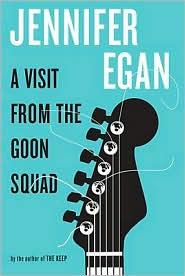
A Visit From the Goon Squad
by Jennifer Egan · 2010
Buy on AmazonJennifer Egan's spellbinding interlocking narratives circle the lives of Bennie Salazar, an aging former punk rocker and record executive, and Sasha, the passionate, troubled young woman he employs. Although Bennie and Sasha never discover each other's pasts, the reader does, in intimate detail, along with the secret lives of a host of other characters whose paths intersect with theirs, over many years, in locales as varied as New York, San Francisco, Naples, and Africa. We first meet Sasha in her mid-thirties, on her therapist's couch in New York City, confronting her long-standing compulsion to steal.…
Recommended by
"I love this novel. It is wonderfully written, brilliantly imaginative and engaging, funny and sad and smart. I also love it because of what it says about SF. That in a genre often caricatured (by those who don’t know it very well) as being about the wish-fulfillment fantasies of adolescent boys – huge space weapons, scantily clad astro-girls and so on – some of the very best work is being written by women. The four novels I’ve chosen so far are all acknowledged classics of the genre. This one is more left-field. Not that it has lacked for plaudits – it won a 2011 Pulitzer Prize – but it might seem only glancingly science fiction. The novel starts in the 20th century and narrates the lives of a series of related characters: Bennie Salazar, who works for a record company, Sasha, his assistant, and others. The narrative is deliberately fractured and structured so as to bounce us around, and chapters are written in a series of different styles: Straight storytelling, a David Foster Wallace-ish magazine article, a Powerpoint presentation, and so on. The characters are beautifully drawn, flawed without being obnoxious, but above all Egan understands how time moves and keeps moving. That is what the novel is about, really. It is as much a time travel story as Wells’s great novella, except that the travel portion is rendered formally, in the way the novel is structured rather than via a device inside the tale. The last 100 pages or so are set in a post-environmental-collapse future, a world in which the characters struggle with the same, human mix of success and failure, ordinary heroism and ordinary foible as before. Events might conspire to mug individuals – the title might suggest that providence is a “goon squad”, ready to beat us up. But more crucially than that, events are the iteration of life in time. That’s what the title is really about – time. “Goon” is “Go on”, you see. The near future setting of the last third of the book is all about this. The environment and society will change radically, it says, and a new generation will grow up so fitted to the new world that they will seem a little alien and spooky (like Frankenstein’s offspring or the children in Clarke’s novel). This is by way of saying: It will not always be like this. And it won’t. That is the truth of science fiction’s so-called “predictions” of the future – not the specifics, but the awareness that the future will not be like the present. There are things on which I disagree with Card profoundly, but this isn’t one of them. It’s not the business of science fiction to predict. In 1865, in De la Terre à la Lune , Jules Verne predicted that man would blast off from Florida and fly to the moon in a capsule exactly the same dimensions as the Apollo command module – but both “predictions” were arbitrary coincidences. He also said that the moon vehicle would be fired out of a gigantic cannon – the pressures of acceleration would have squashed the astronaut-hopefuls like bugs – and that later, when in space, they would dispose of the body of a dead dog by opening a window and throwing it out. Verne wasn’t trying to predict. He was extrapolating the scale of 19th century advances in technologies of war and exploration into a vivid imaginative space. It doesn’t harm his broader work that it hasn’t come true. It’s not trying to come true. That said, there’s something about the future and science fiction. The common belief that science fiction is in some sense “about” the future isn’t wholly wrongheaded. One feature of 19th and 20th century science fiction is that it is fascinated with time in a deep way. Time only opens up, as a wholly new dimension to be imaginatively explored, at the very end of the 18th century. It’s a puzzle, actually, why this should be. [The critic] Darko Suvin thinks it has something to do with the French Revolution. But before about 1800 people almost never wrote stories set in the future, and then after 1800 lots of people did just that. SF as a mode of projecting oneself into the to-come connects powerfully with human concerns in the way that specific prophesy – pedantic, fiddly, bound to be wrong – doesn’t. The five novels I’ve chosen here all engage, in their different ways, with this sense of time as the medium of our existence. Photosynthetic hair. I was commissioned to write a story for an anthology in which science fiction writers were paired with actual scientists . I discussed my idea with Professor Rein Ulijn, now at the University of Strathclyde, who specialises in biochemistry and is internationally renowned for his work on polymeric biomaterials. I imagined a world in which people were genetically engineered to be able to photosynthesise energy directly from the sun through their hair. He didn’t think this was entirely impossible – or else he was too polite to shoot me down. I wrote the story, but the world I’d imagined refused to leave me alone. So I ended up writing an entire novel. This interview was published in November, 2011"
Science Fiction Classics · fivebooks.com
The Atlantic's The Great American Novels · theatlantic.com
By the Book: Dani Shapiro · nytimes.com
"It is such a brilliant book, and it's fun to teach because the construction of it, a nonlinear linked collection of stories that plays with form, already makes for such a great conversation."
By the Book: Kevin Wilson · nytimes.com
""A Visit From the Goon Squad," by Jennifer Egan … [one of the best books about music]."
By the Book: Susanna Hoffs · nytimes.com