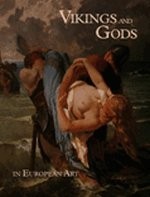
Vikings and Gods in European Art
by David Wilson
Buy on AmazonThis is actually a catalogue for a big art exhibition that took place a few years ago, but it’s a really useful book—I give it to students to read. He goes through artistic depictions of Vikings and pagan gods all the way from when they’re rediscovered—with people like Olaus Magnus—up to the end of the 20th century. In it, we see that it’s not just the reception of the Vikings and the Viking Age that changes, but it’s also, again, this idea that history is what we want to make of it. The reason that we are attracted to particular things changes, depending on our own preoccupations. For example, if we go back to the 17th century, we see Harald Klak, who is a Danish king in the early 9th century, being baptised by Louis the Pious. There’s also a picture of the Danes making peace with one of the Anglo-Saxon kings. But the pictures have absolutely no sense of historical reality as we think of it. We would not look at them and think of Vikings. They’re wearing almost contemporary costumes. That’s interesting for thinking about how history develops, because at this point, they had no archaeological evidence, nothing to back these things up. Support Five Books Five Books interviews are expensive to produce. If you're enjoying this interview, please support us by donating a small amount . At the southernmost tip of Greenland, there’s a Norse site called Herjolfsnes, and archaeologists started to excavate the churchyard there in the 1920s. Because of the pack ice that surrounded the area, they found all sorts of clothing in the graves, all beautifully preserved. But earlier, we’ve got nothing like that, so people had less of a sense of what clothing was worn in the medieval Norse world. Returning to the book, we then get into the 18th century. They only have the classical world that they’re very used to. So everything is couched within classical terms. There’s a picture of Thor from the end of the 18th century… I think it’s meant to be Vulcan. It is all very much in the Roman style, and this goes on. Then, later, the physical depictions start to change, particularly when they start to dig things up. To some extent. When they start to find physical items they want to incorporate them, whether or not they were actually from the right period. So here we’ve got, from 1826, “Scandinavian sacrifice scene in the time of Odin.” Obviously there is no such thing as a ‘time of Odin.’ In the picture, a young boy is blowing on a horn, but the image is based on the 5th century Danish ‘horn of Gallehus,’ which is not from the Viking Age, but from several centuries before. And you’ll find in a lot of these images, as the 19th century gets under way, it could be 2000 years worth of material evidence crammed into one picture. “We have very little evidence that they burned their dead on the sea in ships.” Then, in the 18th century, with the growth of nationalism, Norway in particular is really keen to embrace its Viking heritage, as a way of separating itself from Denmark. So we see societies being set up to celebrate the Viking Age, to celebrate their Viking heritage. Across Scandinavia, at banquets held to celebrate Nordic identity, posters and banners are hung on the walls with images of Norse gods and legendary heroes. For instance, the decoration round this Norse banner here is in the ‘Urnes’ style. This is the kind of swooping, interlacing effect with animals you see in stave churches from 11th century Norway. Again, you’re seeing real material evidence being brought into the picture, historical truth growing as more and more pieces of the puzzle are assembled, but at the same time everyone is bringing in their own agenda, in this case nationalism. Another reason I like this book is that you see the development of the horned-helmet myth. Vikings did not wear horned helmets, and not with feathers either. That’s something we see in modern depictions: if you put a horned helmet on something, you automatically think ‘Viking.’ It doesn’t matter that it is not historically accurate. We’re in an echo chamber of cultural references. People are just building on each other’s images. That’s always gone on. I think it was building on that classical model they saw and then wanted to emulate. The first time you really see horned helmets in illustrations is in a translation of Frithjof’s Saga produced in Sweden in the first decades of the 19th century. It was an incredibly popular saga. Even the Norwegian polar explorer, Roald Amundsen, had his own prized copy. Later on, you get Wagner’s Ring Cycle. For the first performance at Bayreuth, his costume designer came up with the idea of putting horned helmets on some of the characters and that’s a big association. It just grows and grows: it’s the echo chamber effect. Here’s a painting from 1893: Frank Dicksee’s A Viking’s Funeral . Around this time, you start to see a lot of Viking ships. The Gokstad ship in Norway had just been dug up, and suddenly everyone was very conscious of these material artefacts, this evidence of the Viking Age. In the painting they’re burning a Viking chieftain. Actually, we have very little evidence that they burned their dead on the sea in ships. …cultural myth. That’s based on the account of a 10th century Arab diplomat, called Ibn Fadlan, who travels up the river Volga from Baghdad—ironically called the ‘City of Peace’ in his account. He’s going to see the Volga Bulgars who’ve just converted to Islam and, on the way, he meets all sorts of strange, crazy tribes. There’s one that worship penises, for example, and cut off each other’s heads without provocation. But then, on the banks of the Volga, he meets a group he calls the Rus. The Rus seem to be—although there is some debate—the descendants of the Swedish Norsemen, traders who came down the waterways. They basically founded the modern Russian state, but they were a very small Scandinavian elite amongst a much bigger Slavic population. The Russians, traditionally, didn’t like the idea that the European Scandinavians founded their state, so they emphasised the Slavic element. This has been a very big bone of contention: even Hitler got involved in it. He said that the Russians would still be living like rabbits, were it not for that fine drop of Aryan blood that began with the Vikings. “The Nazis really jump on the Aryan myth of Vikings as a super race.” Ibn Fadlan meets these Rus on the waterways, and he witnesses—again, quite luridly, so how much of it is fact I’m not sure—a funeral of one of the great Rus chieftains. A slave girl is sacrificed together with all sorts of animals. It is a long and really quite horrible death. She’s taken round the tents of the main chieftains and she’s made to have sex with them. Then she’s strangled and there’s a horrible old woman called the ‘Angel of Death’ who plunges a knife in and out of her ribs. Then she’s burnt on a ship with everything else that’s been sacrificed and the dead chieftain. The story goes that when Ibn Fadlan is watching this ship go up, one of the interpreters turns to him and says, ‘You guys are idiots. You put your dead in the ground where the worms get at them, and we burn our dead so their souls go straight to paradise in the sky.’ So that’s our main source for the Viking ship burning. There is a mythological source as well, involving Thor, the dead god Balder and a dwarf being kicked into the burning ship. But that’s not history. They did bury their dead in ships, sometimes, if they were high status enough. But there’s fairly little evidence that they burned them. That’s again part of the Viking myth. So in pictures like this that we see being drawn at the end of the 19th century, we see the start of the modern Viking echo chamber effect. Yes, and it also explains a lot about the role of the Vikings in the growth of nationalism. For example, when they were celebrating Columbus arriving in America, the Scandinavians and Scandinavian-Americans said, ‘We got there first!’ So suddenly all these pictures started appearing of Leif the Lucky going off to America. In the 20th century, you see things like this Danish recruitment poster for the Nazis. You have many of these because the Nazis really jump on the Aryan myth of Vikings as a super race. When they invaded Norway, they started a programme encouraging Germans to breed with Norwegian women. Some 12,000 children were born to Norwegian women by Nazis soldiers. After the war, they were completely ostracised. One was Anni-Frid Lyngstad, from ABBA. She was the daughter of a German soldier and a Norwegian mother. They had to escape to Sweden. These propaganda images were all drawing on the Viking past. You have Waffen-SS marching songs with sentiments such as, ‘We went off to all corners of the world, we discovered Iceland and Greenland, we settled France, England, and Ireland. Now we’re here under Quisling’—who was in charge of Norway, but very much in collaboration with the Nazis—‘and hurray! It’s like the coming of a new dawn of the Viking Age.’ So this book also addresses the darker side of the Viking perception. I love this book because you can see something depicted visually and explained beautifully clearly all the way from Olaus Magnus up to the Nazis and beyond. It helps us to understand how Viking history has been interpreted and understood, used and misused over the centuries. It’s a really good book. The question is whether the ‘Viking Age’ is even useful to think about. There has just been a multimillion Euro project started in Sweden looking at the possible causes of the so-called Viking Age, and much depends on which part of the Nordic world you’re looking at. The classic date you usually see in history books is 793 AD, which was the year that Lindisfarne, an island monastery off the coast of Northumberland, was attacked. Yes, but part of the reason my book opens there is to say, that’s a nice date, but it’s not that easy. Based on the archaeological evidence, what we would think of as the Viking Age seems to have actually begun a lot earlier in the Baltic region. Only a few years ago the ‘Salme Ships’ were found in Estonia – two Scandinavian clinker-built ships containing the remains of over 40 warriors killed in battle. Then we see various developments throughout the 8th century in different parts of the Nordic world, but things really get going in the 9th century, in terms of expansion, travel, raids and settlement. It’s driven by a whole host of factors that are very much debated. One idea that is being bandied around quite a lot at the moment, is that there was a gender imbalance, possibly caused by female infanticide. Raiders were going out to get treasure so they could become wealthy and attract women back home. There’s a small amount of evidence to suggest that this could have been true. You do find early booty—for example from the British Isles—in the graves of some Norwegian women. “We know a lot about early ship technology from bog deposits in Denmark” There are other possible factors. For example, Danish raids begin around the year 800 when Charlemagne was in charge of the Carolingian empire. Charlemagne wiped out several thousand Saxons in what amounts to a bloody genocide, they were Christianised, and suddenly the Danes found the Carolingians on their borders. You see how they start interacting with them, using all sorts of different strategies—sometimes peaceful, sometimes not. But the Frankish annals report an increasing number of raids at that time. Then there’s the expansion across the North Atlantic: to Iceland, Greenland, and (for a little while) North America. There are different factors in play there. More generally, advances in ship technology is often suggested as a possible cause of Viking Age activities, but scholars are quite dubious about that now. Ship technology is interesting because they do suddenly have these amazing ships. They couldn’t have done a lot of these things without that technology. So it might not be a cause, but it is certainly a help. They’re even more dubious about population pressures as a cause of Viking Age expansion. Often it’s more of a case of ‘show me the money.’ If you can raid and get a load of cash and possibly, eventually, some land, then that’s great. If you can ally with people who will give you that cash and possibly some land, possibly to stop you raiding, then that’s also great. If you can trade items such as furs, walrus ivory and slaves, and get a good price for them, then that’s brilliant. They had been developing their ships over the centuries. So, for example, by the Viking Age you see the clinker method where you have planks of wood built one over the next over the next. That makes them incredibly flexible and much more able to stay afloat in rough seas. They’re also very shallow bottomed which means they can land on beaches, on islands, and on the shores of Lindisfarne, for example. They don’t have to rock up in deep harbours. Shallow-bottomed boats are also very convenient if you want to go into Western Europe on the waterways: the Seine, the Loire, the Elbe, the Rhine. They have square sails — but we see square sails depicted earlier on Swedish runestones, from around 700. We know a lot about early ship technology from bog deposits in Denmark. After a battle, Vikings sacrificed weapons, possibly men, and sometimes ships and you get a lot of good preservation in the anaerobic conditions in a bog. From the boats preserved in bogs, we can see that a lot of those technological developments started fairly early. So it’s not like everything happens at once and the Norse are like, ‘Huzzah! Now we can all go raiding and exploring.’ That’s often in the saga descriptions. They’re like, “Wow! Another huge land mass.” The question is, did they know what direction to go in when they set out to find new lands? They would have seen, for example, flocks of birds going in one direction. If a flock of birds is heading out to sea, there’s probably land there. How much is just getting blown off course, and how much is slightly more scientific is hard to tell. But it makes sense—in the same way that there were lots of ships that ended up at the bottom of the sea, there were going to be lots that got blown off course… Yes, exactly.