← All books
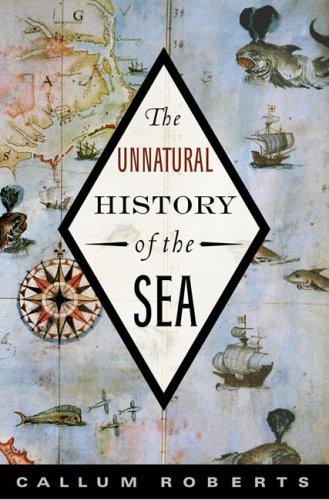
The Unnatural History of the Sea
by Callum Roberts
Buy on Amazon
Ah, this is also about fishing like the Kurlansky book, but this book takes a really broad sweep, not just talking about one species. In fact, one of the points this book makes is that it’s dangerous to talk about one species in isolation because if you take out one species that might have ongoing effects on the habitat. You need to look at what’s happening around that population – you might get growth of algae, or a rise in population of jellyfish or something like that. That is certainly happening around the world. So he talks again about how large populations of fish existed around North America and Europe and how the belief developed that the supplies were inexhaustible, even up to the mid-20th century. He puts that picture well, but then he says that now we know that all the major commercial fish populations are in trouble, we’ve probably got until about 2050 to be harvesting wild fish. His idea about the way out is to develop a whole connected pattern of marine reserves so that fish have a chance to recover once they’ve been fished. Yes. He thinks if we fish a certain area it should then become a reserve for a couple of decades. There are attempts to do it around some Pacific Islands. In fact, the US has put quite a lot of money into developing reserves and Australia is doing the same, but it is very difficult with large fish populations that travel a long way. The tuna goes from the US to the Mediterranean, or from Japan to Australia, and just setting up a reserve is not going to help those fish much because they don’t stay around in one place for very long.
Recommended by
"Ah, this is also about fishing like the Kurlansky book, but this book takes a really broad sweep, not just talking about one species. In fact, one of the points this book makes is that it’s dangerous to talk about one species in isolation because if you take out one species that might have ongoing effects on the habitat. You need to look at what’s happening around that population – you might get growth of algae, or a rise in population of jellyfish or something like that. That is certainly happening around the world. So he talks again about how large populations of fish existed around North America and Europe and how the belief developed that the supplies were inexhaustible, even up to the mid-20th century. He puts that picture well, but then he says that now we know that all the major commercial fish populations are in trouble, we’ve probably got until about 2050 to be harvesting wild fish. His idea about the way out is to develop a whole connected pattern of marine reserves so that fish have a chance to recover once they’ve been fished. Yes. He thinks if we fish a certain area it should then become a reserve for a couple of decades. There are attempts to do it around some Pacific Islands. In fact, the US has put quite a lot of money into developing reserves and Australia is doing the same, but it is very difficult with large fish populations that travel a long way. The tuna goes from the US to the Mediterranean, or from Japan to Australia, and just setting up a reserve is not going to help those fish much because they don’t stay around in one place for very long."
"This book goes through the sequence of events that led us to today’s depleted ocean. It takes you back to a time when people believed the oceans were essentially inexhaustible. Yes, back as far as whale hunting and all sorts of different ways of exploiting the ocean. And it tells the story in a very vivid way. Everyone will learn something from this, even if they think they know lots of stuff about how we have affected the oceans. There are many things in there that I wasn’t aware of. And he reminds us that we easily forget about how things have changed. Even in recent times, we have come to accept a degraded state of the natural world and the oceans. We quickly forget just how abundant life used to be and how rich fisheries used to be. I should point out that he does take an optimistic outlook. He isn’t all doom and gloom. He lays out hundreds and hundreds of years of over-exploitation but he also lays out his manifesto for restoring some of that former glory. He doesn’t think it’s too late. It is all about setting up marine protected areas or marine reserves, and reinventing the way that we manage fisheries. He knows what he is talking about. This guy is a top academic in fisheries and marine conservation. That is the big question. The science is there. It is the people side of the equation that still has a big question mark hanging over it. I can only hope that books like this can help chip away at that. We have to remember that the things that live in the ocean are wildlife. They aren’t just resources for us to use up. We have a lot more respect for wildlife on land and see it as something we need to look after. There is a very different attitude towards the oceans. We see them as a place to dump our waste and grab as much food from as possible. It is vital that we try and get the message across that these are wild creatures and ecosystems that we are damaging, and that losing them will affect our lives in practical and economic ways as well as more intangible ways. The oceans fuel our imaginations. I think it’s crucial for there to still be wild sea monsters out there. Werner Herzog said, “What would an ocean be without a monster lurking in the deep? It would be like sleep without dreams.”"