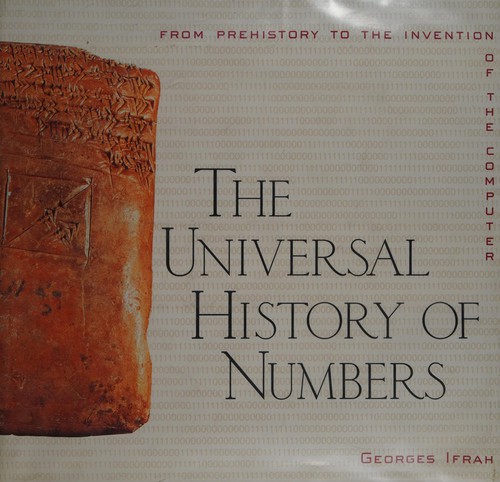
A riveting history of counting and calculating from the time of the cave dwellers to the late twentieth century, The Universal History of Numbers is the first complete account of the invention and evolution of numbers the world over. As different cultures around the globe struggled with problems of harvests, constructing buildings, educating their citizens, and exploring the wonders of science, each civilization created its own unique and wonderful mathematical system. Dubbed the "Indiana Jones of numbers," Georges Ifrah traveled all over the world for ten years to uncover the little-known details of this amazing story. From India to China, and from Egypt to Chile, Ifrah talked to mathematicians, historians, archaeologists, and philosophers.…
"My next book is by Georges Ifrah, who you could say is the real ‘man who counted’. The French have what is probably the best tradition of popular maths in the world: they love their science, their maths , their engineering and philosophy . And from 1650 to 1850 probably the largest percentage of the great mathematicians were French: Pascal, Fermat, Laplace, Lagrange and the rest. Ifrah was a schoolteacher who kept being asked by his pupils, ‘Where do numbers come from?’ He began to research it and – weirdly – it turned out no one had bothered to ask this question in the same way. He’s not an academic, nor is he a writer: he’s a massively obsessed schoolteacher on a mission. So the book is a bit sprawling and doesn’t have much of a narrative but it is absolutely incredible. He goes through each culture and describes why they thought of numbers and how they counted. So we have it explained here exactly how the Maya counted, the Sumerians, Hebrews, exactly how the ancient Chinese counted, all different types of tally systems, hand systems, how the abacus works. Then halfway through it changes and becomes largely about India because Ifrah realises that our own number system really originated in India. Our number system being what we call Arabic numerals and which are really Indian numerals. What you realise from reading The Universal History of Numbers is that everything before India is just a curiosity really. Get the weekly Five Books newsletter The three things that define our number system are: only 10 digits, zero to nine; a place value system, which isn’t true of Roman numerals; and the use of zero, because with a zero it enables easy multiplication and it then becomes feasible for the lay person to calculate, which wasn’t really possible with Roman numerals. So the book then becomes an encyclopaedia of all things Indian – a bit eccentric, but so full of information that when I was writing my book this was on my desk at all times to refer to. It’s the bible of counting and where numbers came from. Well worth having in among any other awkwardly shaped books you might have. Ifrah has never really done anything since, and he’s described here as ‘an independent scholar’ who was ‘the despair of his own maths teacher’. He funded his research around the world on the 10-year project by doing jobs as a waiter and taxi driver."