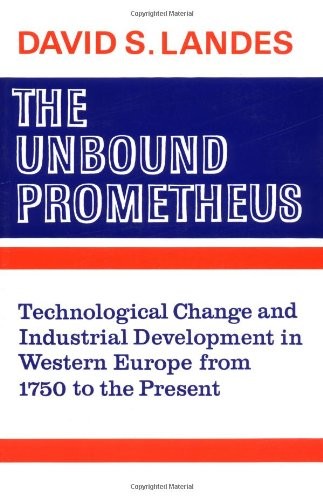
The Unbound Prometheus: Technological Change and Industrial Development in Western Europe from 1750 to the Present
by David S Landes
Buy on AmazonThis book has been a bestseller for over half a century. It was published in 1969 and, yet, it’s still amazingly modern. One reason I chose it was that it inspires people from outside the field. I’ve had the 20-year old son of African immigrants in Toronto getting excited about economic history because of reading it. And I’ve had a 67-year old Indian economic theorist also getting excited about this book. It’s got a spark to it which really inspires readers. I think that’s because it conveys the excitement about the heroic achievement of the Industrial Revolution, not because it was caused by individual heroes—which none of these books argues—but because a whole economy made the first-ever transition to self-sustaining economic growth and changed the world irreversibly. Landes’s book is a fun read. It’s got vivid stories and vignettes, it’s got quotations from contemporaries. But it also uses economic reasoning and quantitative findings. And I don’t think it ever loses sight of the overall question—how did this amazing thing happen? It’s got everything in it, even though it’s half a century old. Landes is very knowledgeable about the rest of Europe, and that’s a major strength. But he focuses on what he sees as unique characteristics of Britain, which made the Industrial Revolution start there. He does have a basic organising argument—one I disagree with—that the cause was rooted in the unique characteristics of culture, of beliefs and values, things happening inside people’s heads, that gave Britain this huge advantage in inventing and adopting new techniques. There are famous phrases that everyone knows from this book, ‘the will to mastery’, ‘the rational approach to problems’, ‘the competition for wealth and power’. Landes sees these values and beliefs as being very central to English culture, and then ultimately to Western European culture. He’s also very perceptive about the beliefs and values that he sees being rejected in this period. He thinks that English and Western European culture began questioning ancient knowledge handed down from classical times and turning away from aristocratic values, like pride and honour and family and identity-based ways of thinking about how you should act. Landes believes that English culture stopped passively accepting the status quo, and started embracing disruptive innovation. He argues that the technological innovations of the Industrial Revolution emerged from this unique early modern English culture which questioned ancient knowledge and traditional values. “Questions about the past have not been solved. There isn’t a definitive answer” It might sound odd that I chose this book, given that I’m not actually persuaded that cultural beliefs and values are what caused the Industrial Revolution. But Landes argues his case eloquently and deploys his evidence brilliantly. What comes out of this book is that there are indications that new values and beliefs can be increasingly observed in 17th- and 18th-century England, and gradually also in other European countries. Where I part from Landes is that I don’t think the fact that we observe these new values means that those new values were causing economic growth. Historians and economists now increasingly recognise that culture is what economists would call ‘endogenous’. Beliefs and values might affect economic behaviour, but the economy also affects our system of beliefs and values. It’s a two-way relationship. Cultural historians often trace changes in culture back to characteristics of the economy. It’s like a simultaneous equation system. It’s a two-way set of causal links. And actually, I think Landes realises that, because a lot of this book consists of his saying, ‘Well, you know, what else was going on in England, that might have fed into these new ways of thinking?’. In the end, though, his explanation is that the deep cause of the Industrial Revolution lies in these unique, authority-questioning aspects of English and Western European culture.