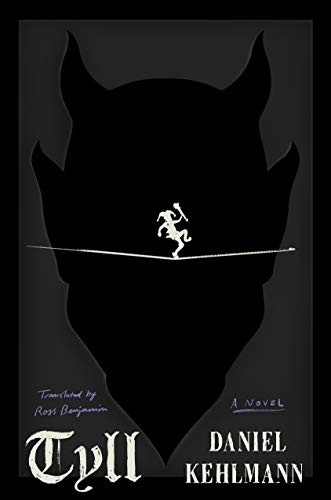
Tyll
by Daniel Kehlmann, translated by Ross Benjamin
Buy on AmazonThis is another one that draws on national myths. Set in Germany at the start of the Thirty Years War , it’s a novel that reanimates a figure from German mythology called Tyll who is a trickster, mischief-maker, puckish, impish character who is really a lord of chaos. He sits somewhere between a court jester and a joker sort of figure – a Germanic joker, if you like. Tyll observes a series of courtly intrigues and stories that happen in this period in Germany. This a book about a period of European history which was riven by the plague and pestilence. So there’s a very deep historical resonance between this book and the present. For all of that, it is an incredibly funny book. It is a book that brings you this a playful, wicked avatar and takes you through this really bloody and dark period in German history. Almost on every page there is a moment of courtly pomposity and hypocrisy and backstabbing and skulduggery; it’s a really, really hilarious, rich comedy that takes you right into the dark heart of the plague-era Germany. So, if you like your comedies dark, this is the book for you. “If you like your comedies dark, this is the book for you” Ross Benjamin has done a really fantastic job. The translation has a kind of steadiness and precision, but also he can absolutely keep pace with the humour and the jokes and – despite its subject matter, despite the violence, the darkness – it, again, is an extremely joyful reading experience. Daniel Kehlmann is an absolutely masterful writer. Tyll, this figure, is really an ideal subject for a writer of his impishness and humour and play. He’s a very fine conjuror of historical moment as well. It feels true to the period without being an antiqued or theme park version of history, which can sometimes be the case. So: original, gritty and real and yet, you get the sense of mordant comic joy to it as well. When we started this, we had the great luxury of seeing each other in person every month. We came together across great distances. Obviously, when this whole situation began to unfold, we had to change that, we had to move our meetings online. For the first time in the history of the Booker Prizes , the shortlist meetings all took place via video link. We had some technical issues to begin with. Our furthest points, I believe, were Bangalore and Los Angeles, and there were many in between as well. So we had a lot of challenges in terms of time difference and technology. But there is such strong communal spirit and rapport between us as judges that we have built up over six months of intensive reading together that we had a really strong connection – and the conversation was just as intricate and nuanced and satisfying as ever, I think. We spent over six hours deliberating over the shortlist one call. I think that must be my video call record. Maybe we are the current record holders for the longest video call in the world. But it was a really, really rich discussion. I think one of things we, as a panel, are really proud of is that we really listen very attentively to each other. Of course, everyone on the panel is a really superb reader with really deep cultural understanding. But they are also readers who are open to being persuaded, and respect each other’s views enough to keep an open mind about a book. I think that’s a really wonderful quality. We’ve always tried to make sure that if one of us feels really passionately about a book – and perhaps it’s a book that someone else isn’t as keen on – we try as much as possible to really consider that properly. “We spent over six hours deliberating over the shortlist one call” That’s meant that our decisions have all felt very collective, and that this is a list that we can all truly be very proud of. That’s said a lot by panels, I know, but it’s true. We’ve also encouraged each other to be bold in these choices: to pick books which are not at all conventional, which playfully challenge perceived narratives and upend things. So I think that that all worked fine despite the technological challenges. It’s also worth saying that we weren’t exactly looking for books which chimed with the current crisis, but rather books which transcended this unprecedented moment. That stood the test of time, even now. Books which continued to speak to us across the divide of then and now. Yes, there are some striking comparisons in some instances, such as the history of a plague-ridden Europe evoked in Tyll , but as timely as they are, we also believe these are books of enduring meaning.