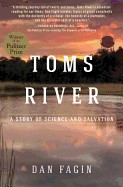
Toms River: A Story Of Science And Salvation
by Dan Fagin · 2013
Buy on AmazonWINNER OF THE PULITZER PRIZE • Winner of The New York Public Library’s Helen Bernstein Book Award • “A new classic of science reporting.”—The New York Times The riveting true story of a small town ravaged by industrial pollution, Toms River melds hard-hitting investigative reporting, a fascinating scientific detective story, and an unforgettable cast of characters into a sweeping narrative in the tradition of A Civil Action, The Emperor of All Maladies, and The Immortal Life of Henrietta Lacks. One of New Jersey’s seemingly innumerable quiet seaside towns, Toms River became the unlikely setting for a decades-long drama that culminated in 2001 with one of the largest legal settlements in the annals of toxic dumping.…
Recommended by
"Winner"
Pulitzer Prize for General Nonfiction 2014 · pulitzer.org
"You wouldn’t necessarily expect the story of a dye manufacturing facility to be one of intrigue, insurrection, deception and death. But Dan Fagin’s narrative of the arrival and explosive growth of a chemical plant in New Jersey in the 1950s weaves a complex tale of powerful industry, local politics, water rights, epidemiology, public health and cancer in a gripping, page-turning environmental thriller. Fiercely reported and accentuated with lessons in both historical science and modern medicine, Toms River is a tale of toxic waste, and the families and communities left in its wake."
NPR Books We Love — 2013 · apps.npr.org
"Toms River is a town in New Jersey, named after the river that flows through it. I lived in New Jersey, so I was familiar with this story a little bit before I read the book. A chemical company there was negligent for many decades in how it disposed of its waste. It held the waste in open pits in the ground, and much of this leaked into Toms River. Years later, there were some cancers in the town. This is a problem that we have with radiation and other types of environmental exposures. You have a group of people who come down with cancer in a particular geographical area. It’s very hard to determine whether the cases are clustered because there’s something in that area causing the cancers, or it is simply a random association of cases. If you were to drop poker chips on the floor randomly you would see some of them grouped together and some spread far apart. So when you see a cluster you don’t know which it is, and that was the situation with Toms River. There seemed to be a cluster but it took a lot of work to determine if it was caused by the chemicals that had been released there. A lot was at stake, many children had been exposed, there were liability issues, questions over who was going to pay for the clean up. Fagin won the Pulitzer Prize for this book and I think justly so. He takes us into some very sophisticated science but in an easygoing style that again is viewed through the eyes of the victims. At the end of day, it appears that there was a real association between the chemicals and the cancer, but the door is still open that it could have just been random. So it was somewhat of a statistical victory, but again there is always that uncertainty as to whether or not this association was real. What Fagin really showed, though, is how things like waste, be it nuclear or chemical, and the community interact and how people’s lives are affected. People want answers and it is scientists’ job to give them those answers. In the radiation community, we use a practice called ‘as low as reasonably achievable’. That means you don’t use any more of a potentially harmful material than you absolutely need to. You dispose of waste as best you can. You try to maximise benefits while limiting exposures. I think if there’s any lesson to be learned, it’s that at low doses we are not going to be able to say with certainty that this chemical or that radiation exposure caused this disease. We cannot do that. But we do know that risk is proportional to dose. If we limit the dose as much as possible we will minimize the risk. We have to have good industrial hygiene practices all the time—whether or not there’s evidence that certain chemicals cause health effects—because we can’t be sure that any of them do or any of them don’t. With the routine use of nuclear power, there’s very little exposure to the public. There’s no release of radioactivity. It’s these catastrophic events that release radioactivity and endanger the public. We can take a lot of precautions against those. Take the 2011 nuclear disaster at Fukushima in Japan. The Japanese knew about the risk from earthquakes and tsunamis. They decided to build a sea wall and they decided to build it to the level of a tsunami that occurred in the 1960s. The trouble is, the 1960s tsunami was not a historically huge tsunami. Support Five Books Five Books interviews are expensive to produce. If you're enjoying this interview, please support us by donating a small amount . A historically huge tsunami happened in 879 AD, but if they had built the wall that big it would have cost too much. So someone somewhere decided that a 1960s level wall would have to be good enough. That’s ironic, because there are stones along the hillsides in Japan that mark the levels of different tsunamis. Anyone could walk around and see that the sea walls were below the level of these historic tsunamis. When you look down on a wall from the high water mark of a previous tsunami, I think that graphically and vividly portrays that you are assuming some level of risk for that. These are decisions we have to make collectively as a society. How much risk are we willing to take for the benefit? Yes we can build a wall higher and higher but at some point the cost will become prohibitive. It’s a value judgment and we all need to be engaged in this. There are things that could have been done better at Fukushima. The wall could have been higher. The electrical components could have been placed on the roof, not the basement where they got flooded. There were some fail-safe mechanisms at the plant that didn’t work properly. But at some point we’re all going to have some risk. And you can’t eliminate the risk by getting rid of nuclear because you have to replace it with something. If you replace it with coal you run the risk of mining accidents, air pollution, acid rain, lung disease. So there’s a cost no matter what you want to do, and society has to find a balance. One of the reasons I wrote Strange Glow is that people’s understanding of radiation is generally so poor they don’t have the necessary tools to make these kinds of decisions. But it’s not true that ordinary people can’t understand these things. The information just has to be presented in an intelligible fashion. Then people can decide if they want nuclear power, or solar power or coal. One is the use of radiation for health screening. Radiation has been used to screen for breast cancer, but hasn’t been as helpful as we’d hoped in diagnosing cases. Consequently the age for recommending breast cancer screening by mammography has crept up, because older people are more likely to have cancer and are therefore more likely to benefit. But we’re going to have to make some value judgments about whether such screening is worth it in long run. And not just because of the radiation exposure. When women are screened and you have a false positive, something that looks like cancer on the X-ray and turns out not to be, that causes a whole bunch of additional medical tests that come with their own risks. And then there are false negatives, women who are given a clean bill of health and then turn out to have cancer. So we have to talk about these things. Radiation exposures in medicine are going up in general as more sophisticated diagnostic instruments are developed. These have benefits, they might protect you from exploratory surgery for example, but also risks. Get the weekly Five Books newsletter Another issue is whether we want to move forward with nuclear power in the wake of the disasters at Fukushima and Chernobyl. Some countries, like Germany, have decided no, others like France have decided yes. Then the last thing is the threat of nuclear terrorism, which, as I said, I think people underappreciate. We can debate how likely it is that terrorists could detonate their own home-made bomb. Certainly, it’s a possibility they could steal a bomb from an unstable nation. Perhaps the most likely scenario is a dirty bomb, which is radioactivity mixed with a conventional explosive. It’s difficult to get enough radioactivity into a conventional explosive to cause serious health effects, but it would certainly scare a lot of people. And it would force the question of how much radioactivity in the environment are we willing to live with, when we return to that area? Because we’ll never be able to clean it up to where it was before, there’ll always be some residual radioactivity. People need to think about these things. What would be acceptable to me? It’s complicated, but I think the public has to be engaged in these decisions."
Radiation · fivebooks.com