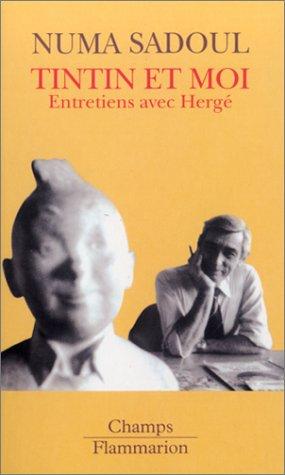
Tintin et Moi
by Numa Sadoul
Buy on AmazonThis came out in 1975. Numa Sadoul was a young student in the south of France who also asked to interview Hergé. He went along with his tape recorder and the interview just went on and on. He took 14 hours of material. Hergé, for the first time, came out and talked about his life, which as I said he had always been reluctant to do. So for anyone interested in Hergé this is a basic background document, because it’s where he spills the beans on himself. Hergé had a rather tortured life, which he never talked about. He had a great sense of humour, but like a lot of comics he also had a very strong depressive side. Tintin was a struggle for him and Hergé was a victim of his success. From the moment Tintin first appeared Hergé was under pressure for the rest of his life to perform at that level, which was very demanding. That and other things plunged him into serious bouts of depression, which undermined his work in the 1950s. At least two. Hergé had a very rough period from the end of the war until he met his second wife in the late fifties – a much younger and very beautiful woman who worked in his studio, and who gave him a more positive approach to life than the frame of mind he’d been in for some time. I don’t think it needs reconciling, I think it needs explanation. Tintin in the Congo was written in 1931, and I would challenge you to find any book written about Africa in 1931 with a different viewpoint. This is how Europeans saw Africans at the time – very paternalistic, very patronising. They were childish, they were simple, they needed to be made sophisticated by the Europeans. That was simply the dated, inaccurate European view of Africa, in literature and in cinema. It’s unfortunate, but that’s how it was. We should read it as a document of its time and not put our politically correct spectacles on. The other thing is that I’ve travelled widely in Africa, as Africa correspondent for The Daily Telegraph , and the hardest book to buy in Francophone Africa is Tintin in the Congo – not because it’s politically incorrect but because they love it so much it’s sold out in bookshops. Africans I’ve spoken to have said what a privilege it was that Tintin came to their continent. I remember reading Tintin in the Congo as a very small child, four or five, but I was most upset by the wholesale slaughter of wildlife, which is also something quite objectionable in the book by today’s standards. But at that time Europeans went to Africa as big game hunters and came back with their trophies. Now we go with cameras not guns, and it’s a different world. Hergé always referred to it as a sin of his youth – he was only 21 or 22 when he did it. That’s again a misinterpretation by people who were jealous of his success. The story behind it is that Tintin had been appearing in the children’s magazine of a paper called Le XXe Siècle . And the moment the Germans occupied Brussels in 1940 Le XXe Siècle was closed down, on the basis that it was a Catholic newspaper. Hergé was upset because he was out of work, but very soon afterwards he received a phone call from the editor of Le Soir , Belgium’s leading newspaper, asking if he’d bring Tintin over to them. Hergé was of course delighted. In a matter of weeks Le Soir had come under control of the Germans, and began to feature reports of Wehrmacht successes on the Eastern front and stuff like that. So Hergé was writing for a paper which was collaborating, and it was embarrassing. But a lot of Belgians in the resistance said they still read Tintin because it lifted their morale. That was why Raymond Leblanc, one of the leading resistance figures, set up Tintin magazine after the war. Talking with Hergé, he said of course that with hindsight he would have done things differently. But he only collaborated accidentally and certainly his politics were not of that kind. If you look through the Tintin books, you’ll find German villains littering them.