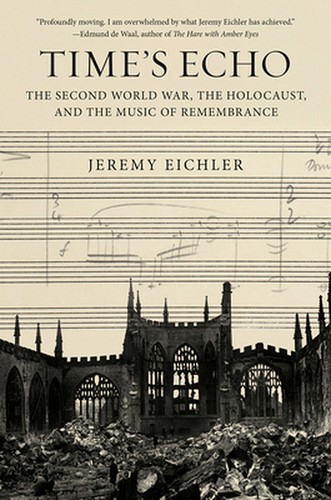
Time's Echo: The Second World War, the Holocaust, and the Music of Remembrance
by Jeremy Eichler
Buy on AmazonA BEST BOOK OF THE YEAR: THE NEW YORK TIMES, NPR • WINNER OF THREE NATIONAL JEWISH BOOK AWARDS • Finalist for the Baillie Gifford Prize for Non-Fiction • A stirring account of how music bears witness to history and carries forward the memory of the wartime past • SUNDAY TIMES OF LONDON HISTORY BOOK OF THE YEAR In 1785, when the great German poet Friedrich Schiller penned his immortal “Ode to Joy,” he crystallized the deepest hopes and dreams of the European Enlightenment for a new era of peace and freedom, a time when millions would be embraced as equals.…
Recommended by
"This is one of the most ambitious books that I’ve read recently. Jeremy Eichler looks at four composers—Strauss, Shostakovich, Britten, and Schoenberg—who were witness to some of the most shocking events of the 20th century. These are events like the Holocaust, the terror in the Soviet Union, and the bombing of Coventry and he looks at how they are reflected in their music. How did these composers incorporate them or address them through music? The book then looks at how music can be a medium of memory. These composers were there, they were able to have an immediate reaction. By nailing it, we, coming a lot later, can get close to those events by listening to the music. In essence, the music is almost like a time portal: it cuts through the decades—centuries, even, by now—to bring you back to an experience, which, in these cases, was truly terrifying. Eichler is a North American music critic. This book is a life’s work and draws on years of research, of knowledge, of thinking. It’s told in a way that is very learned. It tries to move in various registers and tell the story as you go along. We see the siege of Leningrad via Shostakovich. The Benjamin Britten sections cover everything from the obliteration of Coventry to his own experience of going into the concentration camps when they were liberated. Britten was able to attach himself to a cultural corps that was going in to witness what was happening. It’s a remarkable book because it challenges you to think about how you remember things, and where memory lives. Coming at it through the aural sense—how you hear—is quite original. The book is throwing an idea at you that you didn’t necessarily expect. Yes. What you learn about European cultural and intellectual history along the way is quite something."
The Best Nonfiction Books: The 2023 Baillie Gifford Prize Shortlist · fivebooks.com
"I do occasionally. It’s uneven. Most people would accept that she often wrote too fast, and you can see why—she was trying to pay bills. Some of her music is very beautiful. As I said, the list of composers who studied with her is quite long and impressive and their loyalty suggests that they felt that they owed her something. Possibly it was a way of thinking about music and of being a composer. The fact that she was the first composer I ever saw—when she came out on stage to take a bow after one of her pieces was performed at the Proms…in a way, she showed me how to be a composer as well, although I never studied with her."
The Best Music Biographies · fivebooks.com
"Culture and memory live on in music. That’s the premise of this deeply absorbing and moving narrative of how four composers – Richard Strauss, Arnold Schoenberg, Dmitri Shostakovich and Benjamin Britten – metabolized the horrors of World War II and the Holocaust and how each man’s own personal circumstances and choices shaped their artistic responses. Jeremy Eichler, the chief classical music critic of The Boston Globe, is a sensitive and keenly perceptive documentarian, and this richly drawn history places each of the four composers into a broad historical narrative."
NPR Books We Love — 2023 · apps.npr.org