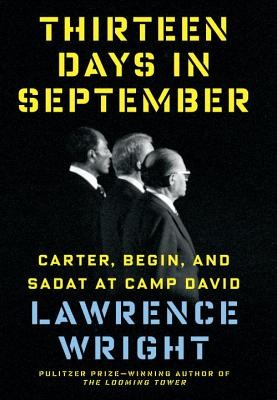
Thirteen Days in September
by Lawrence Wright
Buy on AmazonThe 1978 Camp David Accords were the single most important accomplishment of the Carter presidency. Wright’s book is both a great overview and a detailed ticktock of the peace process and Carter’s role in wrangling two irascible men, Israeli prime minister Menachem Begin and Egyptian president Anwar Sadat, into doing this historic thing. Given what’s happened in the Middle East, and in relations between Israel and its neighbors since, we tend, in hindsight, to downplay this deal, to see it as superseded by later events. But Israel and Egypt are still at peace, they still have diplomatic relations, and that relationship is still one of the few pillars for peace in the region. This book is key to understanding that event and to understanding the Carter presidency. Wright is an incredible journalist and a phenomenal writer. You can’t put this book down. The work that he did promoting democracy after his presidency was so different from George W. Bush’s bombastic militaristic promotion of democracy from the bully pulpit. The Carter Center works in a concerted way to help countries where democracy is budding but fragile, to have free and fair elections that engender confidence in democracy, so when one side wins and the other loses, the electorate and elected leaders accept the results. If you look at events in the world, and even in the United States today, that remains very challenging. The progress the Carter Center made is a real accomplishment. That’s an important observation. Carter was who he seemed to be, which is not something you often say about successful politicians. It was hard for a lot of people to appreciate that when he was in office. Of course, when Carter came up for reelection in 1980, he was in a very difficult position. The economy was in bad shape, both inflation and unemployment were high. Americans were still held hostage at the embassy in Tehran and the rescue effort that Carter ordered failed. Carter was in an almost impossible position. But, over time, after his presidency, Carter’s character came to shine, and people came to appreciate how he stood out among other ex-presidents. As you point out, he put his person on the line as an election observer, building homes with Habitat, and through his public health efforts—for instance on Guinea worm disease eradication. Carter was not just sitting in an air-conditioned office in Atlanta pulling strings. He was out demonstrating his commitment, drawing the spotlight to important problems. I think people finally appreciate that commitment.