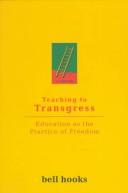
Teaching to Transgress: Education as the Practice of Freedom
by bell hooks
Buy on AmazonIn Teaching to Transgress bell hooks—writer, teacher, and insurgent black intellectual—writes about a new kind of education, education as the practice of freedom. Teaching students to "transgress" against racial, sexual and class boundaries in order to achieve the gift of freedom is, for hooks, the teacher's most important goal.
Recommended by
"bell hooks is an extraordinary writer. I admire not only her ideas, but also the way she writes. She is unusual in that she is a university professor and a very respected world figure in feminist theory and writing, but, at the same time, her books are written in public prose and are read by an extraordinary range of people. She could have been one of the figures in Edward Said’s book, Representations of the Intellectual . She is speaking to the issues of the day and has a wide, popular readership. Support Five Books Five Books interviews are expensive to produce. If you're enjoying this interview, please support us by donating a small amount . I chose the book not because it is trenchant or even a comic description of what universities and academia can be and are, but rather because it’s really a wonderful account of the possibility that education has to shape and transform lives. The book is written from a very personal point of view, of her own experience of education. She is arguing unapologetically for the transformative power of education and of thinking and of ideas. What she draws on, which I think is so brilliant, is the importance of teachers in her own life — often black women teachers who taught her and opened up the world to her in a different kind of way. That process of transformation, for people who didn’t grow up in homes where there were a lot of books, that movement into the world of learning and thinking, can be very painful. bell hooks is a cultural critic. She is a black feminist writer who came to international prominence in the 1980s and 1990s. She writes on a whole range of topics from the racial politics of Madonna to film criticism. She’s written a brilliant essay about the film The Piano. She has even written a beautiful book about love, for example, and relationships. She ranges across the whole wide spectrum of issues from music, films, and cultural production, to pedagogy, teaching and learning, and the experience of gender, and class and race in America. She writes about things that she thinks are important and are the key issues of the day. She writes at all these different levels, but she has a very singular voice. She is a very radical critic of inequalities and divisions in contemporary society, but, at the same time, has an incredible generosity and hopefulness about the potential for things to change. “It reminds me of John Steinbeck’s phrase about his best teachers who ‘did not tell — they catalyzed a burning desire to know.’” It’s somewhat similar to bell hooks’s, really, in that I have written a lot about popular culture and music. I started out as a youth worker. I was a youth worker in the 1980s and then wrote my dissertation about what it was like to grow up in a very close but ethnically-mixed neighbourhood in South-East London. My first book was about that, and the ways in which young people were developing new kinds of culture that bridged their differences. At the same time, sometimes in the same streets, there were very intense forms of popular racism and institutional racism. In this book, bell hooks argues for something that she calls ‘engaged pedagogy.’ It’s a version of education that’s holistic. That’s why she gives the book the subtitle, ‘ The Practice of Freedom. Her vision of education—which I think resonates with figures like Richard Hoggart and the workers’ education movement, which I was very influenced by and benefited from—is as a simple commitment to the idea that anyone can learn and that we need to teach in a manner that respects and cares for our students. I’m very mindful of it today, as students are handing in their dissertations. They’ve been struggling all week with the doubts and anxieties they’ve been living with, especially in terms of, ‘Do I have the authority to have a voice for an argument?’ Many of these students are the first in their family to come to university. They are facing those demons as they approach handing in their dissertation. That version of education that is about respect and care that is holistic I think is a very admirable one. Get the weekly Five Books newsletter In her case, this comes out of her involvement in the American civil rights movement and the feminist movement. She thinks of teaching as a practice that is about freedom and well-being and transformation. There’s something about that that I think is so important to be reminded of in our time of professionalization, of trying to present a view of academia that is worth its salt. She writes very, very poignantly that ‘The academy is not a paradise. But learning is a place where paradise can be created.’ She says, this is a passage that I really think rings true for me as the very best of what academia is and can be: ‘The classroom with all its limitations can remain a location of possibility. In that field of possibility we have the opportunity to labour for freedom, to demand of ourselves and our comrades, an openness of mind and heart that allows us to face reality even as we collectively imagine ways to move beyond the boundaries, to transgress.’ That’s why academia feels like an important place to be, to try and play a small part in fostering that openness of mind. The way bell hooks writes about teaching conveys what’s at stake. It reminds me of John Steinbeck’s phrase about his best teachers who ‘did not tell — they catalyzed a burning desire to know.’ That potential is the gift bestowed on every academic."
Academia · fivebooks.com