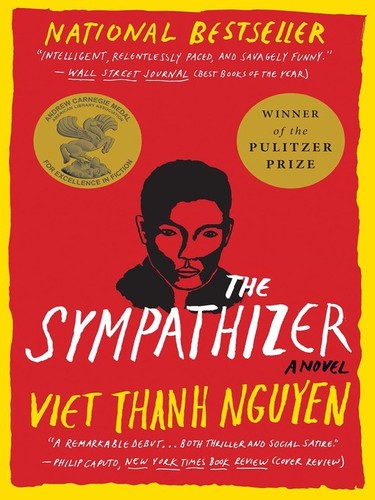
The Sympathizer
by Viet Thanh Nguyen · 2015
Buy on AmazonFollows a Viet Cong agent as he spies on a South Vietnamese army general and his compatriots as they start a new life in 1975 Los Angeles.
Recommended by
"The Sympathizer is another groundbreaking publication. Viet Thanh Nguyen is a powerful new voice for the Vietnamese who left the country after the end of the war in 1975, mainly South Vietnamese who fled after the fall of Saigon in 1975 and settled in the US. For a Pulitzer Prize to be awarded to a novel written by a Vietnamese American, in itself, is a first. The protagonist is half French, half Vietnamese. He’s a spy working undercover for the communists in Saigon and then in the US. When he returns to post-war communist Vietnam, he is imprisoned by his own side. The novel ends at sea with the narrator leaving Vietnam among a crowd of boat people. Viet Thanh Nguyen illustrates the complexity of divided loyalties that come from Vietnam’s history—from being a colony for 100 years, then at war for over 30 years, with families split between supporters of the North and supporters of the South. There are divided loyalties, betrayals, and the loneliness and divisiveness that this creates within families. The plot illustrates the pain of broken families and friendships, and the loss of home. Then there are the Vietnamese in exile who took US citizenship, the difficulty of that relationship, especially for the older generation. They were staunchly anti-communist but at the same time some felt betrayed by their very country of adoption when the US left South Vietnam. But now his generation are coming to the fore and his is a powerful voice. Yes, he’s 50. Other new American-Vietnamese voices include the exceptional writer and poet Ocean Vuong . And one of the earliest, although it’s a memoir not a novel, was Le Ly Hayslip who wrote When Heaven and Earth Changed Places and also Woman of War, Woman of Peace, turned into a film by Oliver Stone. I was a journalist based in Hong Kong, working with the International Herald Tribune , at the beginning of the 90s. I focused on China post- Tiananmen Square and its transition to a market-oriented economy because that was such an interesting story. When I visited Vietnam, I was shocked at the discrepancy between the art and culture I discovered there and what I had seen on the TV news in the US when I was in university. I just couldn’t believe it. I couldn’t believe how post-war US popular culture mis-portrayed Vietnam, especially the role of women in the war. Then, in 1995, the official estimate for civilian war dead was published, mostly ignored by the US: two million civilian war dead! I was shocked by the scale, I was shocked that the US took no responsibility for the casualties it had inflicted, or for the mess they left behind, the victims of Agent Orange, the unexploded bombs. And I just felt anger. Support Five Books Five Books interviews are expensive to produce. If you're enjoying this interview, please support us by donating a small amount . On the positive side, I discovered a world of aesthetics, culture, music, poetry, art and I thought, ‘This is something I’d like to share.’ That’s how I started. My first book was on a Vietnamese artist who painted in Hanoi during the war. I went to Thames & Hudson and they said, ‘Beautiful project, we need X amount of pounds of sponsorship’ Being a words person, I’d never really published art books. I thought, ‘That sounds like a lot. I’ll just publish it myself.’ And I created my imprint, Asia Ink . Coincidentally, a curator at the British Museum had the same passion for Vietnamese art created during the war. So we organised an exhibition on Vietnamese war drawings in 2002 that drew 75,000 visitors. That was the beginning. I kept going because there was just so much to share about Vietnamese culture. I published two books on war art. Vietnam Zippos was the trench art of American soldiers: sex, drugs, rock and roll, f*** this and f*** that. And then there were these beautiful lyrical drawings created by North Vietnamese war artists under the same circumstances. I wondered, ‘Who is bringing civilisation to who?’ I did the trip from Hanoi to Ho Chi Minh City, through Laos, and then back into Vietnam, to collect stories from veterans from both sides of the frontline, mainly from the women I had seen portrayed in the war drawings. People think of the Ho Chi Minh Trail as one path or one road but by war’s end it was a network of 10,000 miles of roads, bridges, and pipelines through Vietnam, Laos and Cambodia. It was built by the North Vietnamese Army to ferry military troops and supplies from North Vietnam to the battlefields in South Vietnam where they were fighting against the South Vietnamese and their US ally. At the height of the war, the US had half a million troops in South Vietnam. The US Air Force, Navy and Marines bombed the Trail day and night in an effort to stop the flow—close to eight million tons of bombs were dropped—but they never managed to cut the Trail. It became a mythical, legendary road of victory for North Vietnam. But it was also a blood road, because of the huge casualties. Anecdotally, at the height of the bombings, only 10 per cent of soldiers in a unit made it to the battlefronts. An interesting part of the trip was that I was able to link sections of the road to military events through interviews, memoirs and articles. There are still a lot of military secrets. Also, I discovered a cultural heritage and layers of civilizations that the Americans were bombing, probably unknowingly. This is a story that’s well-known in Vietnam, of course. Women veterans are highly decorated, heroes of Vietnam, but our history is selective, usually written by men, and usually written by the victors—though in the case of the Vietnam War, mainly written by US authors. So this aspect is little known in the West, although one excellent scholarly account was published in 1998, Even The Women Must Fight by historian and academic Karen Gottshang Turner and the journalist Phan Thanh Hảo, who was the English translator of Sorrow of War . Women militia and soldiers fighting on the North Vietnamese side were posted on the mountainous Trail to clear the roads for the truck convoys going south. They were bombed all the time. They decommissioned bombs, which was incredibly dangerous work. They were stationed in a tough jungle environment. Again, very little food, a lot of hunger, a lot of malaria. It’s just unbelievable. They were aged 17 to 24. Some of them were from farming backgrounds, and used to working in the field, but others were from middle class families who interrupted their studies and enlisted or were drafted. Then you had the women defending the coastal Trail. An estimated 1.7 million women, married with families, defended roads, bridges, towns, and villages as more and more men were sent to fight in South Vietnam. The women played an important strategic role in North Vietnam’s eventual victory. It’s hard for visitors to juxtapose the gentleness with the cruelty of the war, it’s very hard to fathom. I don’t think of the Vietnamese at all as victims. On the contrary, they’re extremely tough and resilient and seem to have little personal resentment against us. They were defending their country against a powerful outside force. I admire that. I think that’s what draws in the visitor. When I met General Giáp, the strategist who won the wars against the French and the Americans, his first words were to thank me for what I had done for Vietnam. It’s a natural politeness on their part. It’s just phenomenal. I still don’t understand it. It does draw you in and mark you. It’s very similar. In the book, a Trail veteran was visited by the secret police a week before we met her for speaking out against corruption and social ills. This was is in 2014! Bloggers are being arrested. Well known writers are being arrested. Facebook accounts are being canceled. It’s all there. Like in China, there were also problems with land grabs, where farmers—because they don’t own the land, the people own the land—were being evicted by local authorities who resold the land to developers at high prices. This has been remedied in some provinces and the government is compensating farmers and fishermen displaced by foreign investment ventures. The irony is that Vietnam is now best friends with the United States. That’s the reality for a smaller country with a border with China, caught between two superpowers."
The Best Vietnamese Novels · fivebooks.com
Publishers Weekly's Best Books — 2015 · publishersweekly.com
The Atlantic's The Great American Novels · theatlantic.com
"Viet Thanh Nguyen's terrific The Sympathizer."
By the Book: Joseph Kanon · nytimes.com
By the Book: Ken Burns · nytimes.com
"novels on identity and belonging (Sigrid Nunez's "A Feather on the Breath of God" and Viet Thanh Nguyen's "The Sympathizer")."
By the Book: Laila Lalami · nytimes.com
"I believe it's the first novel to win the Pulitzer and the Mystery Writers of America Edgar Award, which makes me wonder if superficial genre distinctions really are disintegrating at last."
By the Book: Megan Abbott · nytimes.com