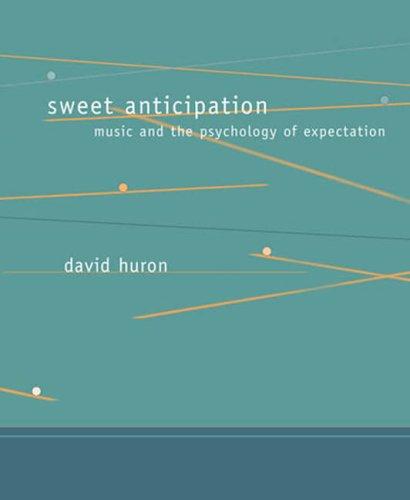
Sweet Anticipation: Music and the Psychology of Expectation
by David Huron
Buy on AmazonLife is never a straight path. In California Oliver Sacks was a physician to Hell’s Angels. Can anybody be further removed from the Oliver Sacks that we all know and love? But even Hell’s Angels have a need for empathy, for somebody to look after them. And by somebody doing that for them, they also have the potential for change… Yes. Going back to Oliver Sacks, music played a huge role in his life. He wrote a book called Musicophili a which is about how music moves us and how even in those who have lost all sense of identity — because of, say, Alzheimer’s — music can still bring them out of their shells. It’s still the nursery rhymes of their early childhood they will be able to recite and that will give them pleasure. The question for me, and the kind of questions I raise in my research, is: Why is that? Why is music so powerful? Why it is that music can evoke emotion within two bars as opposed to a story that takes a long time to develop? Why does music pack such an emotional punch? David Huron in his book, Sweet Anticipation , has come up with what I think is the best answer to this question, namely that we are prediction machines. Based on our past experience, the way we’ve grown from early childhood, with our genetic dispositions, and within a human web of interpersonal relationships, we have a certain history and, specifically with music, a certain listening history embedded, for many of us here, in a Western music history. We form certain likings, and there are certain things we expect to happen. Everybody familiar with the western canon will know the opening bars of Beethoven’s 5th Symphony. And if I were to play a different note to end it, your brain would immediately go, “No! No! That’s not how it goes. That’s not what I expected.” Your brain immediately sends a prediction error. That’s exactly how music works on all levels — in terms of rhythm, of melody, of harmony. It’s setting up predictions, setting up tensions that are then either fulfilled or released. That game — and it is a game that is really playful and joyous — is something that can go on for a very long time. What happens with interesting music is that it’s just on the edge between being completely unexpected and yet having this familiarity that sometimes can get boring. New tunes that you home in on are things that are not that far removed from what you’re used to listening to: Not the same but still not completely unpredictable. This is also the human condition. When you think about food, it’s the same. It’s about exploring and yet exploiting what you already have. Life is sort of stretched out between those poles. The nice thing about music, both in terms of why it evokes emotions in us but also why it’s a great research tool, is that you can do it over and over again and it doesn’t get boring. With food, usually, you get sated at some point. Yes. And it creates those paradoxical situations such as how sad music can also be deeply pleasurable. The Portuguese have a name for it, ‘saudade.’ It’s not quite melancholy but it’s a longing for a past. As you listen you get refreshed, you suddenly have a pleasure you had forgotten existed. I think this is why music is something that is everywhere. Steven Pinker famously wrote, in The Language Instinct , that we could have no music and we would be exactly the same. It’s like cheesecake, he said, something that’s nice but we don’t really need. I think he’s completely wrong. Music is one of those things that is intrinsic to humans. We don’t know of any other species that has music. Others, such as chimpanzees, can distinguish between major and minor keys, but they don’t do it spontaneously, they don’t engage in music-making just for the fun of it. That is also why I’m very interested in music, because it tells us something about the human condition. It also tells us something about creativity because it involves mucking about. You have something, you play around with it, and you create something new that is a bit like what went before but is also something new, and as you play more and more with it, it becomes something completely different. There are certain things in life that aid survival: food is clearly one of them, sex is one of them. We couldn’t live without those. But it’s also very clear that unless we have sex with somebody, i.e. there is a social element, then we wouldn’t survive either. This social element is, in fact, a fundamental pleasure. The reason why music is indispensable is because of the bonds that it creates between people. This begins very early on in infancy. In my research, I’m very interested in the links between vocalisations — motherese, the nursery rhymes mothers and fathers use to try and grab the attention of their infant — and the way that creates a bond. Very late in life, also, those same nursery rhymes are the ones that still have emotional resonance, that remind us of who we are. The link of memory with this deep sense of the pleasure of belonging, of being part of a human web, is what makes music indispensable. Of course language is indispensable in that sense as well: Music and language share a lot of features and I’m very interested in the links between them. So I would say to Steven Pinker that the social element is key to who we are, and music is a key enhancer of that. Even in language, of course, poetry is not that far removed — the kind of prosody, the kind of vocalisations I mentioned earlier are on the road to becoming musical. When is it music? When is it prosody? When is it poetry ? I think this is just part of being human. You’d be wrong to say we can’t have prosody anymore, that we should not have this sing-song in our language, that we should all speak like automatons. Say that to somebody from Italy!