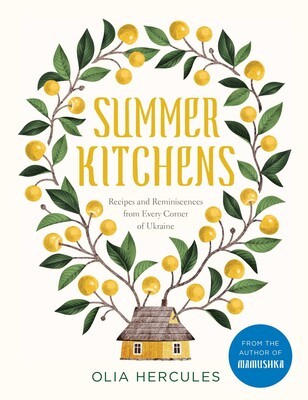
Summer Kitchens: Recipes and Reminiscences from Every Corner of Ukraine
by Olia Hercules
Buy on AmazonI love this book so much. I just got back from Ukraine so I’ve been cooking a lot of my own vegetarian-style borsch. But I think the reason that I have to include this book in our chosen list is because it’s absolutely Eastern European. I’m going to come back to the geographical question—of what is Eastern Europe—later when I talk about Poland. This book is so important because it’s a documentation of Ukrainian villages, their summer kitchens, their dachas, pre-2022 and the full-scale invasion. Summer Kitchens was published in 2020. Hercules would, obviously, have been researching it her whole life, but she was researching it actively for several years before that. So it’s an absolutely crucial piece of documentation, a piece of memory work. And it’s gorgeous. I was looking through it yesterday and it brings tears to my eyes now, because these are villages where farmers have not been able to cultivate their fields properly because of the missiles and war debris. It’s terrible. Terrible. These are tiny little villages. People didn’t have very much, before. They had their dacha, their little summer kitchen, their orchard. They were rich in terms of natural resources and fresh food, but not in what we might consider wealth—material goods. They were using the landscape to feed themselves, fishing for crayfish in the lakes and pickling vegetables. People talk about Italian food endlessly, but if you eat tomatoes from countries like Bulgaria and Ukraine they can be even better: so sun rich. “In Polish cookery, Ukrainian cookery, Moldovan cookery—the peasant is absolutely revered” So I had to include this book because it’s a vital and important record. It’s also absolutely beautiful to look through—the design and the photographs of all these families in their kitchens. Olia, as I was saying, is very good at gently coaxing out family recipes. No one can do it the way she does. So I think it’s so important to Ukraine as a document. You can also see all the influence of the borderlands: the Polish influences, the Carpathian highlands, the Romanian influence. I think that’s what ties it all together. Everything shapes everything else. During the Soviet Union, Stalin moved people around. The Tatars from Crimea, for example, were sent en masse to Central Asia, and have now come back. Olia writes about all of this. In Ukraine, Odesa remains the city that I’ve loved the most. I remember being surprised by the huge vats of pickles in courtyards—massive jars of tomatoes, every vegetable you can imagine. I remember thinking, during visits, that these preserves were perhaps a reflection of a bunker-type mentality. Even before Covid lockdowns and now the full-scale invasion, these were people who were prepared for hardship. They have times of huge abundance, with that hugely rich soil, with the fruit and the vegetables and the fish and the meat. An amazing cuisine. But they also have a history of difficulties, having lived under the Soviet Union and having suffered pogroms and financial hardships. Yes, it’s horrific. I remember an early video she put out, about her brother who was selling e-bikes in Kyiv before the war, a regular guy with two small children, who signed up and was off to the frontline. And her father, who is in the agricultural business, has been raising money for landmine clearance. It’s been devastating.