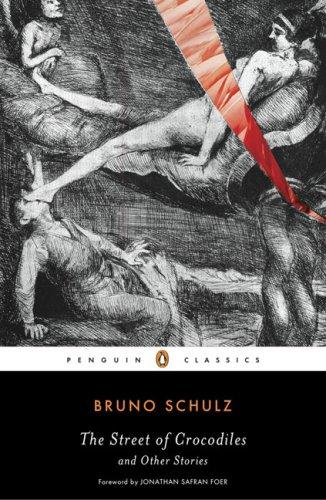
The Street of Crocodiles and Other Stories
by Bruno Schultz and Celina Wieniewska (translator)
Buy on AmazonThe street of crocodiles --Sanatorium under the sign of the hourglass --The republic of dreams --Autumn --Fatherland.
Recommended by
"Bruno Schultz was a Jewish, Polish writer, who lived in Drohobych, a small town in Galicia. He was a modest artist, regarded today as one of the greatest 20th-century writers. He said that our everyday life and our art consist of fragments of old legends, artefacts of ancient cults, crumbs of mythology. He described the small life of his modest family as a rudiment of such mythology. He compared human language to a huge primal snake which was cut into thousands of pieces (the words) that have lost their ancient vitality, that today have the function of communication only, but still always continue “to look for each other in the dark”. Every writer knows the magical moments of putting two words together, when suddenly there is a spark, and you know that these words were neighbours in Schultz’s ancient snake. His novel, The Messiah , is unfinished and lost, but he wrote several stories where, on reading them, life explodes; in every paragraph there is a simultaneous occurrence of all layers of consciousness and sub-consciousness, of dream and nightmare, of fantasy. My first time reading Schultz’s work was “Cinnamon Shops” (collected in The Street of Crocodiles and Other Stories ). I was captivated. I felt like I was in a dream, in total madness. I felt like everyone in love feels: that these words were meant only for me… Only later did I realise he was beloved by others who discovered him years before. In the epilogue to the book, I learned about the story of his death. In the ghetto, he was enslaved by a Nazi named Landau, who made him draw murals at his home; another Nazi officer, named Gunther, after losing a card game to Landau, shot Schultz, just to hurt Landau. When they met later, he told Landau: “I’ve killed your Jew,” and Landau answered: “so now I’ll kill your Jew”. True? Imagined? I believe it is made up, but this tale has a power that has lasted for years. After I read it I walked for hours as if in a fog not wanting to live in a world that allows such monstrosities as these sentences. This time, unlike the paralysis of a ten-year-old reading Sholem Aleichem, I had already started to write and wanted to write about Bruno Schultz: a book that would shiver on the shelf, that would have the vitality of one second of human life, the vitality that Bruno Schultz teaches us in his writing. “After I read it I walked for hours as if in a fog not wanting to live in a world that allows such monstrosities as these sentences” What had such an impact on me is the clash between the vitality of the multi-layered, energetic writing of Bruno Schultz versus the sterile equations of the Nazis—you kill my Jew, I kill your Jew—as if human beings can be replaced by each other. Writing about him, giving him a second life, was the only possible way to stand in front of the paralysis that human evil cast on me. In my books often characters face some kind of arbitrariness: of Nazis, of our body on our soul, military occupation, and above all—the arbitrariness of death. I found out that whenever I wrote about arbitrariness, I stopped being the passive and paralysed victim—I am not in the place where I was before I wrote about it."
Books That Shaped Him · fivebooks.com