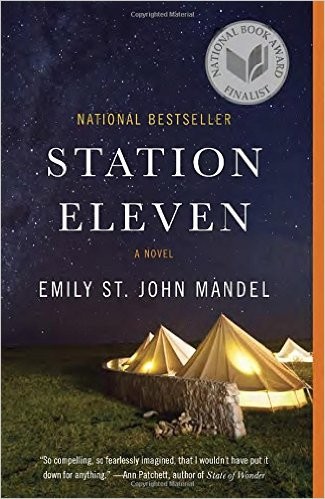
Station Eleven
by Emily St John Mandel
Buy on AmazonOne snowy night Arthur Leander, a famous actor, has a heart attack onstage during a production of "King Lear." Jeevan Chaudhary, a paparazzo-turned-EMT, is in the audience and leaps to his aid. A child actress named Kirsten Raymonde watches in horror as Jeevan performs CPR, pumping Arthur's chest as the curtain drops, but Arthur is dead. That same night, as Jeevan walks home from the theater, a terrible flu begins to spread. Hospitals are flooded and Jeevan and his brother barricade themselves inside an apartment, watching out the window as cars clog the highways, gunshots ring out, and life disintegrates around them. Fifteen years later, Kirsten is an actress with the Traveling Symphony.…
Recommended by
"This book speaks to this moment. It imagines a pandemic that’s far more devastating than the one that we’re living in right now. A group of traveling actors, who are getting ready to put on a Shakespeare play , are also trying to get to an airfield where it’s rumored that civilization is enduring. So, the construct of Stations Eleven is similar to The Road , but there’s more going on. It’s a very dark book, with a broader cast of characters. There’s more of an active focus on the essential role that culture plays in our civilization. But it also speaks to the importance of maintaining community in dark and challenging times; that’s something we’ve all been living with, as we’ve all been forced into isolation. One of the things that Mandel gets just right in the book is that crises tend to accentuate negative and positive trends. I’ve seen this in my own experience, in war. In a pandemic or a war, you see people at their absolute best, acting heroically. And in crisis and conflict you also see people at their most selfish and their most depraved. These situations widen the spectrum on what we are capable of. The most amazing acts of courage and empathy that I’ve seen, I’ve seen in war. And the most depraved things that I’ve ever seen in my life are also things I saw in war. War flings open the aperture of human experience. I see something similar in this pandemic in the community I live in. You see something similar in the pages of many of these apocalyptic novels. That’s one of the things that defines an apocalyptic novel — these extreme scenarios widen the possibility of what characters are capable of doing."
The Best Apocalyptic Fiction · fivebooks.com
"An absolute classic of the genre, yes. One of the things that’s superb about this book is how it interweaves timelines and flashbacks. The contemporary world has a strong presence in it, which makes the near-future dystopia feel proximate and plausible. The meeting of post-apocalyptic and contemporary life makes you feel nostalgic for the world we’re in, and that’s a wonderful thing. “Hope can be a dangerous thing, because we can hold onto hope long after we should” The premise of Station Eleven , for those who haven’t read it, is that a travelling symphony is moving on a circuit through an obliterated North America, performing the works of Shakespeare. I saw Emily St John Mandel speaking about this book at Shakespeare & Company just after it came out in 2014, and she said that in initial versions of the book, she also wanted them to be performing sitcom scripts, like an episode of Friends or How I Met Your Mother , so it would be like a palimpsest archive of culture from Shakespeare to modern times. I think she made the right decision, but I think it’s a funny bit of metadata about this book. One of the things that’s amazing about the novel is that you fall in love with Shakespeare all over again over the course of the book. It’s quite hard to coexist on the page with Shakespeare, but she pulls it off. As with all these books, they are superbly well written, but also read like thrillers. I don’t think there should be a division between ‘good’ literary fiction and big, readable, compulsive stories. Plot is a huge motors in dystopias, and I love that. These novels bring all these things together—beautiful writing, action—and show it’s possible for them to coexist. I think that depends. Dystopia, by definition, is a society where people live in states of extreme inequality. And by that definition, there’s never been a time when the world hasn’t been dystopian; it’s decidedly dystopian right now. One trope of dystopian novels is that people who have so much suddenly lose it, and they only realise how much they’ve had once they’ve lost it. And I do love those books, I’m recommending some of them. But in my own book Dreamland , I was more interested in the slow degradation of society. These are not characters who have been living in a static, middle-class ‘before time’. There’s not a lot of space or time for nostalgia, they’re just continuing to exist, with all the immense difficulty but also joy which that brings. It’s just life."
The Best Near-Future Dystopias · fivebooks.com
Favorite books · radicalreads.com