Spartan Women
by Sarah Pomeroy
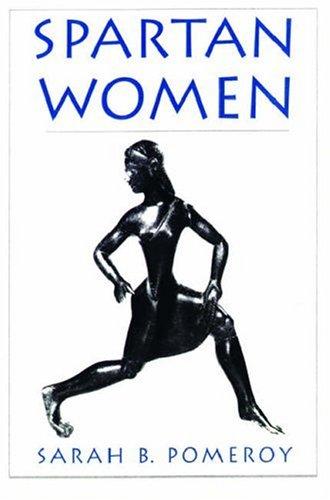
Buy on AmazonThere seems to be a very big difference in the lifestyles of Spartan girls and mature Spartan women. The stereotype of the girls is that they were outside a lot, which is very unlike most other Greek women. The Athenian sources that spend so much time telling us about them say they were scantily clad, muscular and tanned. They were basically everything that an Athenian girl wasn’t. There’s a strong emphasis on their visual appeal to men. There’s lots of mention in the primary sources of men ogling the Spartan girls when they’re out. There is a culture of fat-shaming. It cuts both ways, because the girls get to sing songs teasing the boys who aren’t brave or manly enough. So, the girls are very visible and audible. For women, some of our sources suggest their lifestyle was much more constrained. They weren’t allowed to wear jewellery or their hair long. Some sources suggest that when they were married their hair was shaved off. They were veiled, like their Athenian counterparts. There are recorded sayings about Spartan women being veiled and girls unveiled. And the response to the question why this was the case was that girls need to find a husband, but wives need to keep one. The suggestion is that Spartan women were not necessarily as free and liberated as the behaviour of the girls might suggest. And that’s why I chose Sarah Pomeroy’s book, because Spartan women are so important and this is the only full-scale monograph devoted to them. It was an obvious choice. There’s a little bit. The surviving fragments from the poet Alcman, who I mentioned earlier, include choral songs that would have been sung by girls, unmarried maidens. There are lots of descriptions of the beauty of the Spartan girls and lots of horsey metaphors and also lots of references to gold and silver, which clash with the idea of Spartan austerity. One of the old solutions to that was that Alcman predates Spartan austerity, but that doesn’t necessarily work in terms of chronology. There are some archaeological materials—quite a few bronze figurines of Spartan girls dancing or running and bronze mirrors and other artefacts. Support Five Books Five Books interviews are expensive to produce. If you're enjoying this interview, please support us by donating a small amount . But most of the sources are outsiders and often quite late. There are the sayings of the Spartan women recorded by Plutarch, a writer of the Roman period. They are a wonderful source of information about Spartan women, but they’re so late that there is a big question mark hanging over their word-for-word reliability. It’s more a case of being able to take the tone of the sayings, rather than their actual wording. The sayings reveal mothers who would not have made their boys soft. Many of the sayings of Spartan women are coercing their sons, telling them off for having behaved badly. Several of them relate to mothers actually killing their sons for having shown cowardice. In one story a Spartan boy comes home from the wars and his mother asks, ‘How did the Spartans fare?’ He says, ‘Everyone was killed.’ She says, ‘Everyone?’, and then kills him by beating him with a roof tile. Plutarch records an epigram he’d seen, which said that a boy had been justly killed by his mother for being a coward and not following Spartan laws. And my personal favourite, scary Spartan mother is the one who lifts up her dress and asks her cowardly son, ‘Do you want to crawl back in here where you came from?’ There are a bunch of these stories and they’re not just directed against their sons. There’s a Spartan woman who rebukes her brother for not being manly enough. There is a sense that Spartan women were policing male behaviour. Yes. She is Helen of Sparta really. She’s the wife of Menelaus, King of Sparta, who was abducted, or chooses to go to Troy, depending which version of the story you follow. Helen is worshipped as a goddess in Sparta. She has a sanctuary in Sparta. Herodotus tells us a wonderful story of a girl who grew up to be the most beautiful woman in all of Sparta, but she was born very very, ugly, so much so that her parents were ashamed of her appearance. Her nursemaid took her to the sanctuary of Helen every day and then, one day, this mysterious woman appeared and touched the girl’s face and she turned into the most beautiful woman in all Sparta. This was obviously the goddess Helen touching her and transforming her into a Helen-like beauty. Probably. There are a few experts who would still say they were happy with that story. But these days most would argue that it’s unlikely. There are a couple of places in Lakonia that have been identified as possible places for the site where children were exposed. There’s this really weird cave on the road between Sparta and Kalamata. The road sign calls it ‘the place of rejection’, and human remains have been found at the bottom. But they were random human remains, not just those of babies. It’s a very romantic-sounding story—for want of a better term—but it’s only mentioned by Plutarch, who was writing 500 years after the Persian Wars. If it was true before then, it’s surprising that no one else has mentioned it. Yes. It was alleged that they were bathed in wine and if they behaved poorly in some way, then they were exposed. Plutarch use the words ‘weak and puny’ but then Agesilaus, the 4th century King of Sparta, was famously lame. So, he either disproves the rule, or an exception was made because he was a prince. Or, maybe, they didn’t notice that he was lame. These days, the standard line of thought in Spartan scholarship is that if something is only in one of the later sources, we worry about its reliability. And the exposure of babies is one of the things that’s only mentioned in later sources. It’s still likely that they would have done it in some way, shape or form. Infanticide was very much the norm in the ancient Greek world. You only have to look at the myth of Oedipus to appreciate that. But whether it was organized by the state in the way that Plutarch suggests is another matter.