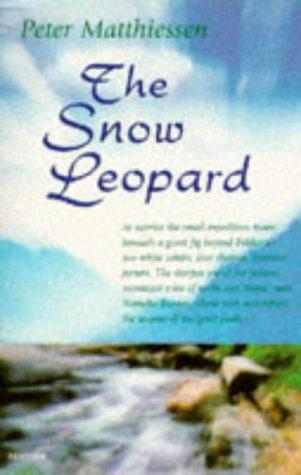
The Snow Leopard
by Peter Matthiessen
Buy on AmazonThis lovely book (1978) describes a two month search for the snow leopard with naturalist George Schaller in the Dolpo region of Nepal. The book combines the search for the snow leopard with a search for inner meaning (Zen Buddism)
Recommended by
"Yes, the mountains of the Himalayas form a similar backdrop to Moitessier’s oceans. It’s a similar metaphoric situation. And a writer’s dream. He’s going into the mountains, but also into himself. This book is pretty iconic in the world of travel writing. You have the background of him having recently lost his wife to cancer. It wasn’t an easy relationship, but at the same time, he has lost the person he perhaps loved most in the world. That was his reason for going. He’s also going because his friend George Schaller, the naturalist, wants to investigate the blue sheep that live in the Himalayas. But Matthiessen is basically going because he wants to think about his late wife and perhaps escape from that reality. He also seeks the snow leopards. Before Matthiessen, the snow leopard had only been seen twice in this Dolpo region of the Tibetan plateau over the last 25 years. George Schaller was one of the guys who saw it. In Matthiesson, a bit like Alexandra David-Neel, we have a writer who is very interested in eastern philosophical teaching. He was a Zen Buddhist, and wanted to visit the monastery at the Crystal Mountain. What you get is a real education in Buddhism, and without trying to spoil it for anyone else, it is a meditative journey on death, loss, suffering, healing, breathing, and the snow leopard itself which comes to represent a kind of harmony between what is real and what is not. Matthiessen was in his forties when he was walking. It certainly weighed on him physically, you get a sense of that. But you get this release with every step he takes, a wonderful kind of cathartic digging. It’s not easy. You can tell it’s not easy. There are regrets, looking back at his late wife and how they treated each other. And he doesn’t get to see, in the physical sense, the snow leopard. But that is almost ,in a sense, what he needed. There’s this line: Have you seen the snow leopard? No! Isn’t that wonderful? And it’s that sense of release, of detaching from himself. For sure. It’s something I’ve thought about. What’s cool about The Snow Leopard is that he is quite honest about that. The Snow Leopard, I think, was a two month trip. Moitessier was away for ten months, which is slightly different. In Matthiessen’s case, I think you get the sense that he needed the isolation to grieve. Moitessier doesn’t mention his wife. That’s a really good question. I think spirituality is innate in the steps that you make. I think that moving, walking, travelling unpowered by motor creates some sense of connecting to ourselves and to the land or sea like nothing else. I think it conjures up something that we miss from the everyday. But I don’t think it has to be spiritual in nature necessarily. What you take from it, about yourself or about the world, can be spiritual if you want it to be."
Long-Distance Journeys · fivebooks.com
"Peter Matthiessen's "The Snow Leopard" brought the scientific search for a remote and wild carnivore into a language only the massive Himalayans and one man's search for a soul could transcend."
By the Book: Delia Owens · nytimes.com
"First, Matthiessen’s book defies easy description. Seeking snow leopards is certainly the primary driver of the narrative, but there’s so much more because underlying throughlines contribute in major ways to making the book so different from the standard travelogue. The basic conceit is Matthiessen’s description of his travels in the Tibetan Plateau alongside George Schaller, who was a leading mammalogist at the time. In that way, The Snow Leopard feels like it should fit into the same science travelogue canon as Humboldt and Darwin—but it’s clearly more than that because of what Matthiessen brings to the story. In other words, it’s not really just about snow leopards—or Himalayan blue sheep, the other mammal that Matthiessen and Schaller sought. Get the weekly Five Books newsletter The book stands apart and it remains fresh because of the ways that Matthiessen weaves his exploration of the outer world with his own inner one. Both are arduous, in foreboding landscapes, and Matthiessen’s shared quest to find elusive mammals happens at the same time that the reader learns so much about Matthiessen himself: the grief of losing his spouse, his adoption of Zen Buddhism, and the guilt from being an absent parent. As an aside, I explicitly borrowed from Matthiessen’s style of father-son correspondence in the opening chapter of my book. When you gather all of Matthiessen’s throughlines, it’s clear that The Snow Leopard is not a typical travelogue, especially because the narrator’s inner life shines through in ways that other similar books do not— In Patagonia , for example, tells us little about Chatwin’s own remarkable personal life. I think what Matthiessen does so well in this book is keep us on the long quest because of the intimacy and trust that he builds with the reader. The process is satisfying because Matthiessen reveals so much about who he is, even if the predator in question remains elusive. Well, perhaps slightly less mysterious. I think there’s this impression today that most of the natural world is, in effect, known. In this view, it seems remarkable that we don’t know all that there is to know about the world’s big cats, or other predators. Scientists intuitively know that this impression in unfounded: the wild lives of most species really are not that well known. In the 40 years since the publication of Matthiessen’s book, we definitely do know a lot more about snow leopards. But basic questions—such as how many are there, exactly, in the world?—remain guesses. I think zoos and natural history films have a way of trivialising predators, turning them into near-caricatures, scripted for short attention spans—the great humorist Jon Mooallem wrote a bit about this reduction in his book Wild Ones . We rarely see predators in their habitats because they’re fundamentally hard to study—even urban ones, such as coyotes and mountain lions are nocturnal. Instead, we’re left with whatever naturalists can tease and pull out, documentation wise, from going out and finding them. “Zoos and natural history films have a way of trivialising predators, turning them into near-caricatures, scripted for short attention spans.” But the hard work of a field biologist remains irreducible. The ways we can know about predators still amounts to finding them, camera trapping them, tracking them—spying on them, as it were. And most predators, because of their body size, ecological position, and various legacies of human hunting, remain tremendously at risk for extinction. Not all species are equal, and we need to care a lot more about the survival of ecological keystones—wolves, sea otters, and the like—because those species have disproportionate effect on food webs relative to their abundances. How many other keystones will we lose without knowing? That’s one of the great unknowns about conservation in the Anthropocene."
Predators · fivebooks.com