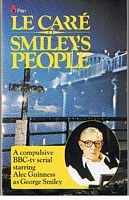
John le Carré's classic novels deftly navigate readers through the intricate shadow worlds of international espionage with unsurpassed skill and knowledge, and have earned him -- and his hero, British Secret Service Agent George Smiley -- unprecedented worldwide acclaim. In Smiley’s People, master storyteller John le Carré brings his acclaimed Karla trilogy to its unforgettable, spellbinding conclusion.George Smiley is asked to come out of retirement for one last confrontation with his soviet counterpart, Karla. Smiley's people crisscross Paris, London, Germany, and Switzerland in an extraordinary final showdown of unrelenting suspense.--LibraryThing A very junior agent answers Vladimir’s call, but it could have been the Chief of the Circus himself.…
"Everyone has read Tinker, Tailor, Soldier, Spy , which I would say is unquestionably one of the greatest ever espionage novels, perhaps simply one of the greatest novels of the 20th century. Tinker, Tailor is a whodunit , essentially. It’s not literally a country house murder mystery, with a lineup of characters including Colonel Mustard. But there are four of them and it’s about finding out which one is the mole (a word which, I think, le Carré invented)—the Soviet traitor in the ranks of British intelligence. It’s such a great plot and it mirrors life very closely. It’s essentially about the Cambridge spy ring and the real-life traitors who worked for Stalin after the war. Smiley’s People is the follow-up. George Smiley comes out of retirement and does a bit of detective work. It’s a redemption story: a chance for Smiley to tie up the loose ends of his life and career. He gets a shot at his nemesis, the head of Russian intelligence—code name Karla, who is this fiendishly cunning Soviet spymaster. It’s a duel between these two old foxes, if you like. Smiley has this very gentle detective manner about him. There’s almost no violence, there are no car chases. It’s not that kind of book at all. It’s a cerebral book about somebody getting to the heart of a tangled story. It’s brilliant. I think it’s better than Tinker, Tailor . I won’t give away the ending, but it has a very satisfying sense of closure to it. It’s wonderfully written. It’s mostly set in London. There are forays into Europe. There are things that le Carré does which always astonish me. When I read it again, it stopped me in my tracks. He’s a great exponent of what Hemingway called ‘the iceberg theory’ where you just see the tip and the rest of the iceberg is implied. With just a few lines, you get the sense of another whole world and a story expanding there. One of the things he does that is so clever is that we follow George Smiley and realize that everyone else has this enormous respect for him. He’s seen as this legendary figure, but it’s never quite fully explained why. Then there’s this tiny little flash in the book where it talks about Smiley being undercover in Nazi Germany during the war. As a matter of historical record, I don’t think any British intelligence officers ever really did that—I don’t think anyone could have pulled it off. But that is the making of the legend. In just one or two sentences you get this sense of an awful sacrifice that he’s made personally in early life. That’s set him up for the rest of his life so that people speak about him in hushed tones. It’s very, very subtly done."