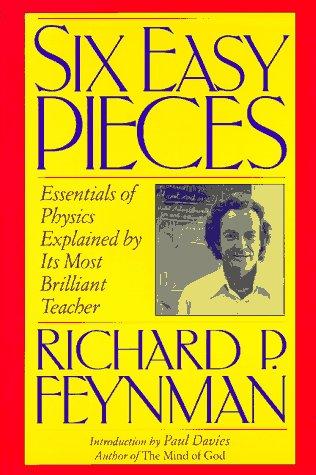
Six Easy Pieces
by Richard Feynman · 1995
Buy on Amazon"It was Feynman's outrageous and scintillating method of teaching that earned him legendary status among students and professors of physics. From 1961 to 1963, Feynman delivered a series of lectures at the California Institute of Technology that revolutionized the teaching of physics around the world. 'Six Not-So-Easy Pieces', taken from these famous 'Lectures on Physics' represent some the most stimulating material from the series. In these classic lessons, Feynman introduces the general reader to the following topics: atoms, basic physics, energy, gravitation, quantum mechanics, and the relationship of physics to other topics..."--P. [4] of cover.
Recommended by
"Feynman's ability to distill complex physics into understandable concepts aligns with Naval Ravikant's emphasis on foundational knowledge and clear thinking, making it an expected read for someone exploring first principles."
Naval's Recommended Reading (The Almanack) · navalmanack.com
"Exactly. I thought to myself, if I put this in as one of my selection, people might think, ‘Oh god, really? You had to put that in?’ But if I didn’t, then people would say ‘Why didn’t you put it in?’ There are two things I love about this book. The first is that Feynman could write about difficult physics and teach it in a way that no one else could. He is widely regarded as one of the best physics teachers of all time, let alone a person who was largely responsible for formulating quantum electrodynamics—which is what he got his Nobel Prize for. His turns of phrase convey a sense of how to understand something terribly complicated. I love that. It’s a wonderful way of thinking about a point of view. The other thing is that these were based on lectures in 1961. What I love about it is reading how far we’ve come since then. There are all sorts of bits when I wish I had been in the audience to shout, “You’re wondering what the substructure of protons and neutrons are, but seven years from now, people at Stanford are going to discover these things called ‘quarks’ and I can tell you exactly why you have that particular pattern there—”, and so on and so forth. It’s not that I feel superior or anything, but it’s wonderful to see the extraordinary progress that we’ve made on such a short timescale and how encouraging that is. His discussions of Newtonian gravitation and how we came to it, phenomena like tides, and how you can measure the speed of light by observing Jupiter’s moons, are described with such humour and clarity. He conveys the excitement of physics. In one of his probably less appropriate, yet very famous, quotes, he says “Physics is like sex. Sure, it may give some practical results, but that’s not why we do it.” He was an extraordinary person. You can see why his students and pretty much just about anyone he ever met just fell in love with him. So, it’s probably quite an obvious choice, but I just had to put it in because I love it and I’ve read it about 20 times. It gives a broad brushstroke of a lot of the basics and is a wonderful way of getting some of the foundational ideas in your head. Then, you can build on them and see how far we’ve come since then."
The Best Physics Books for Teenagers · fivebooks.com
""Six Easy Pieces," by Richard Feynman. I daydream of being as smart as Richard Feynman."
By the Book: Percival Everett · nytimes.com