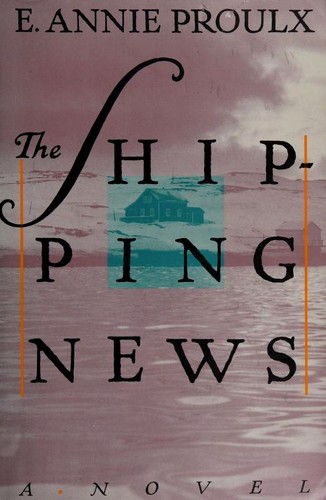
by E. Annie Proulx
At thirty-six, Quoyle, a third-rate newspaperman, is wrenched violently out of his workaday life when his two-timing wife meets her just deserts. He retreats with his two daughters to his ancestral home on the starkly beautiful Newfoundland coast, where a rich cast of local characters all play a part in Quoyle's struggle to reclaim his life. As three generations of his family cobble up new lives, Quoyle confronts his private demons--and the unpredictable forces of nature and society--and begins to see the possibility of love without pain or misery. A vigorous, darkly comic, and at times magical portrait of the contemporary American family, The Shipping News shows why E. Annie Proulx is recognized as one of the most gifted and original writers in America today.
"I begrudgingly read The Shipping News, which even to this day is the novel on my bookshelf with the most highlighted passages. Proulx's versatile use of language and sentence structure undid some blockage in my head. I attribute reading that book to freeing something inside my brain that allowed me to become a published writer."
"I think fundamentally there are three types of novel. There is your commercial page-turning pot boiler which presents you with a question in chapter one and you have to read through the novel to get the answer to the question. And there is this satisfying denouement or unsatisfying denouement at the end and two or three weeks later you have pretty much forgotten the book. It is not the sort of book that you read for the scintillating turn of phrase. It is mechanically written, it is very clever and crafted but it is ultimately sort of Chinese takeaway, and I am not saying that in any way, shape or form as a negative critical thing. It just is what it is. With those types of books, you know the titles, you know the writers. They do what they say on the tin. Then you get literary fiction, which is often criticised for style over substance, where the author has taken as much time over how they are going to say something as opposed to what they are going to say. The Shipping News is an extraordinary book. I mean, take the plot: stupid guy marries promiscuous girl, they have a couple of kids, she dies in a car crash and he moves house – that’s it. It is a vignette of somebody’s life. But, for 350 pages, she does the most extraordinary thing with language – things which break all the rules. W Somerset Maugham said there are only three rules for writing and no one ever agrees what they are. Well, she takes what rules anyone may have and breaks all of them. She takes human characteristics and ascribes them to inanimate objects and takes the characteristics of an inanimate object and ascribes them to humans in such as way as you recognise that human being. I was asked in Dubai how I would define a classic and I said, for me a classic is the kind of book which presents you with a narrative so compelling you can’t read it fast enough, yet it is written so beautifully you can’t read it slow enough. And it leaves you in that limbo of, you have to finish it but you don’t want it to finish. And I am not necessarily saying The Shipping News is one of those books because I don’t think it presents you with a narrative which is so compelling. But I think it is the third kind of book, which is how I would define a classic. The thing about The Shipping News is that she has created these four or five characters like Quoyle and Bunny and Sunshine, the kids, and the Aunt and the girl he falls in love with and the people he works at the newspaper with, and they are such rich involved characters that you so engage with them on almost every level. You see their fears, their anxieties and their tribulations. And I think it is just extraordinary the way she does it. If you have a range of human dramas with, on the far left something like In Cold Blood , on the far right you would have something like The Shipping News because it is a gentle lilting story."