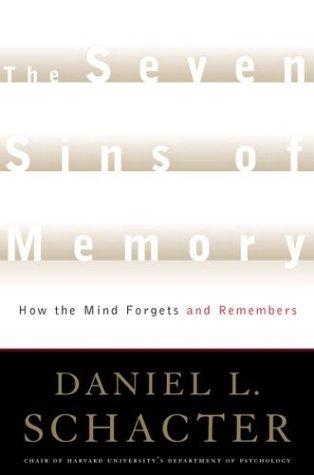
The Seven Sins of Memory
by Daniel Schacter
Buy on Amazon"Daniel L. Schacter, chairman of Harvard University's Psychology Department and a leading expert on memory, has developed the first framework that describes the basic memory miscues we all encounter. Just like the seven deadly sins, the seven memory sins appear routinely in everyday life. Schacter explains how transience reflects a weakening of memory over time, how absent-mindedness occurs when failures of attention sabotage memory, and how blocking happens when we can't retrieve a name we know well. Three other sins involve distorted memories: misattribution (assigning a memory to the wrong source), suggestibility (implanting false memories), and bias (rewriting the past based on present beliefs).…
Recommended by
"Daniel Schacter is a professor at Harvard University, studying how the mind remembers and forgets. The book is a beautiful story of the latest scientific evidence about how our memory works as we forget and remember. It is eminently readable and Schacter describes seven ‘weaknesses’ of our memory that make it very difficult for us to perfectly remember past events. In fact, Schacter argues that we don’t remember in the sense that we simply retrieve a document from digital storage. Instead, we continuously reconstruct our past. And as we do so we rewrite memories so that they conform to our present preferences. Support Five Books Five Books interviews are expensive to produce. If you're enjoying this interview, please support us by donating a small amount . At first, this might sound like a terrible weakness of the human mind but Schacter points out that it is actually a blessing; it makes it possible for humans to avoid cognitive dissonances between their past and their present. It helps us survive in an ever-changing world. But Schacter’s book offers many more insights beyond our brain’s avoidance of cognitive dissonances. There is a great example where he describes how many Americans, if specifically asked to give details about how they as a child were forgotten at the Mall, will ‘remember’ that event, even though very few of them were actually ever forgotten. At times, when primed by specific questioning, human memory may ‘reconstruct’ a past that never was."
Memory and the Digital Age · fivebooks.com