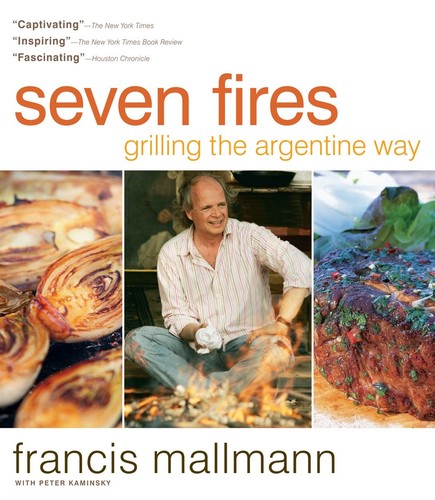
Seven Fires
by Francis Mallman with Peter Kaminsky
Buy on AmazonThe seven fires of the title refer to a series of grilling techniques that have been singularly adapted for the home cook. So you can cook Signature Mallmann dishes—like Whole Boneless Ribeye with Chimichuri; Salt-Crusted Striped Bass; Whole Roasted Andean Pumpkin with Mint and Goat Cheese Salad; and desserts such as Dulce de Leche Pancakes—indoors or out in any season. Evocative photographs showcase both the recipes and the exquisite beauty of Mallmann's home turf in Patagonia, Buenos Aires, and rural Uruguay. Seven Fires is a must for any griller ready to explore food's next frontier.
Recommended by
"He was born in Uruguay and made his fame and fortune in Argentina, where there’s a lot more money and a much more affluent eating class. Another chef and restaurateur once explained to me that Uruguay is a poor country with few natural resources, dwarfed by Argentina to the South and Brazil to the North. But the one thing every Uruguayan man knows how to do is roast meat over a wood fire. It is their cultural claim to greatness. After catering to the highest echelon of Latin American society in a series of Eurocentric restaurants, Mallman said: Wait a minute – why am I sautéing like a French clone when we have this incredible Latin American tradition of cooking over live fire? I picked him because he celebrates a style of cooking that epitomises the rustic and primitive, and yet at the same time he writes about live-fire cooking with great intelligence. And he’s the first guy to organise the various South America live-fire cooking methods into a logical, coherent system. Not to mention his food is amazing. They are seven methods of live-fire cooking. One is parilla – “the grill” – the sort of grilling you would find at a North American steakhouse, grilling on a metal grid-iron over hot embers. Then there’s asado , Argentinean campfire cooking. You take small animals, like whole sheep or halves or quarters of large animals, like steers, and impale them on stakes in front of a campfire. Asado is cooking by radiation, you get smoke flavour, you get fresh air, and very simple seasonings. The third method uses a champa – it’s a slab of cast iron you put on a wood fire, you get it super hot and then you sear foods on it. Think of it as Argentina’s answer to the plancha [the Spanish flat-top grill]. Then a fourth method would be roasting in a wood-fired oven. A fifth would be using a big pot in a wood fire, which gives you kind of a different flavour. The sixth method is cooking in embers or ashes – what I call the “caveman” method. The seventh is something Mallman invented. He builds a fire, puts a cast-iron slab over it, and maybe 18 inches above that, he puts another iron slab and builds a second fire on top. So the food is cooking both from above and below. He calls it infernillo – little hell, literally – and it’s based on the premise that one fire is good but two is better. In general, the way it’s practised, one would say it’s more a craft than an art or science. I think most grill masters would call themselves craftsmen rather than artists because what they’re doing is really very simple. However, there are sophisticated chefs, like Victor Arguinzoniz of the restaurant Etxebarri in Spain’s Basque country, who have raised grilling to the level of high art."
Barbecue and Grill · fivebooks.com