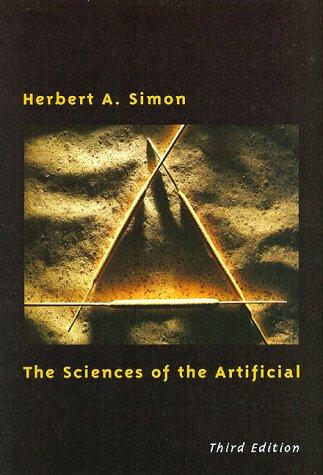
The Sciences of the Artificial
by Herbert A. Simon
Buy on AmazonOutlines a program to develop sciences for artifacts that are usually outside the ambit of natural sciences.
Recommended by
"Cosma Shalizi says somewhere that the first edition of the book has all the good parts. The edition that is readily available is the third edition and most of the final chapters consist of afterthoughts, harrumphs and other kinds of ‘I really should have said that then’s’ that aren’t particularly interesting. So the real insights—and they are real insights—are in the earlier to middle parts of the book. If you think about Lindblom as trying to look at processes of problem solving in a practical way, Simon is trying to figure out how these questions might fit together from a more abstract, intellectual perspective. His fundamental insight is very nice and it’s a crucial and profound one. He argues that human beings are limited in their ability to process information and that this is something that standard economics tends to systematically ignore. If you look at economics textbooks, they typically assume that we have complete information, understand everything about the environment that we are in, that we can map out ad infinitum what strategies other actors are going to play against us, and that we do not have any bandwidth limits on our ability to process information. Simon says this is nonsense. We know human beings simply can’t do that. We are flawed. Our individual capacity to understand the world is limited and so what we tend to do in ordinary life, he says, is go for good seeming solutions that are obvious to us rather than for optimal ones. This means that a lot of the actual processes of cognition, or computation that we do, have to be offloaded onto other social systems rather than our individual brains. If we want to think about markets, in Simon’s sense, we should think about how they work and don’t work as massive systems of distributed computation. Returning briefly to Lindblom, this again suggests that markets do wonderful and extraordinary things. But if you think about markets in this more sophisticated way, then a lot of the very neat results that economists have—that Ken Arrow and other people came up with about how it is that market equilibria are going to be efficient in a variety of ways and that they’re going to be the best possible allocation—don’t really hold. We have no ex ante reason to consider markets inherently superior to hierarchical organizations, to democracy and so on. “Machine learning can do extremely well as a complement” Simon suggests that we need to start thinking about what he calls the ‘science of design.’ He says that we need to start looking at forms of organization—whether this be the market, or specific kinds of hierarchical designs—and think about how to build them so that they are best suited for the functions they’re supposed to serve in an inherently complex social environment. This gives birth to his various ideas about how to think about organizations, about democracy, and artificial intelligence, which is another way of trying to solve problems. When he writes about artificial intelligence—and he is one of the first people who really thinks about AI systematically—he is obviously writing about very different approaches than the kinds of machine learning that are applied today. But his very broad design principles, and approach to understanding how they might or might not work for certain kinds of problem-solving, are very, very useful. They help to identify how these forms of mechanical cognition might also work together with more traditional forms of organization to help us solve problems. We know AI has a variety of specific flaws, and things that it does very well. There are still things that it does pretty badly compared to human beings and human brains, which also have a set of things that they tend to be very good at and a set of things that they tend to be remarkably bad at. So machine learning can do extremely well as a complement. Herbert Simon’s perspective starts from the idea that the world is complex, in the mathematical sense of the term. It is a world composed of various subsystems which work together in ways that we’re never going to be able to fully understand or predict. The very best we can do is to arrive at reasonable approximations of them. Simon wants us to think about different ways of trying to approach this world. We can think about approaches as what he calls ‘artefacts.’ An artefact, for him, is something that interacts with the outside world, but also has some kind of an internal logic for doing this. For example, a business organization might be an artefact. When you start looking at the world in this way, you can begin to see how it is that certain kinds of artefacts might have particular informational strengths or weaknesses. He talks about how you might want to design an organization in a particular way, so as to avoid certain kinds of bottlenecks in information sharing. We tend, for example, to imagine in the abstract that business organizations are strongly hierarchical, that there is a CEO who more or less orders that it will be so and that everybody along all the lines of command says, ‘yes it will be so.’ In practice, of course, all of us who work in real organizations know they are much more like the British sitcom The Office . People are feuding with each other to relieve their boredom and wasting time, and the boss doesn’t have much idea what is happening. Real organizations are messy, and they produce bottlenecks. Thinking about how to remake them so as to minimize bottlenecks is as much art as engineering, and some apparent inefficiencies can be crucial to the working of the organization. “In practice, of course, all of us who work in real organizations know they are much more like the British sitcom The Office . ” I had thought about other books. I thought about maybe bringing in some of Norbert Weiner’s work on cybernetics. He talks about feedback loops as the foundational concept for understanding information. That’s one ancestor of the Silicon Valley way of doing things—Simon’s work is another ancestor. If you look at how Simon thinks about the world, when he is really trying to design these systems, he’s doing what Silicon Valley wants to do, which is redefining complex relationships as information problems that you can reduce to make them tractable, and figure out what actually works and what doesn’t. But what he also is very careful about—which I think people are less careful about today in Silicon Valley, and in places influenced by Silicon Valley—is to repeatedly emphasize that none of these problems are straightforward optimization problems. We’re never going to be able to get to a full optimum. We have to try and figure out ways to make sure that we do not get trapped in inefficient local optima when there are other, better ways of working forward. Simon, as I read him, is saying something like the following: ‘Yes, we can reduce this down. We can make this more mathematical; we can make this more abstract. But we are still living in an extremely messy world in which engineering solutions are going to be helpful much of the time, but they are also very often going to blind us to the actual complexity of the world that we live in, unless we are skeptical and careful.’ Well, that depends. More and more so as time goes on, I think political science tends to view economics with a certain degree of envy. Economists have a high professional status that political scientists, by and large, do not. In the United States, for example, there is a Council of Economic Advisers, but despite occasional proposals by political scientists, there is no likelihood that a Council of Political Science Advisers will be appointed. If you look at organizations such as the World Bank and the IMF, they are mostly staffed by economists. Political science sometimes views itself as a younger sibling of economics, wanting to do everything that economists can do, but with all of the jealousies that tend to go along with that status. It’s sometimes a dysfunctional relationship. Economists tend to be more mathematically and econometrically sophisticated than political scientists, but what political scientists tend to be better at than economists (albeit not all economists; there are some who are very good at this) is understanding that some problems are irreducibly political. This is not a world in which we are always going to be able to get to first-best solutions or even second-best solutions. This is a world in which people are often going to disagree, radically, on what the first-best solutions and what the second-best solutions ought to be. Whether we like it or not, we all find ourselves stuck with other people who not only have different material goals, but also very different value systems. Here we might think about how these different value systems, these different perspectives, can offer valuable information about how to solve broader problems. And so political science, in an ideal sense, could start thinking about systems that can harness these quite fundamental and irreducible disagreements among human beings and apply them to social and political problems that might otherwise be pretty intractable. Not in a way that points towards some kind of optimum, not in a way that will ever point toward some kind of a utopia, but instead in a way that messily—but nonetheless usefully—conducts political behavior in ways that are both conducive towards social peace and political peace. This would be more like engineering design than most political scientists are comfortable with, albeit less like it than the work of economists. We would end up somewhere in Simon’s science of design, with varying degrees of quantitative sophistication across different political scientists (I myself am not at all sophisticated). I’m not trying to redesign democracy. I’m trying to figure out a somewhat related question: how do we think about democracy from an experimental perspective? This is where the Posner and Weyl book, Radical Markets , is pretty interesting. There are lots of things in that book which are, as they say, radical. Some of them are likely to seem morally obnoxious to many. Some I imagine would never work in a thousand years, but what I like in that book is its sense of experimentalism—a sense of ‘okay, let’s take crazy ideas and push them as far as they can go.’ What I would like to see among political scientists thinking about democracy—not from the radical markets perspective, but from a radical democratic perspective—is more systematic attention to experimentation with different forms of democracy. How can we take advantage of some of these new forms of information processing, which allow for new possibilities, while also figuring out how to shore up democracy against floods of information, much of it bad or dubious, which might overwhelm democratic systems? Exactly. I’m originally from Ireland, and there are really interesting experiments taking place there with constitutional conventions. One of the reasons we’ve had the abortion referendum, marriage equality, all of these things, is because a constitutional convention was organized where a couple of hundred people were chosen at random to debate what kinds of changes to the constitution ought be proposed. They listened to experts and then decided, ‘here are the changes that we need to make.’ This had two advantages. First of all, it provided ordinary people with the ability to actually talk to experts, to get a variety of different perspectives, and to think in a more dialogical way about what they want and what they don’t want. Second, it meant that the ideas that came out of these processes had a certain amount of democratic legitimacy. They didn’t come from politicians, but from ordinary citizens, who had had the chance to think about them and debate them. “Whether we like it or not, we all find ourselves stuck with other people who not only have different material goals, but also very different value systems” When you have controversial proposals for changes such as abortion and marriage equality in a country which was strongly Catholic until a couple of decades ago—it is easier for politicians to embrace change if they know that ordinary people have debated it and have thought about it at great length and that these are the decisions they have arrived at. Politicians might otherwise be extremely nervous about touching hot button issues. This gives them the courage to put them forward, saying ‘these proposals were made by ordinary people who have thought this through, not us.’ That’s my feeling as well. It used to be, back when I was growing up, that we looked to the United Kingdom as a beacon of modernity. Now it’s the other way around. It’s very strange."
The Best Books on the Politics of Information · fivebooks.com