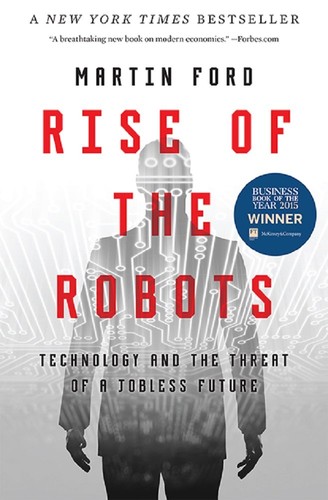
Rise of the Robots
by Martin Ford
Buy on AmazonExamines the effects of accelerating technology on the economic system. "In Silicon Valley the phrase "disruptive technology" is tossed around on a casual basis. No one doubts that technology has the power to devastate entire industries and upend various sectors of the job market. But Rise of the Robots asks a bigger question: Can accelerating technology disrupt our entire economic system to the point where a fundamental restructuring is required? Companies like Facebook and YouTube may only need a handful of employees to achieve enormous valuations, but what will be the fate of those of us not lucky or smart enough to have gotten into the great shift from human labor to computation?"--
Recommended by
"Yes, the next two books are about what I call the ‘economic singularity.’ Martin Ford is a software company owner in Silicon Valley. He noticed the dramatic improvements in what the computers he was working with could do and started thinking, ‘Won’t there come a time when they take over our jobs?’ His conclusion was, yes. They probably will. But maybe we can keep racing with the machines rather than having to race against them. The reason I’ve put his book down is that it’s one of the most convincing about the possibility of technological unemployment. His own conclusion is that a lot of people won’t be able to earn enough money to live on, but most of us will be able to continue working. There will be things that we can combine better with a computer to do than a computer can do on its own. When you get to a point in economic development where most people can’t work—or at least they can’t work enough to make a living—you can’t just allow the whole population to starve. You have to have resources provided which aren’t worked for. In other words, you’ve got to have a sophisticated dole. This is called the ‘universal basic income’ (UBI) or, alternatively, a guaranteed annual income, money that the state or a public organization hands out just because you’re a citizen. Martin does get a bit discouraged here, because he runs up against the problem of whether America could tolerate the idea of universal basic income. There are lots of fans of the idea, but mainstream opinion thinks it’s an appalling one. It smells of socialism, and they don’t like socialism in the United States. So the debate about UBI in the States is very heated. “An AI doesn’t have to hate humans in the way Hollywood often shows them disliking us.” In Europe, I think that if and when the time comes when large numbers of people are unemployed through no fault of their own we’ll just say, as long as we can afford to, ‘We have to give these people money, because it wouldn’t be civilized to allow lots of people to starve or be reduced to terrible poverty.’ I don’t think we’ll find that concept as hard. Martin is very struck by the difficulty of persuading his fellow countrymen. Yes, I think he does. He thinks many people will have to be given a financial top-up. They won’t be able to get enough work to feed themselves. Yes. The idea is that you’ll have an economy of radical abundance and lots of people in Silicon Valley get very excited about this. The upside is great: Robots do all the work and we have lives of leisure. We spend our time playing sports, being social, improving ourselves, creating art or whatever we want to do. Maybe simply watching television. Everybody’s rich because robots produce so much and so efficiently that nobody has to worry. I don’t think it’s as simple as that. Most importantly, I think the transition from here to there is going to be quite bumpy and if it’s too bumpy, civilizations could break down. We really have to avoid that. No, he doesn’t really. I think this is a fairly typical American approach. They see the difficulty of introducing UBI as so massive, that they don’t see very far beyond that. To me, there are all sorts of problems beyond UBI. If you have a society where AIs are producing so much wealth that lots of humans don’t need to work, you still have massive problems. Where do people find meaning in their lives? How do we allocate the best resources — the beachfront properties, the Aston Martins and so on? Most important of all, how do we handle the new type of inequality? We’ve got lots of inequality now. I’m one of those people who think it’s not the biggest problem we have. But in a world where the majority of people don’t work, and aren’t involved in the economic life of the country at all, and there’s a minority of people who own all the AIs and because they own the AIs they own pretty much everything else — they might quickly become a different species. Not only will they own the economic means of producing, but they’ll also have privileged access to all the new technologies that are coming along for human improvement: Cognitive improvement, physical improvement. They’ll become a different species quickly in the sense that they’ll just be much smarter, quicker, and faster than anybody else. I think a society where you get a fracturing like that is very dangerous. One of my favourite writers at the moment is Yuval Harari. He’s got a book coming out shortly where he talks about humanity splitting into two species or groups. He calls them the Gods and the Useless, which is brutal. I wouldn’t be that brutal. But it’s a potential scenario for the future that we have to work out how to avoid."
Artificial Intelligence · fivebooks.com