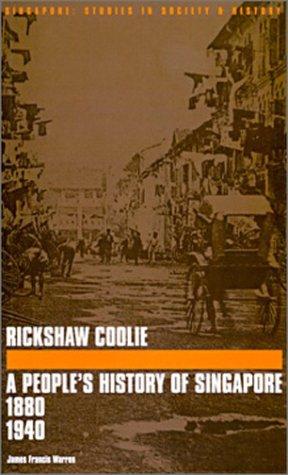
Between 1880 and 1930 colonial Singapore attracted tens of thousands of Chinese immigrant laborers, brought to serve its rapidly growing economy. This book chronicles the vast movement of coolies between China and the Nanyang, and their efforts to survive in colonial Singapore. Focusing in on one particular occupation, of rickshaw coolie, this study unveils the devastating poverty of the Chinese sojourner in the colonial city, the disjunctions between colonial order and the reality of life on the streets. Drawing on a broad range of sources, including Coroner's records overlooked for many years, and making use of the technique of collective biography, this book brings to life the texture of experience, the ironies and - often - the despair of the laborers of urban Singapore.…
"It’s by Lao She, a famous writer who committed suicide in 1966 because he had been persecuted by the Red Guards. He was a Manchu, who lived in Peking almost all his life but who taught Chinese at SOAS in England in the late 1920s. This novel, published in 1905, is about Hsiang-Tzu, a man who pulls a rickshaw in Peking, at the bottom of society, almost an outcast, and who becomes a victim of his own toiling. It’s a very simple story about all the problems of this very simple man who has nothing, and does the most hard work possible, has a lot of bad fortune, and finally dies on a snowy night all by himself. What is nice in the novel is the description of Peking – of ordinary life and street life there, when it was just a village, a huge village, which it remained until the 1970s. Hsiang-Tzu says that his only true friend is Peking itself, and he has a very particular relationship with it. It’s a picture of the simple things in the city, and the way people live together and talk together, and sometimes help each other or try to find a way, and it’s very telling and touching. It’s full of humour too. It’s constantly humorous and I think it suggests a lot about the way that ordinary Chinese can react to life, especially in modern times when conditions are much more difficult than in the old days. Hsiang-Tzu keeps a distance, and in a way understands that he will never be able to struggle against society, but still he does because it gives a meaning to his life. But he’s not blind, and he accepts his misfortunes and finds his own way of being happy, too, and of having contentment from time to time, even if life is hard to him and he dies alone. It’s about the way people come to grips with misfortune, and manage to give humanity to their lives, which I think is very telling and touching."