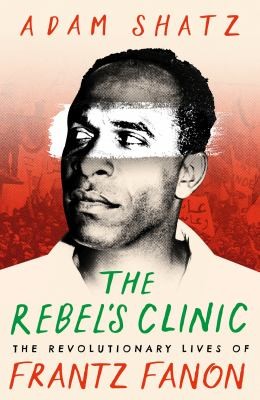
The Rebel's Clinic: The Revolutionary Lives of Frantz Fanon
by Adam Shatz
Buy on AmazonFanon is a fascinating character who has come more and more into focus as post-colonial politics and the politics of race have become vital to the way we see our world and how it is constructed. He is also a quite important figure in the history of psychiatry. He was born in Martinique as a French citizen. French colonies are not called precisely colonies, they become departments of the metropole. By fighting for France in the war and by going to study psychiatry in France, Fanon, first of all, seems a figure who would be very much in line with the French theory of assimilation, in which you are a French citizen before any other identity. This is a very problematic concept, as we see among France’s Arab population at the moment. Fanon, in so many ways, anticipates this, anticipates the analysis of this contradiction in Black Face, White Mask and in The Wretched of the Earth . But his increasingly uncompromising and radical take on race and colonialism has inspired and, in some ways, been misinterpreted. There’s a very brilliant conclusion to Shatz’s book, where he looks at the misinterpretation and uses made of Fanon, and, again, we are back to the question of historical imagination. Shatz speculates about, if Fanon hadn’t died at the age of 36, where his thought would have taken him, and whether he would have moved into more radical and confrontational forms of analysis of post-colonial and race politics, as many people who were influenced by him have done, or whether he would have moved towards a more reconciliatory and less confrontational analysis. Shatz is also very interesting on his private life. He was able to interview many people and shows that Fanon was, in some ways, an intensely flawed person. Shatz doesn’t shrink away from this at all. I think, psychologically as well as politically, it’s an important and enlightening statement that is being made here. It’s interesting to be comparing, essentially, a failed monarch in the 18th century, like Augustus, to a dramatically successful, rather ruthless monarch several centuries before, like Henry V, and then an obscure Black writer and psychiatrist who altered the way people think in the mid-20th and certainly 21st century. These are all biographies taking a historical approach, but they help us redefine and rethink what makes a person historically significant.