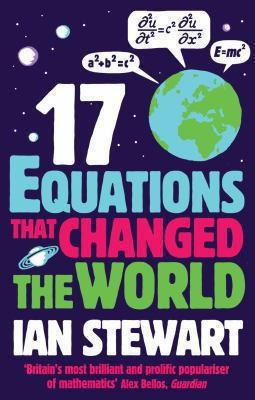
In Pursuit of the Unknown: 17 Equations That Changed the World
by Ian Stewart
Buy on AmazonIn In Pursuit of the Unknown, celebrated mathematician Ian Stewart uses a handful of mathematical equations to explore the vitally important connections between math and human progress. We often overlook the historical link between mathematics and technological advances, says Stewart--but this connection is integral to any complete understanding of human history. Equations are modeled on the patterns we find in the world around us, says Stewart, and it is through equations that we are able to make sense of, and in turn influence, our world.…
Recommended by
"Far from being a mere math primer or trivia aid, In Pursuit of the Unknown is an essential piece of modern literacy, wrapped in an articulate argument for why this kind of knowledge should be precisely that."
Best Science Books of 2012 · themarginalian.org
"Like some of the others, this is also not a typical engineering book. It is written by a professor of mathematics from the United Kingdom, and it describes a number of mathematical breakthroughs, their consequences related to engineering, and the practical application of mathematics in machines and other everyday uses. It shows important equations without going too deep into their theoretical justification. Some classical examples are Pythagoras’ theorem, logarithmic equations, differential calculus, Newton’s theory of gravity, Einstein’s relativity and so on. The book shows how these were 17 of the most important equations in history, and how mathematics has contributed to human progress. It’s a great introduction to the underlying principles of engineering. For example, you have something called a wave equation. This particular equation can predict how music is produced by a string instrument. But it can also be used to predict the effect of an earthquake on buildings or other structures. It follows that it allows us to make buildings and bridges that are more resistant to those earthquakes. Interestingly, the same equation is used by oil companies to find oil a few kilometres underground. So, it shows how one relatively simple mathematical equation can have a variety of practical usages. Support Five Books Five Books interviews are expensive to produce. If you're enjoying this interview, please support us by donating a small amount . Another example from this book is the Black-Scholes equation, which is used by banks all over the world to price financial derivatives—so, for financial engineering. Interestingly, that particular chapter explains how mathematics can be misused, leading to global economic and social consequences. You don’t need advanced mathematics to enjoy this book. Professor Stewart does a good job in explaining the applied side of those equations without recourse to deep mathematics."
Engineering · fivebooks.com
"This is not the first book about equations to be published but what I liked about it is that there’s lots of applied maths in it. And, of course, being by Ian Stewart, it’s very well written. He is a brilliant writer and one of the most famous people in the world for popularising mathematics. For every equation, he starts off with a page that shows the equation and explains what all the terms are in a diagram. He then talks about the equation, where it came from, applications of it, and gives explanations of it in a very readable way with minimal use of equations (other than the equation itself). One thing I should say that is a bit of an unusual comment is that I love the index of this book. It has a 12-page index which is the best index of all the books I’ve selected — and yet this is the most popular book, the sort that usually doesn’t even have an index. I’ve got a bit of a thing for indexes because they really are a great way into topics. I was flicking through this book’s index and I saw an entry that said ‘digital photography, 157-160.’ That’s a particular interest of mine. Now, you’d never know from the chapter title, ‘Ripples and blips. Fourier Transform,’ that this chapter includes digital photography. But it does – it’s about how images are stored on the computer. The so-called JPEG format. It’s a complicated process but it involves breaking the image into little squares and then doing some maths on each square in such a way that you can throw information away without the human eye seeing that you’ve thrown information away. It exploits the fact that the human eye is more sensitive to changes in brightness than changes in colour. You can fiddle about with the colour in a photo more than you can fiddle with the brightness. JPEG exploits that. As Stewart points out, though, although JPEG is used for virtually everything—all the images on your computer will be stored as JPEGs—there’s one example, fingerprints, where JPEG is not very good. Fingerprints have got lots of edges and JPEG is very bad at handling edges. So for fingerprints, there’s a different method called wavelet compression that he explains and, again, it is relevant to the Fourier equation. Back in the 1990s, the FBI realised that this wavelet idea was the right one for storing fingerprints. Yes. Fourier was a French mathematician. In 1807 he submitted his now famous paper to the French Academy of Sciences, based on a new partial differential equation. As usual, it wasn’t appreciated at the time. They declined to publish the work. Now, it’s absolutely crucial to many areas of science. Digital photography, as we said, but also mobile phones – there will be Fourier transforms in them. It has all kinds of applications. Sound can be understood by using Fourier analysis. It really is a very important topic. You don’t necessarily need the equation to be benefitting from what the equation is telling you. But I think for things like relativity, Einstein couldn’t have done it without writing down his equations, analysing them, and making predictions from them. So I guess it’s true, to a large extent. Stewart has also got the wave equation in there and the Navier–Stokes equation, which governs fluid flow. These are important because, say, if you’re designing an airplane you want the wings to minimise drag. Or if you’re designing a boat for the America’s Cup – you want a boat that goes through the water in the best way. Waves are incredibly important. Yes. Of all the books I’ve presented here, this is the one that would be the most readable for someone who has not got a strong mathematics background. It’s also worth noting that in a recent interview Stewart said this is his favourite out of all the books he’s written. This equation is relatively simple. There was a famous paper by the ecologist Robert May in the 1970s that showed that this equation had the property that it could have very unpredictable solutions – this idea of chaos. One aspect of chaos is that you just make a small change in where you start and what happens further on can change dramatically. The weather, for instance, is chaotic. There’s the idea of a butterfly flapping its wings in another part of the world and changing the weather here in the UK. Yes. Some systems are very, very sensitive to changes in the underlying data. The point is that this is a simple equation where this has been shown to be the case. Normally it’s quite complicated equations that are required to produce chaos. So, this is chaotic but it also has applications. In modelling and understanding population growth, this is the sort of equation that has been used. As Stewart says, it models how a population of living creatures changes from one generation to the next. Well, the fact that the equation can be chaotic means that the population might display all sorts of strange oscillations so that you might think, ‘What’s going on here?’ — in the population of fish or insects of whatever it might be. That might be what happens because of the underlying mathematics. When I was working on the book, I dug out some of the papers that discuss this theme. It was Eugene Wigner who wrote the original paper with that title, “The Unreasonable Effectiveness of Mathematics in the Natural Sciences. “ I hope that we give a bit of a feel for that in our book, but I wouldn’t want to make any great claims that, even in 1000 pages, we could fully answer that question."
Applied Mathematics · fivebooks.com