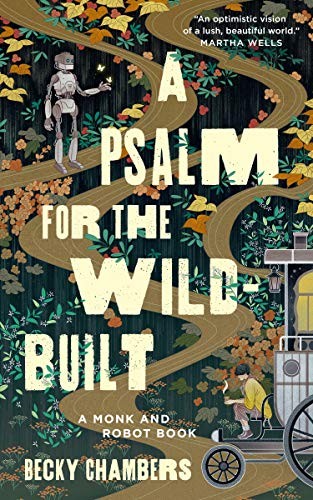
A Psalm for the Wild-Built
by Becky Chambers
Buy on AmazonIt's been centuries since the robots of Panga gained self-awareness and laid down their tools; centuries since they wandered, en masse, into the wilderness, never to be seen again; centuries since they faded into myth and urban legend. One day, the life of a tea monk is upended by the arrival of a robot, there to honor the old promise of checking in. The robot cannot go back until the question of "what do people need?" is answered. But the answer to that question depends on who you ask, and how. They're going to need to ask it a lot. Becky Chambers's new series asks: in a world where people have what they want, does having more matter?
Recommended by
"Oh my god, this book! So I talked a little bit about how in my book Under the Whispering Door , which is my version of the way-station to the afterlife, I have a tea shop. The owner of the tea shop, a man named Hugo, is also a ferryman, whose job it is to help people cross over to the next life, or at least help them prepare for what their next step is. And a big part of that was tea. Hugo makes tea for the ghosts who come through, and he gets a specific type of tea for each one. The reason I did that was because tea is one of the oldest drinks in the world. It is the second most consumed drink in the world, following water, and there are so many traditions when it comes to tea. Every civilization, every culture in the world, has some kind of ceremony when it comes to tea. “It’s not about the chosen one and the end of the world; it’s about the world that we live in” So in this book: imagine then the end of the world, and instead of a tea shop, you have a tea monk who basically goes around selling tea, hawking his wares. When he’s in the middle of his travels, he meets a robot. The book asks a fundamental question that I am absolutely in love with: What do people need? That is such an amazing question, because there’s not one right answer, everybody is so different – and yet, is there a right answer that could be universal? What is it that humanity needs? What does humanity need at the end of the world? What does it need when we’re all scattered and separated and apart? What does it mean when we have little pockets of survival around this broken world? They have beautiful, philosophical conversations about what it means to be human, and what a human being needs to survive. This is a very short book, a novella. It has some sequels too. I have a hard time writing shorter works, because I love every single word ever written, so my books are usually very big. The fact that Becky Chambers was able to fit all of this into around 150 pages is mind-boggling. I’ll never be that good an author, ever. I love the book. A Psalm for the Wild-Built is just an extraordinary piece of fiction. Yes! It’s not necessarily about who people are. It’s not necessarily about what their hopes are for the future. It’s about, what do they need now? What do you need right now to be happy – to be content? And to have it come from a machine is even more remarkable – especially in the futuristic year of 2024, living through the advent of artificial intelligence , the idea of a robot being the one to ask what people need is wonderful. It makes me hope that we don’t have to live in a future that’s like The Terminator ! The House in the Cerulean Sea is about a caseworker for the Department In Charge of Magical Youth. He’s essentially a social worker. His name is Linus Baker, and he is the perfect bureaucrat: he does what he’s told, and he does it well. And because he is so paint on the wall dry, he is tasked by a shadowy government group to go to a very specific island. On this very specific island are six children who are some of the most dangerous magical children in the world. His job is to check: are they planning to destroy the world? He has all these preconceived notions and ideas about what these children are. And when he gets there, he finds that – surprise, surprise – they’re just children. Yes, one of them is the Antichrist. Yes, one of them is a boy-blob named Chauncey. Yes, one is a wyvern. Yes, there is a were-Pomeranian. Yes, there is a wonderful girl named Phee who is a sprite. Yes, there’s a garden gnome named Talia who threatens death on a regular basis… But when Linus gets there, he finds something he did not expect. He finds a home, and not only that, he finds hope and joy and love with this family – and with Arthur Parnassus, the headmaster. Over the course of the novel, he begins to realize that things are not what they seem, and that – like Arthur says in the book – it takes a few people coming together to change everything. That was the genesis of the book. I’d wanted to write something about magical children and the idea of being othered, because so many people in the queer community have grown up being othered. They have grown up not being able to relate to their peers, and being told that they’re different. I know what that feels like. I was a queer kid growing up in the rural countryside in the 1980s and 1990s; you can imagine how a slightly effeminate queer kid with undiagnosed ADHD would do in a place like that. Not well. When I wrote The House in the Cerulean Sea , I wanted to expand on a couple of ideas. There was the idea of nature versus nurture. If a child – say, a child like Lucy the Antichrist – is told that he’s going to be the most destructive thing the world has ever known, he’s going to bring about the end of days. But what happens if someone like that is given a chance to just be a kid? What happens if people who’ve been told they’re monsters all their lives get a chance to just be? I wanted the book to explore the power of trauma, but also the power of healing, and what that looks like. When I write these books, I have to know what I’m talking about. So for the first book and the sequel, I spent so much time talking to teachers, social workers, people who have been fostered or adopted, and people who fostered and adopted. I have to know what it feels like to be in those situations. The sequel is called Somewhere Beyond the Sea . To be honest, I was not planning on writing a sequel. I wanted The House in the Cerulean Sea to be standalone – and that’s still going to be the case for Under the Whispering Door and In the Lives of Puppets ; I’m never going to go back and write sequels to those. The reason I chose to write a sequel to The House in the Cerulean Sea is because of something that’s happening in the United States and in the UK. I won’t speak to the UK side of things because I am not from there, but in the United States, there’s a very big anti-trans movement that is going on. In 2021 and 2022, our government invited people to testify: trans people, and parents and guardians of trans youth, and medical professionals who provide gender affirming care. The purpose was supposed to be hearing people speaking their truths. And they were met by two types of politicians. One, the politicians who said, ‘We see you, we hear you’ – and then turned around and voted against any pro-trans protections. Or two, the worst ones, the ones who sat there with smarmy condescending smiles and questioned literal children about their brains, about their bodies, about their right to exist. And that absolutely floored me, that this was allowed to happen. These are people who are supposed to represent you. I remembered at the end of The House in the Cerulean Sea where Arthur was invited to come and testify in front of the government, and I decided to use that as the jumping off point. What if, instead of being invited to testify, it was an ambush? What if something like that happened in the book? I actually got to speak with some of the people who testified in front of the government. I asked them all one question: if you knew what was coming, would you do this all over again? Every single one of them unequivocally said yes. That’s why I wrote this book: for people in my community who have used their voice only to be met with vitriol from people who should know better – people in power. What happens when those people in power decide to say no to you; what they want to end everything you hold dear? What do we do then? That’s where the sequel comes in. It’s important to me. I am not a social worker, I don’t know anything about social work – so if I’m going to be writing about a man whose job is tantamount to social work, then I need to talk to people who actually do the job. And then I find out, of course, that like so many other people – like teachers and librarians – they are woefully underpaid, woefully overworked. I was able to speak to some social workers that I spoke to back in 2018 for the first book, and I asked them: Has it gotten any better? No. There’s a couple of people that I spoke to back in 2018 who are no longer social workers, because it was too hard for them to deal with. And I get that. To be a social worker, you have to be one of the kindest, most empathetic people in the world, while still being able to be tough when needed. That is a tremendous job to have to do. I love that. How many times do we get to see a fat, fussy, queer man in his forties as the main character, as hero of the book? I wanted to show that every shape and size you could come in, you can be a good person, you can be a hero."
The Best Cozy Fantasy Books · fivebooks.com