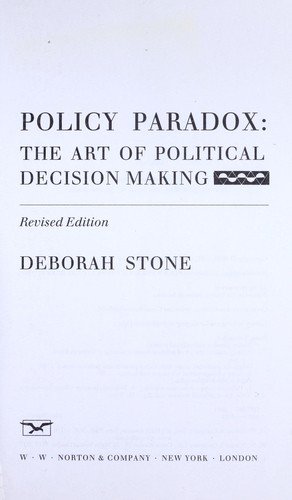
Policy Paradox: The Art of Political Decision Making
by Deborah Stone
Buy on AmazonThe most accessible policy text available.
Recommended by
"Policy Paradox is a book that I assign to all my public policy students. Deborah Stone delves into this topic with great theoretical depth. Often, when we talk about policy, we talk about particular policy issues. In-depth thought about how policies develop and what kind of analytical framework we approach them with is less common. One of the ways we typically approach analysing policies is through an economic framework. We think about the policymaking process like a market moved by rational actors. Stone juxtaposes another framework, which considers community, commitments, emotions and values. She calls it the ‘polis’ model. “What role should values and principles—like equity, liberty, efficiency and security—play as we’re shaping policies?” As she outlines this alternative framework, Deborah Stone looks at important questions. What role should numbers and statistics play in politics? What role should values and principles—like equity, liberty, efficiency and security—play as we’re shaping policies? Ideas about these questions float around in our political discourse and shape what politicians say and how the American people respond. So Policy Paradox pushes us to think about ourselves not just as rational actors but rather as a political community. It pushes us to assess and acknowledge the role that values play in our politics. This is a book that the more you dig into, the more you get out of it. It is also utterly readable, which is not always the case with academic writing. It’s a great text. Stone opens the book with a series of policy questions. And points out that, with many policy questions, there are no clear answers. We, as a people and as a polity, have been debating issues like the desirable degree of government assistance for generations. Stone asks: How do we resolve these paradoxes? And her conclusion is: There is no straightforward formula. Instead of a formula, she provides us with a framework for addressing policy paradoxes—imagining ourselves as a political community and acting accordingly."
The Politics of Policymaking · fivebooks.com