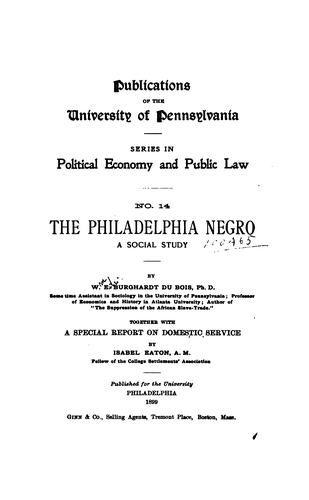
In 1897 a young sociologist who was already marked as a scholar of the highest promise submitted to the American Association of Political and Social Sciences a "plan for the study of the Negro problem". The product of that plan was the first great empirical book on the Negro in American society. William Edward Burghardt DuBois (1868-1963), Ph.D. from Harvard (class of 1890), was given a temporary post as Assistant in Sociology at the University of Pennsylvania in order to conduct in-depth studies on the Negro community in Philadelphia. The provost of the university was interested and sympathetic, but DuBois knew early on that white interest and sympathy were far from enough. He knew that scholarship was itself a great weapon in the Negro's struggle for a decent life.…
"It’s a landmark book in the history of social science and the history of cities. It’s a look at the African-American community in Philadelphia 110 years ago. DuBois spent 15 months personally canvassing Philadelphia and analysing census data. It’s an amazingly good piece of quantitative social science research. It set an example that was much followed by people doing research on cities. That’s one reason to admire it: its place in intellectual history. Because DuBois’s later work The Souls of Black Folks is such a transformative and transcendent piece of literature, that is seen as being his legacy. But for those of us who crunch numbers on a daily basis, as social scientists, The Philadelphia Negro is as great a legacy. There have been many great books written about urban African-American communities. There have been great books on Chicago. There have been great books on Harlem. But DuBois was first and in many senses his work was as good, if not better than, anything that followed. He provided a deeply insightful view into the community. He was very focused on the problem of nonfunctional single-parent families, which seems particularly prescient. Cities, of course, do tend to attract poor people. I think that’s a sign of success, not failure. Poor people are attracted by the economic opportunities offered by cities. In the case of the African-American community in Philadelphia, they were also attracted by the promise of a freer society. I think that is another asset of cities. You can’t understand cities without understanding the diverse motives that draw people to them. DuBois helps you do that."