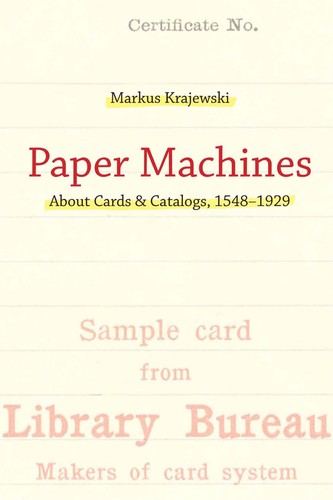
Paper Machines
by Markus Krajewski
Buy on Amazon"Today on almost every desk in every office sits a computer. Eighty years ago, desktops were equipped with a nonelectronic data processing machine: a card file. In Paper Machines, Markus Krajewski traces the evolution of this proto-computer of rearrangeable parts (file cards) that became ubiquitous in offices between the world wars. The story begins with Konrad Gessner, a sixteenth-century Swiss polymath who described a new method of processing data: to cut up a sheet of handwritten notes into slips of paper, with one fact or topic per slip, and arrange as desired. In the late eighteenth century, the card catalog became the librarian's answer to the threat of information overload.…
Recommended by
"Paper Machines is a really fun book that’s just been translated into English. It explores the development of the movable slip as a tool of information management. In the 16th century a Swiss bibliographer named Conrad Gesner first recommended slips as a method for indexing books. He recommended collecting the material to index on separate slips, some actually cut out of books and others handwritten. The slips would be interfiled in alphabetical order, using a temporary glue (for which he provided a recipe) so they could be kept in place and moved around. When all the slips were properly alphabetised, they could be glued in place permanently on sheets and the index was done. Gesner’s is the first documented description of how to use slips. Slips were valuable because they are mobile, but the mobility also posed the danger that wind or a mischievous cat would cause slips to become out of order and you’d end up with chaos. In the 17th century a special piece of furniture was devised called a “literary closet” that featured hooks associated with subject headings on to which you could stick your slips. The hooks would keep the slips from blowing away but you could still move a slip from one hook to another to reorder the material. Problem solved, except that this literary closet was an expensive piece of office furniture and did not have a lot of impact. It took until the late 18th century for library catalogues to use mobile slips as a permanent way of storing material. The movable card catalogue had a long career after that. My book focuses on what I call reference books, even though that’s a 19th century term. What I mean is large books meant to be consulted rather than read through that generally came with finding devices, an alphabetical index or charts that map out the organisation of the book in a diagram fashion. I was especially interested in books printed from roughly 1500 to 1700. I focused only on Latin reference books, which were the biggest ones, which posed the most challenging problems of information management. Reference books were a response to the complaint that there were too many books. These collections of examples and anecdotes and sententious sayings would be useful for a preacher to cite in a sermon, for students and teachers to use in their writing, and for politicians and rulers who wanted quick access to examples from the past that could guide their decisions and be used in their arguments. Printed reference books offered ready-made selections from books that people didn’t have time to read themselves – they excerpted religious texts, ancient texts, and even some famous recent authors like Petrarch and Boccaccio. Even though they were big and expensive these reference books were quite steady sellers – early modern readers clearly thought they were useful. Printed reference books drew on medieval methods of information organisation. For example, using page layout and section breaks and alphabetisation in the text or in the indexes. Printing helped spread familiarity with consultation reading to new audiences. In early printed books, indexes came with instructions on how to use them but by 1650 these were generally no longer necessary. In my research I was struck by the continuities between the methods deployed by the makers of early modern reference books and what I do today. I recommend note-taking as a way of building a personal treasure trove of information one gathers from Internet surfing or reading. For years and years I’ve simply used word documents to create notes and to draw up thematic and bibliographical indexes to those notes. Having such a store of materials, it would require a lot of back cataloguing for me to adopt a new organisational system and software. That’s how I’ve managed so far, but the advice of an early modern pedagogue (the Jesuit Jeremias Drexel) is still relevant when it comes to note-taking: Use whatever system works for you, as long as you take notes! But I want to end with a plug for the brain. I don’t think one can digitise everything. Human memory and judgement have always played a central role in the history of information and I expect they will continue to be crucial to our ability to do creative work that builds on the massive accumulation of information that we have."
The History of Information · fivebooks.com