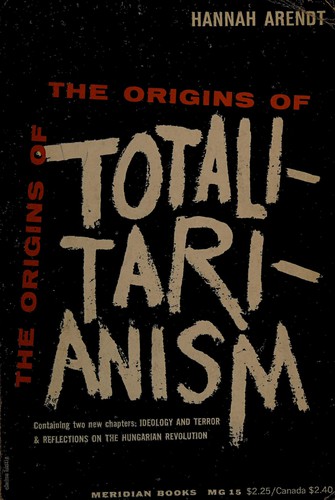
The Origins of Totalitarianism
by Hannah Arendt
Buy on AmazonHannah Arendt's definitive work on totalitarianism and an essential component of any study of twentieth-century political history The Origins of Totalitarianism begins with the rise of anti-Semitism in central and western Europe in the 1800s and continues with an examination of European colonial imperialism from 1884 to the outbreak of World War I. Arendt explores the institutions and operations of totalitarian movements, focusing on the two genuine forms of totalitarian government in her time—Nazi Germany and Stalinist Russia—which she adroitly recognizes were two sides of the same coin, rather than opposing philosophies of Right and Left.…
Recommended by
"Your readers may be familiar with The Origins of Totalitarianism and her historical genealogies of the main components of Nazism , which begin with the imperial mindset and imperial methods of repression during the colonial period. Her most useful (and her most chilling) conclusion for today is that totalitarian tools were not specific to Nazism or Stalinism or any ideology. The Hitler and Stalin and Mussolini regimes used a common set of tools to create certain kinds of subjects. The key thing in totalitarianism is the isolation of the individual that causes the inability to distinguish between fact and fiction. “The key thing in totalitarianism is the isolation of the individual that causes the inability to distinguish between fact and fiction” Civil society healthy depends on horizontal bonds—with churches, with family, through networks—rather than the vertical bonds between the ruler and the people. Once people who no longer know what truth is and are ruled by fear, the horizontal bonds of community that keep civil society together are severed and the totalitarian bond becomes difficult to break. Many of her observations have application far beyond the regime she was talking about. Her words should be studied today by those who want to do what to prevent the further spread of authoritarian regimes and the ideologies they are propagating. Not entirely, but the 20th century did produce the phenomenon of totalitarian dictatorships with personality cults fed by mass media. That was the basis of the regime of Mao, of Hitler, and of Mussolini. Mass media enable these men to efficiently propagate and standardize the messages of their regimes. That distinguishes modern dictatorships. I am skeptical of some of the categories used today. For example, “soft authoritarianism.” We need to take all of these categories with a grain of salt. However, authoritarian regimes can be seen as part of a continuum. “The 20th century produced the phenomenon of personality cults fed by mass media” In certain states, like China under Mao and the Soviet Union under Stalin, rule by terror and control extended through the bureaucracy, throughout society to the individual. While Mussolini was a terroristic ruler, responsible for the death of millions, the pope and the king were always alternate sources of authority and emotional attachment in Italy; control was never as complete."
Fascism · fivebooks.com
"I began with this book because it’s her first major work published in English. When I’m introducing Hannah Arendt in a lecture, I often begin by saying that her work is about two questions that are interconnected. The first question is, ‘how can we protect spaces of freedom?’; the second question is, ‘is there a way of thinking that is not tyrannical?’ I begin with The Origins of Totalitarianism because it’s a study of the various elements that crystallized in the appearance of totalitarianism in the 20th century. Arendt writes about the decline of the nation state, the privatisation of public political institutions. She writes about the rise of what today we would call ‘fake news’ and political propaganda. She writes about our inability to distinguish fact from fiction. She writes about mass rootlessness, homelessness. And she writes about the necessity of solitude and the dangers of loneliness. It’s a 597-page book. When you get to the last ten pages, she says that loneliness is the underlying cause of all totalitarian movements. Why loneliness? Because loneliness radically cuts us off from human connection. It makes us desperate for meaning. It turns us back against ourselves in a dangerous way that leads us down rabbit holes in thinking that make it impossible for us to judge and to tell the difference between fact and fiction. She says it’s one of the most desperate experiences a human being can have. When we experience loneliness, we’re hungry, desperate for meaning and connection. Ideology, or ideological propaganda, provides simple solutions for complex human problems that feed that hunger, that need for place and meaning. Yes. The lonely are particularly vulnerable to ideological thinking in whatever form it might take. Importantly, for Arendt, loneliness also means that we are not only cut off from conversation with others, but we’re cut off from having conversation with ourselves. So, loneliness fundamentally compromises our ability to think and our ability to judge. Solitude, she says, is that condition where I keep myself company. And that’s very different from loneliness. Solitude is necessary. The private realm is necessary. The space of the four walls is necessary. We need to be able to retreat from the public world to be alone with ourselves and to think in a way that’s nourishing for ourselves. No, I wouldn’t call it a work of history. Arendt says it’s not history. She’s employing Walter Benjamin’s understanding of ‘constellation’, drawing together the elements that crystallized in totalitarianism and she gestures towards that in her first preface to the book. She’s thinking about how the different parts fit together. She doesn’t want to offer a historical account that’s reductive in any way, or seems to follow a kind of logical sequence of events—because some things are not fully comprehensible, like death camps, for example. And so how do we try to understand that which is incomprehensible? Also, importantly for her, a historicist argument would imply that the Holocaust was fated to happen in some way: because X happened, Y happened, Z happened, and then there it is. She doesn’t want to offer that kind of account."
Hannah Arendt · fivebooks.com
"I’m trying to write a book on Arendt at the moment—as a literary scholar. That’s how I came to her. I think her stature as a great writer is really underplayed. Yes. It’s interesting that she wrote poetry, but to really love it you have to have a certain love of the German romantic tradition and, maybe, to be slightly more indulgent towards Heidegger than I can ever bring myself to be. What I like about her prose are exactly the same things I like about Levi. And she’s doing it in her third language quite often. She writes in German and French, as well as English. The Origins of Totalitarianism is the first great book to try and understand totalitarianism. It’s a book of political theory, as well as a work of history and of philosophy. But it’s also a testimony. She started writing the book when she was a stateless person, a refugee in Vichy France. She was taken to a detention camp, from which she escaped. She started work on the first section of that book, which is a section on anti-Semitism, in Montauban, which was a city of refuge in the South of France. She sat there in the library, re-reading Proust, and reading Clausewitz’s On War. She eventually made it to America, she started to write the middle section of the book, on imperialism, which tells you how colonial practices of barbarism and administration boomeranged back to Europe, creating a seedbed for Nazi totalitarianism and fascism. And then the final section, on totalitarianism, she wrote as a stateless person waiting for her papers to come through in America. So, in some ways, it’s a book that’s trying to understand what is happening by someone who is actually experiencing it. On one level, I think of it as a relentless archiving of that moment—its footnotes are heavy, almost manic. She’s archiving her own formation, as well. I do think it’s an absolutely extraordinary book. She’s trying to find a new form and a new language for a new thing that she lived through, in her third language. She’s sometimes criticized for being too passionate in the book, which is not something Arendt is often criticized for. But she said that she had to write it that way and that if you were to write an historical book on what happened to the poor during the Industrial Revolution in England, which was absolutely atrocious, one of the major atrocities in the history of capitalism, equally you could not write it without being angry. Your moral response is in the writing. She says that the style is a matter of moral response. Then, in the middle of the book, she also has a critique of natural human rights. She said, and what her own experience showed, was that once you are made stateless and pushed out of a country, once all you have is human rights, that is when you are most vulnerable. Then she says, in this biting critique of the natural rights tradition, “the world found nothing sacred in the abstract nakedness of being human”. She took that paradox very, very seriously. It’s why she was quite skeptical about the 1948 new human rights regime. Arendt said that you couldn’t stitch that paradox back up. But what she said instead is that, if you can’t have natural rights, you can still have the right to have rights. This is so crucial; you have to have political communities where it’s possible to construct rights for one another. We are the ones who give each other rights, rights are human constructions made in a political society of free speech. And she says what you need is a society where you can be heard and listened to and appear as a person. Then we can start talking about rights, because it’s at that moment that we construct human rights—as part of a political community. And so for her the foundational rights—and she’s also utterly 18th century in this—are the right to assembly, the right to be heard and to speak. That’s precisely why Arendt will always ask how, if we’re going to have something like a state, if we’re going have something that deals with boundaries and recognition and community, how can we do that without reproducing forms of nationalism and racism. Tribal nationalism wrecks the nation state because at some point it cuts through things like law, cuts through the offices of state, to produce, for example, a Nazi Germany. Nationalism of that kind destroys the tradition of the nation state. So, as soon as racism inserts itself, then the whole nation-state project comes apart. What she was always looking for was forms of republic or federation—she thought that the European Union would be quite a good idea—in order for people to be held in states of difference and debate. But you’re right. And the real lesson around that, for Arendt, was what happens to political organizations once nationalism, or racism, trump the apparatus and political functioning of the state."
Human Rights and Literature · fivebooks.com
"Our category on Tyrants and Totalitarianism includes Hannah Arendt's The Origins of Totalitarianism."
By the Book: Ben Sasse · nytimes.com
By the Book: Maria Popova · nytimes.com
"I went back to the writings of thinkers like Hannah Arendt (The Origins of Totalitarianism) and George Orwell who chronicled how cynicism and weariness and fear can make people susceptible to propaganda."
By the Book: Michiko Kakutani · nytimes.com