← All books
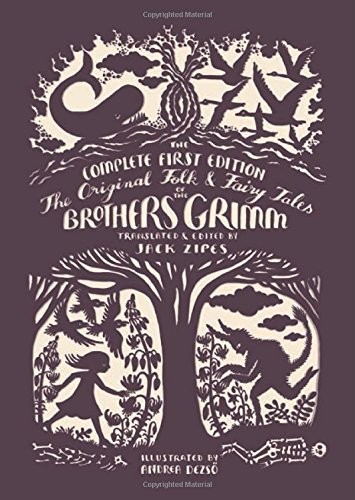
The Original Folk and Fairy Tales of the Brothers Grimm
by Jack Zipes (translator and editor) & Jacob & Wilhelm Grimm
Buy on Amazon
When Jacob and Wilhelm Grimm published their Children's and Household Tales in 1812, followed by a second volume in 1815, they had no idea that such stories as "Rapunzel," "Hansel and Gretel," and "Cinderella" would become the most celebrated in the world. Yet few people today are familiar with the majority of tales from the two early volumes, since in the next four decades the Grimms would publish six other editions, each extensively revised in content and style. For the very first time, The Original Folk and Fairy Tales of the Brothers Grimm makes available in English all 156 stories from the 1812 and 1815 editions. These narrative gems, newly translated and brought together in one beautiful book, are accompanied by sumptuous new illustrations from award-winning artist Andrea Dezsö.…
Recommended by
"I was raised with stories of gingerbread houses and dark forests, with castles wrapped in roses and a dead horse’s head talking to a young girl — “The Goose Maid” still makes me shudder — and their interpretation of German landscapes. These tales are about the fears and hopes of a bygone age, of mean stepmothers and foolish heroes. I probably underestimate how strong an influence they had on my writing. I also avidly read the writers’ fairy tales—Hans Christian Andersen, Oscar Wilde and the Swedish myths that Astrid Lindgren plays with in such magical ways. The similarities are fascinating, especially when one finds them in cultures with very different social structures and religious beliefs. They make us aware of fundamental human traits—of fears and desires we all share. Fairy tales don’t romanticize human nature, though they may romanticize other things. Rather, they show us as cruel and greedy, revengeful and often as very selfish. But of course, they also show our wish to be noble, selfless, caring—and brave enough to face danger and death without fear. I like the thought. It is interesting that we so often associate men with fairy tales just because they wrote down stories told by women. I certainly see myself more in the tradition of those female oral storytellers. I also found it interesting that, for example, in Russian tales (and tales I suspect to be much older), women are stronger and far more independent characters than in more comparatively recent tales. Maybe these are echoes of matriarchal structures and long forgotten goddesses. Sign up here for our newsletter featuring the best children’s and young adult books, as recommended by authors, teachers, librarians and, of course, kids. The Grimms made the tales they collected fit their values of a nineteenth-century bourgeoisie. Of course, the women stayed home and waited for the prince to rescue them, and the men always came home after an adventure. I think we are all in constant transition, looking for the magical path that will lead us to our destiny. Fairy tales contain such deep emotional truths about human nature that they can’t help but resonate. Fairy tales also work well with visual storytelling. For example, fear represented as a dragon, or the image of a girl on her knees picking lentils out of the ash. In modern storytelling, we often forget how much truth one powerful image can hold. As an illustrator, I’m very aware of it. In sharp contrast to words, images are always multi-layered. They hold subconscious meaning we react to, even though we may not be able to immediately decipher them."
"I think they are the stories that give you a lasting sense of wonder. They let you experience unexpected events and often terrifying ones. And, fortunately, everything comes out right in the end. They are stark tales and written in very basic language. There are wonderful images to nourish your imagination for life, for example Snow White in the glass case. I see this as an image that chimes in with ideas that were current when we were just becoming aware of autism in the middle of the 20th century: the idea of a beautiful but unreachable child. What might be going on inside her mind? How can she be woken up? In the tale there was a simple cause, a poisoned apple, and a simple and totally accidental cure. The apple was only stuck in the throat and came out again. It is a completely false image, but a very striking one. Sadly, the causes of autism remain unknown and there is no cure. The tales also involve changeling children, an image often invoked by parents, and there is the story of the gifts given at the birth of Sleeping Beauty and the curse given by one bad fairy. Fortunately, this curse is counteracted by the gift of another good fairy. I think of this as a story about our genetic endowment at birth. We are all dealt out gifts of good genes and also some not so good ones."