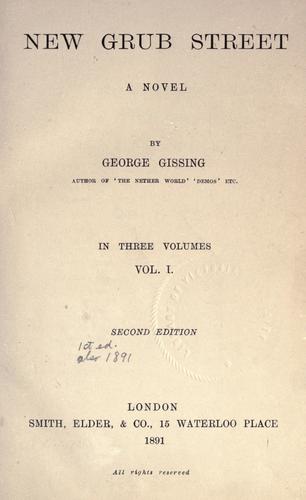
New Grub Street
by George Gissing
Buy on Amazon"New Grub Street portrays the intrigues and hardships of the publishing world in late Victorian England. In a materialistic, class-conscious society that rewards commercial savvy over artistic achievement, authors and scholars struggle to earn a living without compromising their standards. "Even as the novel chills us with its still-recognizable portrayal of the crass and vulgar world of literary endeavor," writes Francine Prose in her Introduction, "its very existence provides eloquent, encouraging proof of the fact that a powerful, honest writer can transcend the constraints of commerce."" "This Modern Library Paperback Classic is set from the text of the 1891 first edition."--Jacket.
Recommended by
"It’s a shame Gissing has fallen out of favour. He’s an interesting writer. He had a miserable life, much of it his own fault. He spent most of it in poverty, mainly because he chose the wrong women, to put it mildly. He was at Manchester Grammar School and he stole for a prostitute and ended up spending some time in prison and then went to America. He foolishly came back and came to find her and started living with her, then she became an alcoholic and went mad. His second wife was equally a woman of fairly ill-repute, which meant he was constantly having to write to support his children and his rather chaotic domestic household. Because he was writing so many novels, it’s fair to say many of them are patchy. But New Grub Street is one of his great novels. It is centred on writing and writers: the world of the hack writer versus the world of the serious writer. Gissing puts himself into this book, he wants to promote the idea that the only writing worth doing is one that might not sell, but that will actually be appreciated by the intelligent reader. In this novel, I think Reardon, one of the main characters, is actually Gissing. He’s desperately trying to produce a second novel of a quality that his first novel had reached. He has a friend—Milvain—who says, “No, I want to write a commercial novel. I want to just write commercially, to make money, even if it’s not great writing.” In this novel, to come back to London fog, you have this terrific scene in the British Library where Marian Yule is being forced to do some research for her father. She’s a reluctant researcher, to say the least, and as she’s sitting there she’s feeling dispirited, she’s not happy at what she’s doing, she’s in love and the person she’s in love with doesn’t seem to notice her. And the fog creeps into the British Library. This is the old British Library Reading Room, if you’ve ever been there you’ll know it’s this dome shape, and Gissing describes it superbly. As the fog fills the room, she sees the people working there wandering around. She sees them as insects. It makes her feel more dispirited. She can smell, she can taste the fog and it adds to her clouded view of where her own life is going. I think the fog in this instance is about the traumatic pain of writing creatively. Yes, Henry James has a piece where he says, “It’s a foggy day, but actually I can shut the curtains, I can put the lamp on, and I can pretend to be writing even if I’m not!” Someone like Gissing, of course, could not afford the oil for his lamp, he could not afford coal for his fire—a fire that would of course add to the fog—and so for him fog is the end of his working day. For many people, it would mean they could not go out and sell their goods on the street because no-one would see them. For many people this disrupted their means of earning money. There are some wonderful stories about fog entering churches, and the vicar giving his sermon and no-one being able to see him. One story is from St. Paul’s, and he’s giving a sermon, rather ironically, on the light of the world. This is during the middle of the day: it’s day that’s turned to night. This is something that’s taken up by a lot of pulp writers, I look at writers like Hay and Barr , who write stories about London being destroyed by its fogs, where all the inhabitants of London literally suffocate to death: life is over for them. It was different from one year to the next. But the peak times for fogs were November, December, January. But you could still get a fog in April. They could last for up to five or six days. The really big smogs of 1873, 1952, they were five to six days. They could also be very patchy. You might be on one side of the street in an absolute black fog and you might cross over to the other side, which would be very clear. But the worst fogs were dense everywhere in London. Even before you came out of your front door, the fog would seep in under the door, through the letterbox, and intrude into the household space. You’d be able to smell it. It would smell very sulphur-like, it would make you sneeze, and it could make you feel very unwell. It would certainly make you feel depressed. November became traditionally the month for suicides because of people feeling depressed by the weather, especially by the foggy weather. You’d go out and you’d put your scarf over your nose and your mouth, and you’d try as best you could to get down the street. But, remember, before electric lighting came in, you wouldn’t be able to see your way. You’d literally have to grab the railings and hold one after another so that you wouldn’t fall into the road. There were many accidents where people went into the road and were knocked over by a horse and carriage, or even walked into the Thames without realising it and drowned. It makes you realise how few Victorians could swim, but it also makes you realise how cluttered the Thames was, because you would be dragged under the ships. Support Five Books Five Books interviews are expensive to produce. If you're enjoying this interview, please support us by donating a small amount . It was very dangerous and the smell would have been phenomenal. It would have been very pungent and very greasy. You would feel the flakes of soot on your face, going down your throat, and many people died because they had weak lungs and they couldn’t discharge the particles from their lungs, so they would drown. At the 1873 cattle show in Islington many of the finely-bred cattle died, because their lungs were too well-bred to be strong enough to dispel these particles. Several animals died immediately on the spot. Many had to be put down. About sixty to seventy animals lost their lives. It was a massive loss to the owners of these very highly-prized cattle. Ironically, it was the cheaper animals who survived, because their straw bedding wasn’t cleaned out nearly as frequently. The urine from the straw would create a kind of antiseptic disinfectant to clean the air around them."
London Fog · fivebooks.com
"This story about publishing and love is one of the great, turn-of-the-century sweeping tales. It’s one of my all-time favorites."
Favorite books · radicalreads.com