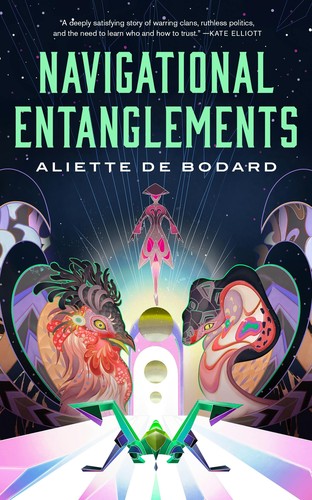
Navigational Entanglements
by Aliette de Bodard
Buy on AmazonAward-winning author of The Red Scholar’s Wake Aliette de Bodard comes for your heart with a compelling tale of love, duty, and found-family in an exciting new space opera that brings xianxia-style martial arts to the stars. Jockeying navigator clans guide spaceships through the Hollows: an area of space populated by the mysterious but deadly creatures known as Tanglers. When a Tangler escapes the Hollows for the first time in living memory, each clan must send a representative to help capture it—but the mission may be doomed and the hearts of two clan juniors may be in danger too. Việt Nhi is not good with people. Or politics.…
Recommended by
"Aliette de Bodard is one of my new favourites in science fiction. She’s a French-Vietnamese writer – of science fiction, and also of fantasy and magical realism . This book is the kind of space opera that I really find myself hankering for. It takes place in a far-future space civilization based on Vietnamese culture, where faster-than-light navigation through space is administered by clans. The main character, Việt Nhi, is a junior member of the Rooster clan. There are creatures that live in the interstitial spaces between jump points, which they call the hollows – very dangerous and frightening creatures – and one of these makes it out into our reality. Việt Nhi and the other juniors have to go and find it. There’s also a love story, which I absolutely adore. This is also a very refreshing book. I grew up reading space opera when it was mostly manly men doing manly things, and they were all from Western civilizations. There were exceptions every now and then, but the bulk of it was having to suffer through white, straight cis men doing the dude stuff. You always knew how it would end, and you would get strange cultures, and they would always be parodies in a very colonialist fashion. One reason I enjoy reading both this and one we’re going to talk about later on, Binti , is that they’re not Western narratives, and I am still so thirsty for that. I want to promote Aliette’s books everywhere I go. Well, I think all interesting science fiction is at least partly about relationships. There is the school of hard science fiction , which concerns itself with technology and visions of the future and weird stuff happening on distant planets and all that. But if there are not people in there who have feelings and thoughts and relationships to each other, it just feels like a role-playing game – “This is the world building I created. Enjoy it.” Nothing really happens in it, people don’t feel stuff, and it feels very dead. As a contrast, when soft science fiction came along – and the fact that it was called ‘soft’ science fiction is very interesting – it centred on people and relationships. It not only asked “What is out there in space?”, but also “Who are we in space? And who are the other people in space?”. Because there are probably lots of people out there… So I don’t think you can write an interesting story without writing about relationships. It doesn’t have to be love, it can be anything, but I find it quite dull if characters don’t relate to each other. And in shorter works you can get this concentrate of an interaction, of a relationship, without analysing it or dragging it out too long. You can get to the core of it: what is this relationship like? What are the stakes? Who are the people in it, and what is going on with them at the most important time in their lives? – because that’s usually where the book takes you. Ah – it feels like the story of Amatka is longer than the book itself. Amatka is set in a world where language literally controls matter. You have to tell objects what they are, and if you don’t, they will fall apart. The story is an exploration of what that does to society, and what happens when you stray from the type of very harsh social control that is required to keep everything in balance, so that everything doesn’t turn to goop – because that’s what happens. This was originally based on dream notes. The whole process took seven years, which is why the story of the book coming to life is longer than the story itself. I had very weird dreams for a couple of years, and I wrote them down, and made it my project to try to draw a map of these dreams – because there were some locations that kept coming up again and again. I ended up with a map of my own dream continent that I visited at night. I wanted to write about this, and I realised that the best way to write about it would be poetry, because poetry is a way of talking about very complicated concepts in a very concrete way. So I wrote a poetry collection that no one wanted to publish. And I put it aside, and then I came back to it later on and turned it into a short prose collection – and no one wanted to buy that either. So I shelved it again. Then I came back to it, and I started writing some scenes as if it could be a novel. And I had maybe 30 or 40 pages when a publisher that I’d sold a short story to emailed me, and she said, “Would you happen to have a novel manuscript? – because I have an opening for you next autumn.” So I said, “Yes, of course, I have a novel. I’m just going to edit it…” I wrote the rest in four or five weeks in an absolute panic, and sent it in. I’ve never written anything in that way before or after, and I do not recommend this process, because it took such a long time and so much energy; but eventually it was done, and I sold it to a Swedish publisher. There’s another round of this story, which is that it sold really badly in Sweden, which made me very angry. So I translated everything into English, and managed to get an agent interested in it; and she sold it to Penguin Random House, which is when it was edited again . So I had to rewrite it once more. I would rather chew my arm off than do that again. But I’m pretty happy with the end results. You’re absolutely right. I knew the story I had on my hands by the time that editor asked me if I had a novel. I knew what was going to happen, I just had to sit down and write it."
The Best Short Sci Fi Books · fivebooks.com