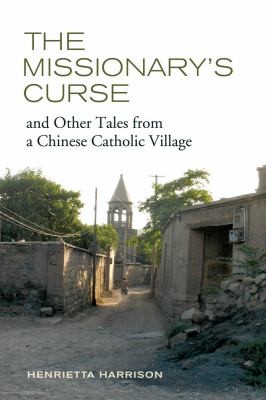
The Missionary's Curse and Other Tales from a Chinese Catholic Village
by Henrietta Harrison
Buy on AmazonChristians have been coming to China since the Tang dynasty, around 700 CE. They were the Nestorians who later became defined as a heretical sect but at the time were very influential. Then came the Franciscans in the 13th and 14th centuries. Finally, the Jesuits established a permanent presence in the 16th century. Most famous was Matteo Ricci, a fantastically colourful figure. The Jesuits were accepted as purveyors of scientific knowledge, like clocks and astronomy, until 1700, when the Jesuits were attacked for being too accommodating to traditional Chinese belief. Ricci and his successors had few reservations about ancestor worship and purposefully translated words that were similar to traditional Chinese ideas, so arguably many Chinese thought they were actually worshipping a form of Chinese religion. For example, the word for Catholicism in Chinese is tianzhu , “lord of heaven”, but there’s actually a deity called tianzhu in China, so it sounds like something traditional. In what was called the Rites Controversy, the Pope sent a delegation to Emperor Kangxi in 1707 banning Chinese rites, such as ancestor worship. Of course Kangxi thought that this little religion, which he probably felt had been tolerated out of the goodness of his heart, had gotten out of control. So he essentially banned it. “Christians have been coming to China since the Tang dynasty, around 700 CE” The Missionary’s Curse is about a small Catholic village in Shanxi province in the Taihang mountains. The author, Henrietta Harrison, is a professor at Oxford University, and she speculates that traders from Shanxi met the Jesuits in Beijing, brought back this new religion and converted the whole area. Through this microscopic story Harrison describes the story of Catholicism in China – and by extension Christianity – through several brilliant epigrammatic stories. My favourite is the story of the 19th century Chinese priest who felt that the Italian priests were racist. The Chinese priests were looked down on – even to the point that in the graveyard they were buried at the feet of the Italian priests. So he went by railway and steamboat to Rome and petitioned the Pope. According to the story, when the Pope came out of St. Peter’s, the priest knelt down on the side of the street as he passed by, wearing a giant conical hat on his head with his petition written on it. The Pope stopped and the Chinese priest explained his story. The Pope said, ‘You are right, the Italians are wrong – go back and I will solve your problem.’ Through archival work at the Vatican, Harrison shows the priest did actually go to Rome, but he likely didn’t meet the Pope. But the record shows that the Vatican did listen to him and were probably sympathetic to him. Support Five Books Five Books interviews are expensive to produce. If you're enjoying this interview, please support us by donating a small amount . By going to Rome for redress, the Chinese priest showed he was aware that he was part of a global religion. Harrison’s book describes how cultures interact, starting with the idea that perhaps they take things that are familiar – terms, such as tianzhu , and perhaps holy figures like the Virgin Mary, who echo Chinese deities. But over time, practitioners realize they are part of something bigger. So what happens is they begin to adopt international norms. Harrison sees this as a paradigm for broader issues of how cultures slowly grow to understand each other – starting with the familiar but eventually becoming part of a global norm. In the 19th century Christianity was heavily persecuted as a foreign religion, and it only flourished because the Opium Wars forced China to allow missionaries back into China. That lasted about a hundred years until the Communists took over in 1949 and kicked out all the foreign missionaries. Many people thought Christianity might collapse in China, because it was cut off from the West. But Christianity indigenised and is now a permanent part of China’s religious landscape, even though there are continued attacks on Christianity and many Chinese still view Christianity as a foreign religion. Not all Christian groups, however, have grown equally quickly. In 1949 there were roughly 3 million Catholics and 1 million Protestants. Today there are about 10 to 12 million Catholics, and about 50 or 60 million Protestants. The number of Catholics has not increased all that quickly, it has actually just tracked population growth, probably because cut ties to the Vatican has made it harder for bishops and priests to be appointed, whereas Protestant churches are less hierarchical and can be established by any group of believers. In both cases, it’s the so-called “underground” or “house” churches that have grown fastest. The term, though, is a bit of a misnomer. The government knows they exist so they are hardly underground and most are too big to operate in people’s homes. I describe one of them in my book with hundreds of members, a library, a seminary and a school. There are half a dozen churches like that around Beijing alone. The deep background is that because religion was driven underground in the Cultural Revolution, when it revived in the 80s and 90s a lot of religious groups, especially Christian groups, had a cultish aspect to them – a bunker mentality that we can’t trust the outside world, meeting secretly and run by charismatic figures. One of them, the Church of Almighty God, had ideas mainstream Christians would consider to be heretical: that there had been a second coming of Jesus already, in Hunan, where Jesus manifested as a woman. But they also tapped into various ideas that are popular in Chinese folk religion. Then there was a case which made it easier for the government to persecute them. A member of the church beat a woman to death in a McDonalds. It was caught on video tape, which you can still find on YouTube. Of course, the Church of Almighty God said this person was not a member, just a mentally deranged person who beat someone to death. It’s hard to judge because there’s no way to verify it – everyone involved was either executed or arrested. But in general the government is still very sceptical of Christianity, which I think it’s fair to say is the most socially engaged religion in China, given its gospel of helping the poor.