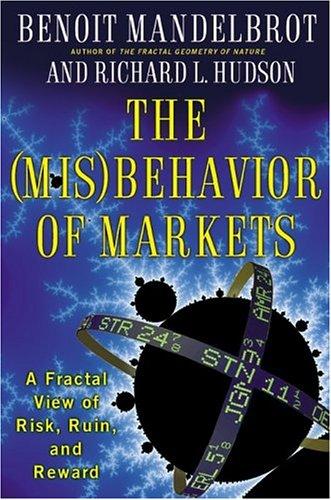
The Misbehavior of Markets: A Fractal View of Financial Turbulence
by Benoit B. Mandelbrot
Buy on AmazonLet me begin by touching on Mandelbrot’s role in the history of financial thinking. As I have said, it was in the 1950s and 1960s that Bachelier’s work was rediscovered, that Osborne began introducing new ideas from physics and that Thorp began to get interested in the whole field. There was a flurry of interest in the use of statistics, particularly the idea of randomness in stock markets. The important thing to note here is that you might think that randomness in markets makes markets unpredictable. In fact, it’s the opposite. If markets are random that means that certain kinds of statistical tools are going to be extraordinarily useful. There isn’t extra information on top of the statistics that one could use to gain advantage, if in fact markets are random. So, if you want to price something like an option, where what you care about is the probability of certain events happening, random markets actually make things much more convenient for making the sorts of predictions that you’d like. What Mandelbrot realised early on, at the start of the 1960s, was that the kind of assumptions about statistics that everyone was making were wrong. They just weren’t borne out by the data. He argued there was a much broader class of ways in which a system could be random, including ways of being random in which extreme events, such as market crashes, are much more common. Mandelbrot developed a theory of these sorts of extreme events, and how to do statistics in the presence of the dominance of these events. He showed that the kind of models being constructed were systematically missing the fact that market crashes and huge market gains were going to happen much more often. No-one paid attention to him at the time. His papers were published and anthologised, but the field progressed without him. The Misbehaviour of Markets, which was published in 2004, is, in some sense, his vindication. After being ignored, he left the field and developed lots of fabulous new ideas related to fractal geometry. It was only in the early 1990s, after the 1987 financial crash, that people in mainstream finance began to think there was something wrong with the Black-Scholes model and related ideas. Many saw that the problem was precisely the one Mandelbrot had first identified 30 years earlier. This really points to the way in which the problem isn’t with mathematical modelling and the use of mathematical methodology to understand finance, but with the inattentiveness to certain kinds of assumptions. Mandelbrot was able to figure out the way in which these assumptions were faulty. In this book he very concretely lays out proposals for how we ought to think about the mathematics in light of these sorts of issues and questions. It’s not a very technical book. It’s written for a general audience.