Bunkobons

← All books

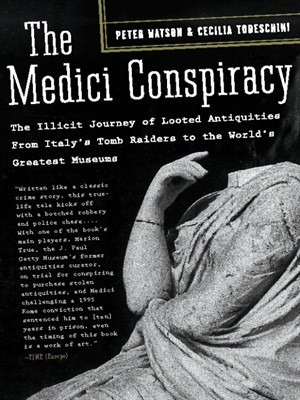
Cover of The Medici Conspiracy

The Medici Conspiracy

by Cecilia Todeschini & Peter Watson

Buy on Amazon

Yes. In recent years there have been a number of undercover investigative journalists who have been involved in major recoveries of stolen works of art , in particular the journalist Peter Watson. For several decades Watson has done absolutely incredible work where he goes undercover, along with the police, to try to make headway with unsolved crimes. This began back in the 1980s when he worked with Rodolfo Siviero, a star of the Carabinieri art squad, when he went undercover to try to recover the so-called “Palermo Nativity”, the Nativity with St Francis and St Lawrence by Caravaggio, which was stolen from the Oratory of San Lorenzo in Palermo in 1969. The theft prompted the establishment of the world’s first art police, the Carabinieri art squad. Watson wrote a book about that called The Caravaggio Conspiracy . And then more recently he has written, with co-author Cecilia Todeschini, another book called The Medici Conspiracy , which is an in-depth, very thoroughly researched investigation of the theft, looting and smuggling of antiquities by a chap called Giacomo Medici. Since the 1960s most art crime has fallen under the auspices of organised crime groups. This ranges from small local gangs to large international mafias. Peter Watson’s investigation of the 1969 theft of the Palermo Nativity revealed that it was stolen by members of Cosa Nostra . And then we fast-forward to the crimes of Giacomo Medici, who could be said to have been running his own small organised crime syndicate. He was the mastermind behind a large group of tomb raiders, or tombaroli as they call them in Italy, that was stealing primarily from Cerveteri, which is an Etruscan necropolis just outside Rome. Important artefacts, which had never been seen by archaeologists, were dug up by looters and smuggled to the free port in Geneva where they would sit in a warehouse. Giacomo Medici would take Polaroid photos of them and he would show the photos, not only to art dealers, but also to the heads of major museums around the world including the Met [Metropolitan Museum of Art in New York] and the [J Paul] Getty. And the problem was that some of these major curators, including, most famously, Marion True, whose trial ended in Rome last year, knowingly purchased looted antiquities through Giacomo Medici. They didn’t sufficiently check the provenance. They looked at works that were so fantastic they seemed too good to be true and they took the word of a dealer. Medici was really providing the cream of antiquities coming out of Italy during the second half of the 20th century. He was eventually caught in 1997 and then imprisoned in 2004. The Medici Conspiracy tells the story of this fascinating and charismatic figure in incredible detail. The scholarship is meticulous because the authors knew that they would be making serious waves in the art world, so there was the potential danger of lawsuits on the part of those mentioned in the book. Absolutely. The history of art looting in war is very long. When I teach the history of art crime, I actually begin with 212 BC, which is when the Roman Republic sacked the Greek settlement of Syracuse in Sicily. This marked the beginning of the Roman love affair with all things Hellenistic. The result was that the Roman army would actually divert from the strategic routes to try to seize more art. From then on really all the major military campaigns in the following centuries involved art – the Fourth Crusade, of course, the Napoleonic campaigns… And then we get to World War II.

Recommended by

"Yes. In recent years there have been a number of undercover investigative journalists who have been involved in major recoveries of stolen works of art , in particular the journalist Peter Watson. For several decades Watson has done absolutely incredible work where he goes undercover, along with the police, to try to make headway with unsolved crimes. This began back in the 1980s when he worked with Rodolfo Siviero, a star of the Carabinieri art squad, when he went undercover to try to recover the so-called “Palermo Nativity”, the Nativity with St Francis and St Lawrence by Caravaggio, which was stolen from the Oratory of San Lorenzo in Palermo in 1969. The theft prompted the establishment of the world’s first art police, the Carabinieri art squad. Watson wrote a book about that called The Caravaggio Conspiracy . And then more recently he has written, with co-author Cecilia Todeschini, another book called The Medici Conspiracy , which is an in-depth, very thoroughly researched investigation of the theft, looting and smuggling of antiquities by a chap called Giacomo Medici. Since the 1960s most art crime has fallen under the auspices of organised crime groups. This ranges from small local gangs to large international mafias. Peter Watson’s investigation of the 1969 theft of the Palermo Nativity revealed that it was stolen by members of Cosa Nostra . And then we fast-forward to the crimes of Giacomo Medici, who could be said to have been running his own small organised crime syndicate. He was the mastermind behind a large group of tomb raiders, or tombaroli as they call them in Italy, that was stealing primarily from Cerveteri, which is an Etruscan necropolis just outside Rome. Important artefacts, which had never been seen by archaeologists, were dug up by looters and smuggled to the free port in Geneva where they would sit in a warehouse. Giacomo Medici would take Polaroid photos of them and he would show the photos, not only to art dealers, but also to the heads of major museums around the world including the Met [Metropolitan Museum of Art in New York] and the [J Paul] Getty. And the problem was that some of these major curators, including, most famously, Marion True, whose trial ended in Rome last year, knowingly purchased looted antiquities through Giacomo Medici. They didn’t sufficiently check the provenance. They looked at works that were so fantastic they seemed too good to be true and they took the word of a dealer. Medici was really providing the cream of antiquities coming out of Italy during the second half of the 20th century. He was eventually caught in 1997 and then imprisoned in 2004. The Medici Conspiracy tells the story of this fascinating and charismatic figure in incredible detail. The scholarship is meticulous because the authors knew that they would be making serious waves in the art world, so there was the potential danger of lawsuits on the part of those mentioned in the book. Absolutely. The history of art looting in war is very long. When I teach the history of art crime, I actually begin with 212 BC, which is when the Roman Republic sacked the Greek settlement of Syracuse in Sicily. This marked the beginning of the Roman love affair with all things Hellenistic. The result was that the Roman army would actually divert from the strategic routes to try to seize more art. From then on really all the major military campaigns in the following centuries involved art – the Fourth Crusade, of course, the Napoleonic campaigns… And then we get to World War II."
Art Crime · fivebooks.com