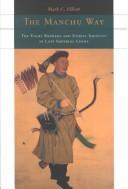
The Manchu Way: The Eight Banners and Ethnic Identity in Late Imperial China
by Mark C Elliott
Buy on AmazonNormally, the minorities are the subjects. The Manchus, however, were in charge. They took over China in 1644, overthrew the Han Chinese Ming, and became the Qing, one of the most successful Chinese dynasties. Qing borders, with the exception of outer Mongolia, pretty much define the shape of China today. So for a long time, in modern Chinese historiography, Chinese historians treated the Qing as if they had been rapidly Sinified. They said that they lost their Manchu identity and became just another dynasty. In the 1980s and 90s, you started to get a pushback against that, mostly from American historians who had gone back to the Manchu sources and learned Manchu and said, ‘No, the Qing always kept a strong Manchu identity.’ They saw China as just one part of the bigger Manchu empire that they controlled, and the Chinese identity as only one identity they subsumed. The book is fascinating because it was one of the earliest books in the ‘New Qing History’ tradition. It shows that, faced with the threat of losing their Manchu identity, the Qing tried all these measures to keep themselves Manchu and force people to stick to the old ways. He argues that these methods didn’t quite work but instead Manchus developed their own ways of being Manchu that weren’t necessarily what the authorities wanted, but were based on their own sense of self. You have the government both trying to impose a vision of what being a minority is—in this case the ruling minority—and at the same time people facing all these daily pressures to be more like the Han and settle down. There’s always this mix pressing on peoples’ sense of self. Firstly, people are proud of their own history and don’t want to be swallowed up. The Manchu were very conscious that some earlier dynasties had lost their identity as northern, hunting peoples. The Jin, an earlier, Manchu-related dynasty, had given up hunting among the royal family 50 years after they conquered north China. The hunt was a big part of their identity: it kept you tough, it showed that you were still connected to your origins. In the Confucian tradition, hunting was slightly vulgar and not something the Emperor should be doing. They didn’t want it to happen to them. They were also conscious that they were controlling a big range of peoples. The Han Chinese, the central kingdoms, were the core of their power but their control reached way up north and west. They were controlling peoples for whom they had an appeal as still being authentically northern. Their control over Mongolia, for instance, was very much rooted in having a Mongol identity as rightful heirs to Genghis Khan. There is also a proto-environmentalism there. They really have a sense that the northern lands are threatened by the Chinese way of life, by Han settlement, so they spend a lot of time trying to keep their original homes in the north protected from settlement. They had a strong understanding of the fragility of these grassland areas and how they could be destroyed by mass settlement, so they tried to pin the Han behind the Great Wall. It doesn’t really succeed though. They wonderfully describe the Han Chinese who settled illegally as ‘weed people,’ overrunning this beautiful green area. Chinese revolutionaries always defined themselves as anti-Manchu. The big symbol of that was that the Manchu imposed their own haircut on almost all of China. The queue, with the forehead shaved and the hair high on the back of the head was a distinctly northern style, adopted so that hair won’t fall in your eyes while riding a horse. The first act of revolutionaries was always to cut off the queue. You see this anti-Manchu nationalism up until 1911 when the Manchu fall. The funny thing is the Manchu identity of the Qing is then defined out of history by the PRC. They realize that all of their boundaries and claims—particularly in Inner Mongolia, Manchuria and Xinjiang—are all based on Qing dynasty conquests. They can’t say that these people weren’t Chinese, because if they say that they have to say that all the places the Qing won aren’t Chinese either. So, instead, they define the Manchus as having really been Chinese all along, which is why books like Elliott’s have gotten huge pushback among official Chinese historians and in state media.