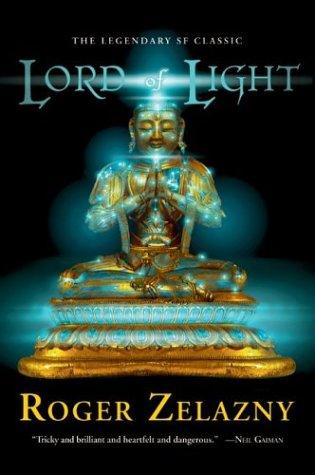
Lord of Light
by Roger Zelazny · 1968
Buy on AmazonA colony of humankind is subjugated by the First Colonists, the crew of the starship that brought them to their new home 1000 years before. They have taken control of ancient technologies and enhanced themselves with godlike psychic powers and virtual immortality. Adopting the panoply of the venerable Hindu religion, they live lives as its Gods, surrounded by advanced technology within the trappings of a primitive civilization. Our hero Sam, unready to battle the tyrannical forces of the Celestial City allied with his former wife, now the rapturous Kali, Goddess of Destruction. A story of the classic drama of power, love, honor, pride, and fantasy erupting in an epic war of the Gods and ultimate transcendence.
Recommended by
Hugo Award for Best Novel — Winners · en.wikipedia.org
"Lord of Light! It’s one of my guilty pleasures. I can’t claim that Lord of Light is as great a work of literature as the other four, but I enjoy it hugely. It’s set on a future planet which has been settled many centuries back by settlers from Earth. The group of people who were originally the officers and leaders of the human colony have reinvented themselves as Hindu gods. The story is essentially about one of them who decides that this isn’t good enough and attempts to reinvent himself as the Buddha, and therefore attempts to cause a religious revolution on this planet. Of course, all the divinity stuff is being conducted through technical trickery, including reincarnation, which is a major plot element. They do, in fact, manage to achieve reincarnation through technical means. When people die they may come back as animals or, if they’re lucky, as other people. Of course that system, because it’s being run by human beings rather than divine fate, is very much open to corruption and misuse. Our hero, in his attempt to disrupt human society, makes common cause with the non-human indigenous inhabitants of the planet, which again has got weird resonances with colonialism, which is a topic we haven’t really hit on so far. It’s not a deep critique of colonialism, but it’s a very interesting one which, again, dates from the mid-1960s, the point when Dune was being written, when the white world was looking at the non-white world in a very different way. “As the Philip K Dick once put it: ‘The sci fi writer sees not just possibilities but wild possibilities.’” I think the other thing to say about it is that it’s a good exemplar of the New Wave writing of 1960s science fiction, of which the most famous British example would probably be J G Ballard, who of course was so far outside the science fiction box that a lot of people are a bit surprised that he’s considered one of us by science fiction fans. But he is, and that meant a much deeper attachment to myth and to vivid descriptive writing and to tying back into older stories, not just writing new ones. Lord of Light is flawed because it’s an American looking at Asian traditions and getting it not-entirely-correct, but at the same time the point is, as the great writer Philip K Dick once put it: “The SF writer sees not just possibilities but wild possibilities. It’s not just ‘what if?’—it’s ‘my God; what if?'” Lord of Light still does that for me, and clearly did it for those who answered my survey. It’s a work full of energy, full of vivid images. There’s one very, very bad pun in it which I won’t repeat for you; you’ll have to read it and find it for yourself. But it’s an adventure story set in a very different sort of environment from the usual adventure story. As with anything, I think that reaching around, finding what ticks your boxes and then reading more of it is the way to do it. But I’ve got to say is that one of the great things about the science fiction community is that there are conventions held frequently. The World Science Fiction Convention is coming up shortly in Dublin . The annual big British science fiction convention will be in Birmingham in 2020, it’s called Easter Con . There are other smaller events up and down the country and around the world. So I would say that if find you’re enjoying this sort of stuff, it’s worth finding other people who enjoy it as well, because it’s a branch of literature in which the sense of community is awfully strong. Ursula Le Guin and Roger Zelazny and Ann Leckie were all very much integrated into the wider science fiction community before they became well-known as writers, and Herbert certainly was afterwards as well."
The Best Sci Fi Books for Beginners · fivebooks.com