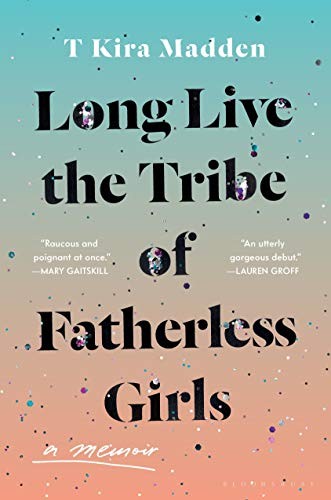
Long Live the Tribe of Fatherless Girls: A Memoir
by T. Kira Madden
Buy on AmazonYes, it’s a queer coming of age story about her experiences as a biracial woman. Her mother is Chinese-Hawaiian and her father Jewish. Her heritage is quite complicated, and she’s experiencing girlhood from quite a privileged world, but you can’t pin it down. Because while there is privilege, both her parents suffer from addiction and are absent in different ways—emotionally absent, physically absent—through drug use. Madden is an only child navigating this traumatic landscape alone and then later finding a lifeline in her friends, the titular fatherless girls. As a writer, she has an amazing capacity to remember detail, lines that people have said, details that make you feel that you are there in her body, experiencing these things with her. And there’s an earnestness, an enormous desire to be loved. That desire is weaponised against her by the “glittering viciousness” of the other girls she hangs out with and by predatory men. It’s impossible to read it and not connect with her. The book defies being tied up neatly with a bow, and that’s one of the reasons I loved it so much. Memoir often takes one thread, views experience through a singular lens, and anything that doesn’t apply falls by the wayside. It comes around to a sense of closure, a sense of emotional landing or of having arrived somewhere… The biggest artifice of memoir as a genre is that there is an ending. Because the lives of the memoirists don’t stop dead at the end of the book, they continue to live and learn and grow. What T. Kira Madden does is really resist that arc that commercial memoir so often imposes on a story. That made it, to me, piercingly relatable. It isn’t an easy message: That we grow up and have experiences good and bad, hurtful and delightful. But she manages to capture that messiness of girlhood. It’s structured like a series of vignettes, or interconnected essays. And the fragmentary nature of the book, I think, reflects how we remember our childhoods. We don’t have in-between bits, only flashbulb moments that are meaningful, with which we try to piece together a story. In retrospect, as adults, we are constantly projecting plot points onto our pasts to make sense of our experiences. Here, she is resisting the urge to fill in those gaps for you. I think that’s what I learned from her as a memoirist: You don’t have to write what you don’t know. You don’t have to speculate or help the reader understand. You can give them these beautiful, embodied moments of memory and they will string it together the way we all do with our own pasts. I love that. And also: Trust in yourself as a writer that you have given them what you need to. I have a tendency to over-explain, overwrite. So when a writer comes at the page and their craft with economy and precision, I’m in awe.