by Jim C. Hines
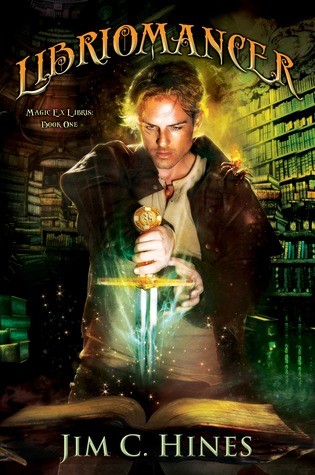
Isaac Vainio is a Libriomancer, a member of the secret organization founded five centuries ago by Johannes Gutenberg. Libriomancers are gifted with the ability to magically reach into books and draw forth objects. When Isaac is attacked by vampires that leaked from the pages of books into our world, he barely manages to escape. To his horror, he discovers that vampires have been attacking other magic-users as well, and Gutenberg has been kidnapped. With the help of a motorcycle-riding dryad who packs a pair of oak cudgels, Isaac finds himself hunting the unknown dark power that has been manipulating humans and vampires alike. And his search will uncover dangerous secrets about Libriomancy, Gutenberg, and the history of magic....
"Jim Hines is absolutely fantastic. He has not mostly written in urban fantasy—he started out with a pure fantasy world, and he is currently writing a science fiction world, I believe. But the Magic Ex Libris series is about Libriomancers—Isaac Vainio, to be specific. He can use magic to pull objects out of books—whatever he wants, as long as it hasn’t already been pulled out, which is the limiting factor. It’s just such an innovative form of magic. And it’s very meta, because he interacts with all of the books we know and love. He’s got Excalibur , or he’s got the magic demon-killing gun , or whatever, because he’s pulling them out of literal books. The main limiting factor, other than the singularity of things, is that intelligent creatures can’t be pulled out of books. You can’t take a person out – it breaks them. They’ve gotten around that in various ways… He has a fire spider named Smudge, who is from one of Hines’ own earlier works, a red-kneed tarantula that’s on fire all the time. Smudge is not fully intelligent, so he came out okay. His bodyguard—and maybe his girlfriend, he’s really not sure, and she’s not sure either, because of squishy consent that he doesn’t want to overstep—is a dryad named Lena, who he pulled out of the book in the form of a seed. So she was not a thinking creature at that moment in time. Vampires are a big, big problem. Because if you stick your hand into a book that has an infectious vampire disease and get bitten, the disease is not intelligent: you’re just going to pull it out of the book with you. So there are locked books that they have shut down, so nobody can get into them. One of my own books features as a locked book! “Maybe if non-intelligent diseases can get out of books, we should pre-emptively lock the zombie apocalypses…”—That’s good thinking. That’s the kind of good logic that appeals to me as a reader. It makes it easier for me to buy into the ridiculousness of the rest of the premise. This is a series of four and they are all a lot of fun, and I read them all in fairly quick succession. I highly recommend picking it up. I have a very logical mind, which I know is a weird sentence for someone who writes fantasy novels with all of her spare time and her not-so-spare time. But I like it when things make sense: the fastest way to lose me as a reader is to have things not make sense. I could never get into the Song of Ice and Fire books because when you look at the agriculture posited for that setting, it doesn’t work. I don’t need to know every single law or bylaw, but I do need to know how you’re growing coffee in a pre-industrial-revolution European climate! Show me your orangeries if you’re going to have oranges! That is very much a ‘me’ thing, but it’s not unique to me. I know a lot of people who work that way. And for a lot of us, we never really fall very far outside our ‘flavour condition.’ It’s not a genre—‘explain things’ is not a genre—but it is a flavouring that gets applied to all different genres. One of the biggest, most successful zombie novels in recent memory was Max Brooks’ World War Z , which a lot of people truly, truly love. People who do truly, truly love World War Z , please don’t come after me with sticks… I hate that book because the virology makes no sense at all. There is nothing, not even the venom of a blue-ringed octopus, that is so virulent that the second you are exposed, even in the slightest amount, you’re dead. It doesn’t work. And because it doesn’t work, I kept getting bounced out of the book by knowing too much. I just could not immerse. Now, opposingly, you have Richard Matheson’s I Am Legend , which is one of the classics of the zombie vampire sub-genre, where the main character in the book is not a scientist. He is not an epidemiologist. He has no idea what the hell is going on. He attempts to explain what he thinks is going on, but if you read closely, it’s very clear that he’s talking out of his ass to make himself feel better, which is a thing every human does. And because the main character doesn’t know, the author is not committing, and you don’t have to grapple with the logic of it on any level. When they made the movie adaptation , they not only made their main character an epidemiologist rather than an everyman, but they gave us an origin for the zombie vampire virus and said that it was a modified strain of measles that had been designed as a cure for cancer. Then they were all shocked when the measles mutated and became airborne. Now, there has never been a modified strain of measles that stayed not airborne for more than four generations: measles wants to be airborne. So the only way I could take the movie seriously was by viewing it as the aftermath of a successful act of bioterrorism. Middlegame is the book that I was not good enough to write. I spent ten years writing other books to get good enough to write Middlegame . I want to find the next book that is beyond my current skill level, because then I have a goal to reach toward. Middlegame was essentially inspired by a song written by Dr. Mary Crowell called ‘The Doctrine of Ethos,’ breaking down this Greek philosophical term that is frequently used in music education. I thought it was the most fascinating song ever. It’s a beautiful piece of music. So I started hitting that with a hammer and trying to figure out what I wanted to do with it. I ended up with alchemists trying to bring about the Doctrine of Ethos by creating human embodiments of concepts—and that’s Middlegame . I had had the idea of a universe of incarnate concepts kicking around for ages – I think everyone has, it’s a very classical folklore trope—you know, the idea that sometimes death or time is a person. You see that in Neil Gaiman, Terry Pratchett, all over the place, because it is human: we want the things that run our lives to be like us in some way. That all led me to alchemy, so I spent a couple of years reading every book on alchemy I could get my hands on, and it wound up turning into this ridiculous time travel superhero story. Keeping the timelines straight… there was a point where my bedroom wall looked like a crime scene tracker, because I had to know what had shifted when and where. I try not to get frustrated at reviewers who critique my work, because your feelings are your own, and I am okay with that. But I will periodically have somebody reviewing Middlegame who gets annoyed with my ‘sloppy continuity’ at the midpoint of the book, and I’m like, “That is not sloppy continuity! There was a timeline reset between the two things you’re talking about.” Every time the timeline resets, we’re essentially in a different book. Middlegame allowed me to pull off the biggest and most ridiculous party trick of my life. That series is built around the idea that a lot of authors are alchemists who are trying to sway consensus belief toward the ideas about how the world works. A woman named Asphodel Deborah Baker started writing a series of books about a place called ‘The Up and Under,’ and in The Up and Under, you can follow the Improbable Road, which is basically a rainbow soap bubble road to the Impossible City—which is very intentionally never fully described. The Impossible City has to remain a little nebulous because it’s Camelot, it’s Olympus, it’s every aspirational city in human folklore. She wrote these books to try and influence the way people thought, and then the American Congress of Alchemists got mad at her, and they had one of their own men write the Oz books to flip around thinking and destabilize Deborah’s idea of things. Excerpts from the first of those books , Over the Woodward Wall , are scattered throughout Middlegame , and my editor said, “Hey, have you considered writing Over the Woodward Wall ? And I said, “Would you like me to send the manuscript over?” The fourth book in the Up and Under series recently came out under the name A. Deborah Baker. They are middle-grade fantasy. They are written very much as a pastiche of the language of that time, and they are real physical artifacts that you can have in your home. This is the coolest merchandise I will ever manage to get made."