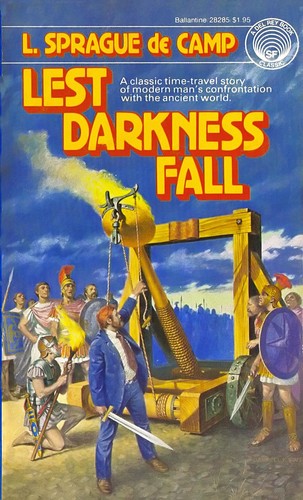
Lest Darkness Fall
by L. Sprague de Camp
Buy on AmazonArcheologist Martin Padway is visiting Rome in Italy. He is struck by lightning and catapulted back to Rome of the sixth century A.D. The Western Roman Empire has fallen to the Goths, and civilization teetering on the brink of falling into the Dark Ages. As Mysterious Martinus, can Martin win through the life and death perils of religious controversy, political intrigue and international diplomacy to twist the course of history and avoid that fall into darkness? This is a science fiction classic.
Recommended by
"Yes, this is the book that made me what I am in a ridiculous number of ways. It is another Connecticut Yankee in King Arthur’s Court kind of story. It drops a modern archaeologist back to Italy in the sixth century, when it’s ruled by the Ostrogoths, and when the Byzantine Empire under the Emperor Justinian I is trying to reconquer as much of the lost west as he possibly can. The archaeologist, Martin Padway, decides that the Ostrogoths would make better rulers for Italy than the Byzantines would, and does his best to help them and to pass on modern knowledge as he’s doing it. As for why it’s the book that made me what I am, there’s a story that goes with that. I found this book in a second-hand store when I was 14 or 15. I think I paid 13 cents for it, a used paperback. I’d already read some other stuff by Sprague de Camp, and I liked it; and I read this, and I started trying to find out how much he was making up and how much was real. And I got hooked! I soon found out that he was making up very little, and most of what he was writing about was quite real, except changed by the addition of the modern man… When I graduated from high school, I wanted to be an astronomer, and I got into the California Institute of Technology; and then I flunked out at the end of my freshman year, because calculus was much tougher than I was. I had to do something then to stay in college. What was I going to study if I was going to stay in college and if I was too dumb to be an astronomer? I became a history major, and I ended up at UCLA doing Byzantine history . In 1977 I got my PhD in Byzantine history. I was highly educated, totally unemployable. I was also trying to write. I wrote my first novel that sold in parallel with my dissertation, which meant my dissertation took longer than it would have otherwise… So Lest Darkness Fall changed what I studied, which changed what I wrote about (it didn’t change the fact that I was going to write, because I was always going to write anyway.) It changed what I knew, and most of what I have written, because that either comes from research I did for my dissertation, or from learning how to do research. For two years after I got my doctorate, I taught at UCLA while my professor had a guest gig in Greece, and while I was teaching there, I met the lady that I’m married to – so I can blame that on Lest Darkness Fall. I have the kids I have and the grandkids I have because of Lest Darkness Fall . I’m living where I’m living because of Lest Darkness Fall . I’m writing what I’m writing because of that book. Other than that, it didn’t change my life at all… This is what you could call alternate history on the micro-historical level. If somebody else had bought that book the day before I walked in, my whole life would be different now in ways I can’t even imagine. Yes! It’s really fascinating: real science fiction, Jules Verne and all those people, didn’t develop until the 19th century, when change became rapid enough that you could see it inside the space of one lifetime. It became visible. It became obvious – now people could say, “When I was a kid, we didn’t have that new-fangled telegraph. You couldn’t take a train here, you had to ride a horse or walk.” It’s the same impulse that had spawned historical fiction a generation earlier, when they recognized that the past was another country and they did things differently then… But alternate history does not require technology. The earliest example of alternate history that I know of was written right around the time of Jesus Christ by the Roman historian Livy, who wondered what would have happened if Alexander the Great had not died in Babylon in 323 BC, but had turned West and attacked the young Roman republic. Good old patriotic Livy was sure that his noble Roman ancestors would have beaten the Greeks. My personal opinion is that Livy was an optimist, but that’s neither here nor there. The point is that he imagined what would have happened if history had worked differently. We all have these ‘What if’ moments in our lives. And you can think, ‘If this could happen to me, this could happen to a whole country – this could happen to a whole world . That’s interesting. Let’s tell a story about that.’ And it is interesting, and I’ve been telling stories about it for a long time now."
The Best Alternate History Books · fivebooks.com