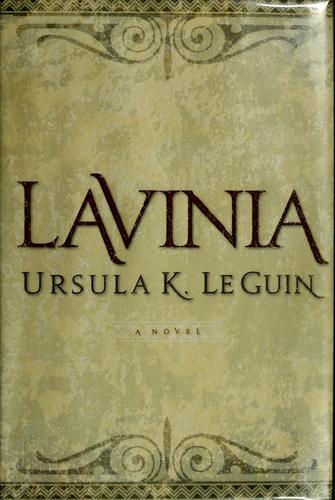
Lavinia
by Ursula Le Guin · 2009
Buy on Amazon'Like Spartan Helen, I caused a war. She caused hers by letting men who wanted her take her. I caused mine because I wouldn't be given, wouldn't be taken, but chose my man and my fate. The man was famous, the fate obscure; not a bad balance.' Lavinia is the daughter of the King of Latium, a victorious warrior who loves peace; she is her father's closest companion. Now of an age to wed, Lavinia's mother favours her own kinsman, King Turnus of Rutulia, handsome, heroic, everything a young girl should want. Instead, Lavinia dreams of mighty Aeneas, a man she has heard of only from a ghost of a poet, who comes to her in the gods' holy place and tells her of her future, and Aeneas' past . . .…
Recommended by
"She did write a lot of non-speculative work, including books for children. She just made a huge contribution to literature overall. One of the reasons I wanted to include this book in the list, beyond expanding beyond the books everyone recognises and talks about, is that I think there’s an interesting relationship between historical fiction and speculative fiction. They are both interested in how culture changes with time, and the kind of moments that orient a culture to take a new path. These moments accumulate—as we spoke about with Paradises Lost , and how the humans that arrive are a different kind of human to those that left Earth. Those kinds of changes. Get the weekly Five Books newsletter With the case of Lavinia , she does careful research about the lives of people in what we now call Italy, when the events of the Aeneid were meant to have taken place. They have different gods, different ways of thinking about violence, different ways of thinking about gender. It’s an alien culture, if you will. That’s one thing that historical fiction explores through careful research, and science fiction is also really interested in—the diversity of what’s possible for human cultures and values. Nicola Griffith, another science fiction writer I really, really love, also wrote a historical novel, Hild , which does similar things to what Le Guin is doing in Lavinia. Here Le Guin is also giving voice to a character who’s not really given voice in the patriarchal literary tradition. I think this is consistent with what Le Guin does in her speculative fiction. She writes about how the indigenous regard cultural colonisation, or how people who aren’t invested in gender understand politics. Things like that. She’s also interested in the role that legends have in shaping behaviour. Because even though I’m calling it historical fiction, there’s a metafictional quality to this, because Lavinia has conversations with Virgil, and in some way understands herself to be a sort of textual figure of Virgil’s invention. It’s clear that Virgil’s not writing history. He’s inventing this grand mythos for the founding of Rome that probably has nothing to do with the actual founding of Rome—but yet becomes so important to subsequent understandings of Roman identity, the Roman empire, and so on. It’s a book that really shows the power of stories. And, ultimately, that’s what Le Guin has explored throughout her career—the power of stories in shaping cultural values and political societies. Absolutely. Indeed, that’s part of my understanding of what science fiction, as a genre, does, and why I want to work in it. It’s a place for thinking through what happens when different cultures meet, for thinking through how technology changes social and political life. We’re thinking through whether the things we take to be necessary are actually contingent after all, and where we can go from there."
The Best Ursula Le Guin Books · fivebooks.com
Locus Award for Best Fantasy Novel — Winners · en.wikipedia.org
"One wife is left behind in Troy. She is done away with in some unspoken fashion. Aeneas has his dad on his shoulders and his little boy by the hand. His wife is following some steps behind, and she gets lost. The gods mean this to happen because he needs to marry an Italian princess at the end of his wanderings. This is Lavinia, and she is utterly silent. She appears in a very few lines of the Aeneid , though she’s often spoken of because she’s the prize: she’s already promised to an Italian prince, Turnus, Aeneas’s main opponent. In one scene she’s standing there passively and catches fire, to show a divine portent: she’s going to be the mother of Rome. She just stands there burning, unharmed, during a sacrifice in her father’s palace. Her other appearance is in a very creepy set of lines. The war is raging away and her father, mother, and Turnus are in a terrible policy struggle. Turnus wants to keep fighting, her father wants to give up, and her mother has been egging Turnus on. A dramatic confrontation is happening in front of this poor young girl, and she bursts out sobbing and goes red in the face. Turnus is gazing at her. In Homer there’s a simile about a wound: there’s blood running down Menelaus’s thigh and it’s like ‘dyed ivory’. His wound becomes a thing of beauty. That simile is echoed in the Aeneid with reference to Lavinia’s blushing, while Turnus looks at the helpless, hysterical young girl. It’s the most erotic thing that he’s ever seen in his life. It gives him a violent urge to go and fight. Off he runs with words of defiance, to prepare for battle—the climactic battle, as it happens. His erotic impulse and his impulse to fight are inseparable. The science fiction and fantasy author Ursula K. Le Guin gives Lavinia a voice. She talks about all kinds of things, including how this situation came to be. Virgil notes that Lavinia is both the only surviving child and a girl; clearly, this is a dynastic problem that, given a foreign incursion, becomes a military one. The original narrative provides Le Guin with plenty of room for a feminist interpretation. She explores what it’s like for a princess to lose her brother and to be blamed for it, to be carrying the entire burden of the succession, not only for the sake of the family’s future, but for the whole nation’s. They’re actually depicted as quite a happy couple. She turns out to love Aeneas and to be a good wife and mother. She insists on her voice being heard but, for me, that voice sounds fairly conventional. She doesn’t have an easy time later in life. As the ancient legend continues, Aeneas is killed in a later battle, and Le Guin doesn’t depart from that. Lavinia has got plenty to complain about, but she comes across as not even inwardly very rebellious. Well, there’s a pretty strong protest registered against the repression of women’s voices. That’s indisputable. But the theme seems to be ‘What are you all afraid of, in keeping women silent? Women can’t make anything different than it’s fated to be.’ It’s a far cry from the claim that women will transform the world once they get the chance."
Virgil · fivebooks.com