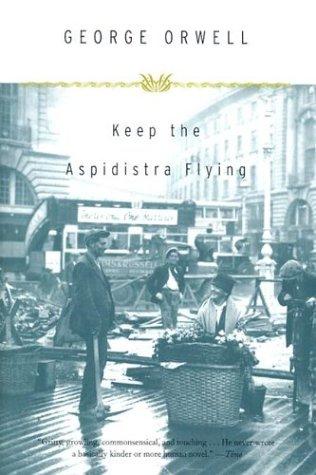
Keep the Aspidistra Flying
by George Orwell
Buy on AmazonGordon Comstock loathes dull, middle-class respectability and worship of money. He gives up a 'good job' in advertising to work part-time in a bookshop, giving him more time to write. But he slides instead into a self-induced poverty that destroys his creativity and his spirit. Only Rosemary, ever-faithful Rosemary, has the strength to challenge his commitment to his chosen way of life. Through the character of Gordon Comstock, Orwell reveals his own disaffection with the society he once himself renounced.
Recommended by
"I chose this one again for personal as well as wider critical reasons. The wider critical reason is that it fits absolutely wonderfully in the trajectory of that route to Nineteen Eighty-Four . The plot is more or less the same as A Clergyman’s Daughter : it’s about a frustrated poet and embittered bookseller’s assistant called Gordon Comstock who works in a bookshop in Hampstead in North London, is completely disillusioned with the world, and rails against what he calls as the ‘money God’. He’s an anti-capitalist without really understanding how political systems work. The novel was written in the 1930s before Orwell had actually nailed his colors to the political mast. Inexplicably, despite the fact that he’s erratic and a bit of a crank, he’s got this wonderful girlfriend called Rosemary, who loves him sincerely. He’s given up his job in the advertising agency just so he can work in this bookshop. Like Dorothy in A Clergyman’s Daughter and like Winston Smith in Nineteen Eighty-Four , he rebels against the system and is ultimately swallowed up by it. At the very end of the book, he ends up married to Rosemary (who’s expecting a baby) and gone back to work in the advertising agency because it’s the only way to cope with the world. The only way he can provide for his family and get their lives back on track is by going back to what he didn’t want to do at the start of the book. Like Winston Smith, he rebels, the rebellion fails, and he has to reach an accommodation with a world he’d previously disparaged. I read it in my mid-teens, and I just found Gordon Comstock, for all his imperfections, a wonderful figure. He wasn’t necessarily anybody I aspired to be, but there are some marvelous themes early in the novel where he’s working in the bookshop. Through him, Orwell projects his view of British literature in the 1930s. At one point, Gordon goes around the shop ranting about the various authors he doesn’t like, actually kicking the spines of the books he dislikes. There’s also a wonderful scene too where he comes back to his lodgings and finds that some immensely snooty highbrow poetry magazine called the Primrose Quarterly has rejected one of his poems, and he just has this terrible rant: “The sods! The bloody sods! ‘The Editor regrets!’ Why be so bloody mealy-mouthed about it? Why not say outright, ‘We don’t want your bloody poems. We only take poems from chaps we were at Cambridge with. You proletarians keep your distance’? The bloody, hypocritical sods!” This is very revealing in Orwellian terms. Comstock is presented as an outsider, this person on the fringe of the literary world with no connections and no strings that he can pull. Yet at the same time as Orwell was working in a bookshop, his articles and his poems were being published in a magazine called The Adelphi by a friend of his called Richard Rees, who like him was an Old Etonian! Orwell is much better connected than Gordon Comstock, but it’s as if he’s projecting his resentments through this fictional character. Though Comstock is not Orwell, the similarities between them are very interesting. Exactly. I’m convinced that most of Orwell’s work, especially the fiction, contains mythological projections of himself—in other words, the person that he really wants to be. He conceives of himself as this outsider, this tangential figure out there on the margins. But in fact, if you examine Orwell’s life in the 1930s and especially the 1940s, he was very well-connected. He’d just met his old friend Cyril Connolly about this time, a very influential literary critic. When Connolly started Horizon , probably one of the best literary magazines in Britain at that time in the 1940s, Orwell is one of his star columnists. Orwell is much better connected at this time than you’d imagine from some of his writings. He’s not on the doormat side of literary mythology as he imagines himself to be. You’re quite right, but a lot of it is slightly contrived. Orwell’s friend Anthony Powell once said that after the Second World War , when slightly smart evening parties with smart dress codes started up again, Orwell would come along in an old, shabby suit. It had obviously been made by a really good tailor, so it looked more distinguished the shabbier it got. In the doorway to these parties, he’d look round and say, ‘Oh, is it alright that I come in dressed like this?’ “I’m convinced that most of Orwell’s work, especially the fiction, contains mythological projections of himself” There was a kind of contrivance about it. He knew the rules. He was an old Etonian. On one occasion, when he invited an old Spanish Civil War comrade to come and have supper with him, he put on a dinner jacket. I think Orwell is being slightly manipulative here, and slightly self-conscious—choosing how to behave. In terms of Orwell’s political consciousness, in early 1936 he went on a tour of what was known as the distressed areas of northern England to write what ultimately became The Road to Wigan Pier . This is sometimes seen as the mark of his political awakening. I have my doubts about that, because the reports that he makes from places like Wigan, Leeds and Sheffield are not so much political as anthropological. When he comes across socialists and political activists, he’ll write something like ‘And I met so-and-so today, who is involved in the Labour movement’, giving the idea that he doesn’t really know much about it or what it consists of. There’s still a sense that he’s a journalist looking for copy. Although he sympathizes very greatly with the people he comes across, he hasn’t really yet decided what focus this sympathy is taking. There’s great doubt until late on as to what form The Road To Wigan Pier would take. In fact, I discovered once in the archive a letter from Orwell’s publisher Victor Gollancz to Orwell’s agent, really quite late on, asking ‘What is George up to? Is he writing some essays? Is he writing a proper book? What is it that he’s working on?’ So, The Road to Wigan Pier came together quite late on as a piece of work. Very shortly after it’s finished, Orwell goes off to Spain to observe the Spanish Civil War, which he ends up fighting in. And he says that his original aim in going to Spain was to write some journalism. It was when he got to Barcelona very early in 1937 that he discovered what he thought was the ideal human community, which is a lot of people who seemed (although there might be economic differences between them) to be living in conditions that were more or less equal. Instead of a servant in a hotel who would call you ‘sir’, he would call you ‘you’. All of the deference and all the class distinctions that he observed in Britain all seemed to have disappeared in Barcelona in 1937. I think this had a profound effect on him in terms of thinking of what a society could do if it really took steps to try and institute conditions of genuine social equality. That’s the catalyst—1936 and early 1937—when he starts becoming the political writer we know him to be in his mature years."
The Best George Orwell Books · fivebooks.com