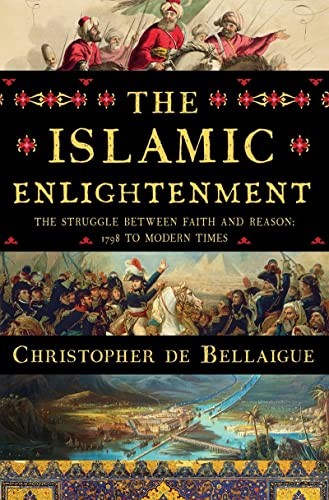
The Islamic Enlightenment: The Struggle Between Faith and Reason, 1798 to Modern Times
by Christopher de Bellaigue
Buy on AmazonWhen I saw the title of the book, I thought it was going to be about the flowering of Islamic culture in mediaeval times—when they probably printed and had more books than we had in Western culture. It was very interesting for me to discover that it wasn’t about that, but an Islamic enlightenment I didn’t know about, in the 19th century. Now, today, because of the evident prejudice towards Islam you see in some places, we’ve seen Donald Trump trying to ban people entering the United States from some Muslim countries. We know the cause of it is terrorist activity. (By the way, I couldn’t resist tweeting something I read in the FT two days ago, which had been culled, I think, from the Huff Post. It was a wonderful pair of statistics. It was the number of people killed by lawnmowers in 2017 in America: 69 and the number of people killed by Islamic terrorists: 2. Don’t you love that?) If we’re thinking carelessly, we now have this view of Islam as a hardcore religion based on the Quran. You mustn’t depart from what the Quran says and all the rest of it. But of course the truth is—and Bellaigue proves this in his book—that during the whole of the 19th century it was like all religions, which is that they express certainties, but they change as society changes. “It had be something you want to read. Not like All-Bran, something that you must read. It had to be enjoyable because otherwise why bother?” During the 19th century, Islam had to deal with the introduction of medicine and of operations, with the intimacy required for real medicine. That happened in Egypt. It had to deal with modern transport. There’s a wonderful photograph of a female aviator, very early in the 20th century, in Turkey. And so on and so forth. All modernization during the industrial revolution—which was not just industrial but also technical, scientific, and so on—was a threat and challenge to the expressed certainties of religion. And the religion changed, because all religions do. Whether you’re religious or not, that’s what they do. That was a real revelation for me. And I thought it was a brilliant subject for Bellaigue to pick. The other thing about Bellaigue is that he is an entertaining writer. People may have thought I was being slightly over the top when I said this on the night of the prize, but I stick by it: his style is somewhat in the tradition of Gibbon and Strachey. Both Edward Gibbon and Lytton Strachey were very funny writers, they liked to make jokes and exercise their wit. And Bellaigue also has that spare wit that I like. It does stretch into the early 20th century, so Atatürk comes towards the end of it, but it’s really about the 19th century. Atatürk brought in the secular, but this book is about Islam and about Islam changing.