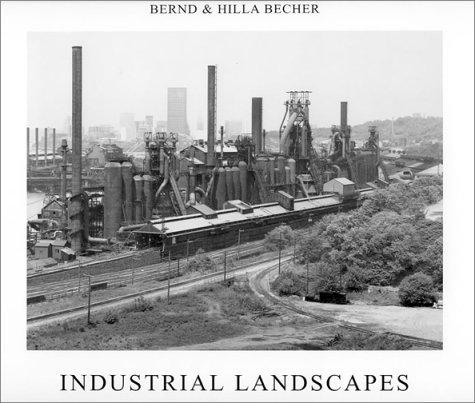
Industrial Landscapes
by Bernd Becher & Hilla Becher
Buy on Amazon"Bernd and Hilla Becher have profoundly influenced the international photography world over the past several decades. Their unique genre, which falls somewhere between topological documentation and conceptual art, is in line with the aesthetics of such early-twentieth-century masters of German photography as Karl Blossfeldt, Germaine Krull, Albert Renger-Patzsch, and August Sander.". "Industrial Landscapes introduces a new aspect to the Bechers' photography, one that will surprise connoisseurs of their work. Whereas their previously published works concentrated on isolated industrial objects, they now show huge industrial sites amid their natural surroundings.…
Recommended by
"In Silent Monoliths , I’m definitely nodding to the Bechers—I’ve got all their books and have spent a lot of time studying their rigorous typologies. They were masters at stripping away everything except the subject itself, but I’ve also been equally drawn to their Industrial Landscapes series, where they actually let you see the factories and mines in context. I wanted this book to function on both levels, so I split it into two sections: “Typology” and “Topographies.” For most towers, you’ll see the isolated “object” shot, but then I step back to show the landscape and the towers in situ—sometimes it’s a still-active railroad, other times it’s a post-industrial, abandoned scene. It was an easy negotiation! as it was to be my modus operandi for the project all along. When I characterize this book, I say it’s “Bechers with a twist.” Unlike the Bechers, my typologies aren’t as strictly uniform. Some towers are shot frontally, some at 45-degree angles, and they’re not as tightly framed as the Becher’s subjects are. I even have several photographed at night. Looking back over my work from the last twenty-five years, I’ve realized most of it is about architecture and infrastructures. The coaling towers were integral to railroad infrastructure. Steam locomotives couldn’t run without coal, and these towers had to be strategically placed along mainlines to allow for rapid refueling of passenger and freight trains. A railroad’s motive power and operations departments were responsible for calculating where those locations would be. I wanted to suggest these elements of railroading, which is why I included the broader landscapes in the second section of the book. I’d push back a little on the idea that American railroads aren’t near residential areas or embedded in townscapes. When you go into places like Mingo Junction, West Virginia, or Braddock, Pennsylvania, you see the working class or urban poor living right next to transportation networks—beside freeways, beside railroads. I could show you photographs from Chicago where high-rise public housing blocks were clustered along the Dan Ryan Expressway. That was Corbusier’s “Radiant City” concept—machines for living. They were horrible places to live. When you go into these hollowed-out Rust Belt towns, you see industry and residential life right on top of each other, so I’m not sure it’s historically that different from the situation in Europe. Getting my Hasselblad in 1985 changed everything. Suddenly I was on a tripod. I wanted everything sharp from front to back, so I used a 50mm lense a lot. Handling that Hasselblad—it’s a wonderful machine. Just winding the shutter is satisfying. I wanted my photography to match that precision and mechanical beauty. There’s a meditative quality to being on a tripod too. You focus, lock up the mirror, use the cable release—it’s almost balletic. I don’t feel that with digital. It’s too easy to just keep going without contemplation. But maybe that’s just me; I sometimes feel like a loose cannon when I’m shooting digital! My approach for Silent Monoliths was to shoot the monument with a Hasselblad on a tripod, then use a six-by-seven camera with a leaf shutter that allowed me freedom to walk around without the tripod’s restrictions. I’d even back things up digitally afterward, because I hand-process my film and occasionally something can go wrong. “I also wanted to remind myself that “everyday” material culture is informative, rewarding, and sometimes beautiful.” One more thing about the Bechers, and I say this with reverence for them and their work, but they covered so many industrial subjects it’s an interesting curiosity to me that they somehow missed the coaling towers. The towers were right there, hiding in plain sight, perhaps even next to other industrial sites they photographed. Maybe there were access issues. Around railroad environments it’s decentralized—not like going into a steel mill and talking to the plant manager to get permission. Also, maybe with an eight-by-ten camera, setting up next to an active railroad line was problematic. But I’m thankful they didn’t photograph them, because luckily I got to. Like them I’m sure, what I find satisfying about doing typologies is that individually the images might not have much power, but put them together in a grid and it gets away from the idea of a single masterpiece. This contrast and comparison is endlessly fascinating to me. Also, by being drawn to what many would consider banal subject matter, my intention with the coaling towers—and the rest of the typologies I’ve done—was to rescue the commonplace from anonymity. I also wanted to remind myself that “everyday” material culture is informative, rewarding, and sometimes beautiful. I also love the process of cataloging and indexing which is the kind of activity you get into when doing typologies."
Industrial Artifact Photography · fivebooks.com